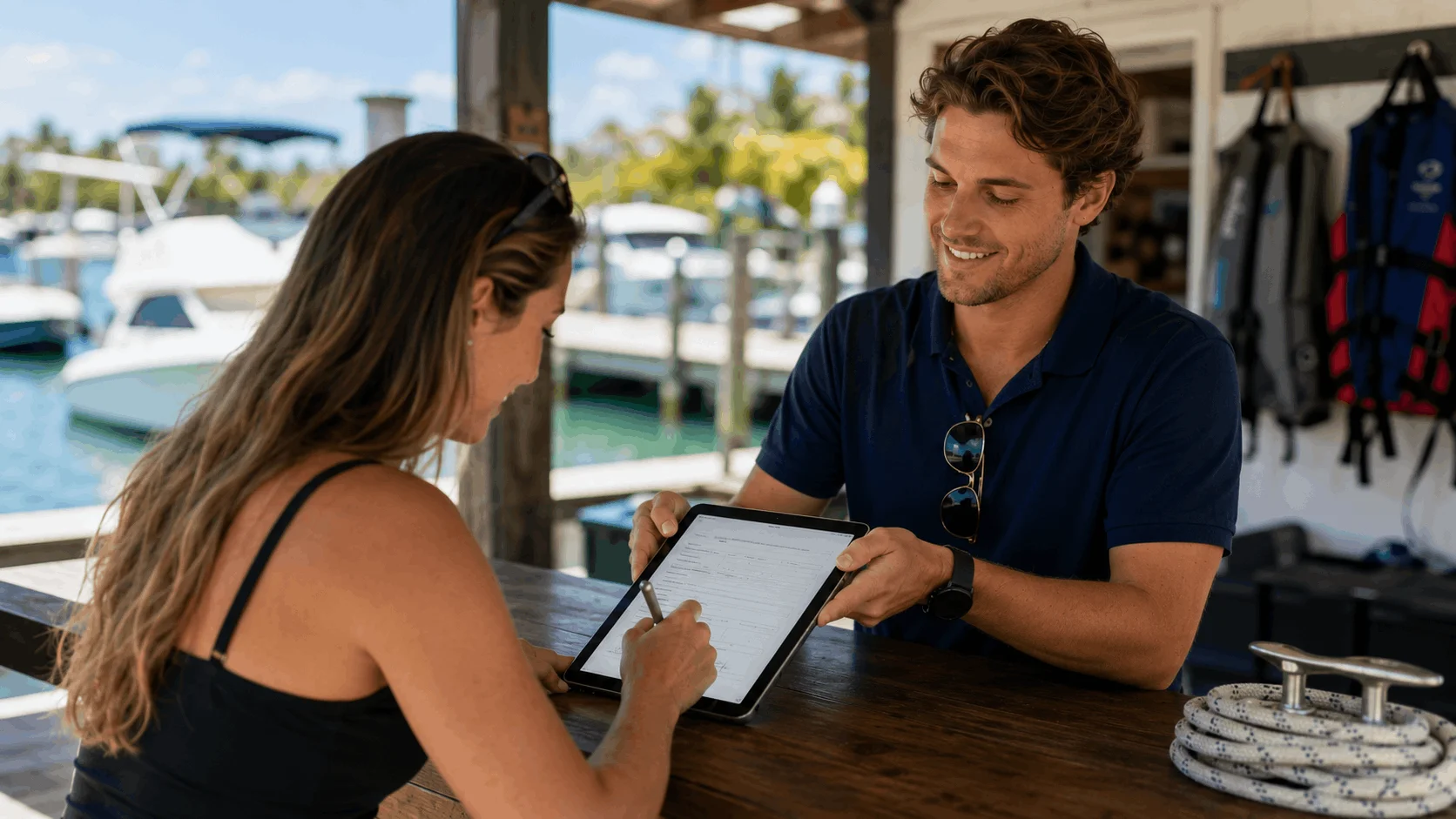
A boat rental liability waiver is the document a renter signs before taking out a boat, pontoon, jet ski, kayak or paddleboard. It explains the risks of being on the water, records who is operating the boat and confirms the renter accepts your rules, safety requirements and responsibility for the vessel.
Boat rentals combine two kinds of risk: people getting hurt, and expensive equipment getting damaged. Renters are often on holiday, unfamiliar with the water and in charge of a boat for the first time. A clear waiver will not make the lake safer, but it shows that every renter was told about the risks, agreed to the rules and gave you the details you need if something goes wrong.
This guide covers what to include in a boat rental liability waiver, how to handle operators and passengers, damage and fuel terms, common mistakes, and how to collect signatures online. It is general information, not legal advice. Boating and waiver rules vary by country and state, so have your final wording reviewed for where you operate.
Do boat rental businesses need a waiver?
In practice, yes. Marinas, lake rentals, pontoon and jet ski operators, and kayak and paddleboard outfitters almost always ask renters to sign before they leave the dock. Reasons include:
- Risk disclosure. Boating carries known risks, such as capsizing, collisions, drowning and weather changes, and the waiver is where you describe them.
- Operator responsibility. It records who is driving the boat and that they accept responsibility for safe operation and for their passengers.
- Rules of use. It confirms the renter agreed to your boundaries, return time, speed limits and alcohol policy.
- Damage and costs. It sets out who pays for damage, lost equipment, late returns and fuel.
- A signed record. If a dispute comes up, you can show who signed, when and which wording they agreed to.
- Insurance. Many marine insurers expect operators to use signed waivers and rental agreements.
A waiver is one layer of protection. It works alongside a proper safety briefing, well-maintained boats, life jackets on board and the right insurance.
Waiver vs rental agreement
Boat rental businesses often need two things, and they are easy to mix up:
- The liability waiver covers injury risk: the renter acknowledges the dangers, takes part voluntarily and releases you from certain claims.
- The rental agreement covers the boat: rental period, deposit, fuel, damage, cancellation and where the boat may go.
Many operators combine both into one form so renters sign once. That works well as long as each part is clearly labelled and the release language is not buried among the fuel and deposit terms.
Is a boat rental liability waiver enforceable?
It depends on where you operate, the wording and how the waiver was signed. Courts commonly look at:
- whether the risks were described clearly and specifically
- whether the release language was visible and easy to understand
- whether the renter had a real chance to read it before signing
- whether the injury came from an inherent risk of boating or from negligence, such as a faulty engine or missing safety equipment
Waivers generally cannot excuse gross negligence or reckless conduct, and some places, along with maritime law in certain cases, limit them further. Children add another layer, so see our guide to waivers for minors and what makes a liability waiver invalid.
What should a boat rental liability waiver include?
Here are the sections most boat rental waivers cover.
1. Renter and operator information
- full name, date of birth, phone number and email
- the name of the person who will operate the boat, if different from the renter
- driver's licence or ID number, if your process requires it
- boating licence or boater education card, where your local rules require one
2. Rental details
Record the boat or equipment type, the rental date and time, the return time and the number of people on board. If you rent several types of craft, list which one this waiver covers.
3. Operator experience and qualifications
Ask the operator to confirm their boating experience and that they meet any minimum age or licence requirements. Note that a safety briefing was given and that they understood it.
4. Acknowledgement of risks
Be specific rather than generic. Typical risks include:
- capsizing, falling overboard and drowning
- collisions with other boats, docks, rocks or submerged objects
- injuries from propellers, engines, ropes and anchors
- sudden changes in weather, wind, waves and currents
- sunburn, heat exhaustion, cold water and hypothermia
- injuries while swimming, tubing or water skiing from the boat, if you allow it
5. Safety rules and responsibilities
Ask the renter to confirm they will:
- keep life jackets on board for every passenger and make children wear them
- stay within the permitted area and away from restricted zones
- follow speed limits, no-wake zones and local boating laws
- not exceed the maximum number of passengers or weight
- not operate the boat under the influence of alcohol or drugs
- return before dark or by the agreed time, and head back if the weather turns
- follow staff instructions and the safety briefing
6. Passengers
The operator usually signs for the boat, but passengers face the same risks. Decide whether each adult passenger signs their own waiver, and how children on board are covered. Collecting a waiver from every adult on board gives you a far better record than one signature for the whole group.
7. Health declaration
Ask the renter to confirm that everyone on board is fit to take part and can swim, or will wear a life jacket at all times. Mention conditions that may matter on the water, such as heart conditions, seizures or pregnancy.
8. Damage, loss, fuel and late return
Set out who pays for damage to the boat, lost equipment such as paddles or life jackets, towing if the boat breaks down because of misuse, refuelling and late returns. If you take a security deposit, explain when it is kept and when it is refunded.
9. Voluntary participation and release of liability
State that renting the boat is voluntary and that the renter accepts the risks described. Include a clear release of claims related to the rental, in plain language. Avoid trying to exclude liability the law does not allow you to exclude.
10. Emergency contact and treatment consent
Collect an emergency contact who is not on the boat and, where appropriate, consent for staff to arrange first aid or emergency medical care.
11. Photo and video permission (optional)
If you post photos of renters on social media, ask for consent as a separate, optional checkbox.
12. Agreement checkbox and signature
End with a statement such as "I have read and understood this waiver and rental agreement", an agreement checkbox, the signer's name and a dated electronic signature.
Boat rental liability waiver sample structure
Here is a simple outline you can adapt. It is not a complete legal document.
Boat Rental Agreement and Release of Liability
- Renter details (name, date of birth, contact, ID)
- Operator details and boating licence, if required
- Boat, rental period and number of passengers
- I confirm I received and understood the safety briefing
- I understand boating involves risks including capsizing, collisions, drowning and serious injury
- I will follow the safety rules, permitted area, speed limits and alcohol policy
- Health declaration for all people on board
- Damage, fuel, deposit and late return terms
- Voluntary participation and release of liability
- Emergency contact and consent to emergency treatment
- Optional photo and video consent
- Signature and date
Kayak, paddleboard and jet ski rentals
The same structure works for smaller craft, with a few changes:
- Kayaks and paddleboards. Focus on capsizing, cold water, wind pushing paddlers offshore and staying within sight of the launch. Many renters go out alone, so a reliable emergency contact matters.
- Jet skis. Add minimum operator age, rules on speed near swimmers and other craft, and no carrying passengers beyond the rated capacity. Collisions are the main risk, so be specific.
- Pontoons and party boats. Larger groups mean more passengers to cover. Ask each adult to sign, and be clear about alcohol rules and who is responsible for children.
Common mistakes in boat rental waivers
- Generic wording. A standard liability waiver copied from a gym does not describe water risks.
- Only the renter signs. If the person paying is not the person driving, or there are other adults on board, one signature leaves gaps.
- Mixing the release into the rental terms. A release hidden between fuel charges and deposit rules is harder to defend.
- No record of the safety briefing. If you give a briefing, have the renter confirm it on the form.
- Vague damage terms. Disputes over scratches and propellers are easier when the costs and process are written down in advance.
- Signing on the dock in a rush. Renters keen to get on the water skim the text. Send the waiver ahead so they read it at home.
- Losing paper forms. Paper on a wet, windy dock gets lost, smudged or blown away.
Paper vs online boat rental waivers
- Dock check-in. Paper forms create a queue at the dock. Online, renters sign before they arrive.
- Every passenger. Collecting paper forms from a whole pontoon group takes time. Online, each adult can sign on their own phone.
- Weather and water. Paper gets wet and damaged. Online records are stored safely.
- Versions. Paper versions are easy to mix up. Each online signature stores the exact wording agreed to.
- Finding a form later. Paper means searching boxes at the end of the season. Online, you search by name or date and download a PDF.
How to create a boat rental liability waiver online
With AgreeDock you can have a working waiver in a few minutes.
Step 1: Start from a template or AI
Use the boat rental liability waiver template, or describe your rental business to the AI waiver generator and get a draft written for your boats.
Step 2: Customise the wording
Add your permitted area, return times, alcohol policy, deposit and fuel rules. Edit the risk descriptions to match your boats and your water.
Step 3: Add renter, operator and passenger fields
Add fields for the renter, the operator's licence, the number of passengers, emergency contact, health declaration and an optional photo consent checkbox.
Step 4: Share the link or QR code
Put the link in booking confirmations so renters and passengers sign before arriving, and display the QR code at the dock for walk-ups.
Step 5: Review signed waivers
Each signed form appears in your Signatures list with the answers and the exact wording agreed to, and you can download it as a PDF.
Running a rental business? See how rental businesses use AgreeDock to collect waivers and agreements before customers arrive.
Frequently asked questions
Do I need a waiver to rent out boats?
Most boat rental businesses use one. It records that renters were told about the risks, agreed to your rules and accepted responsibility for the boat. Check local requirements and what your marine insurer expects.
What should a boat rental liability waiver include?
Include renter and operator details, the rental details, operator qualifications, specific water risks, safety rules, passenger coverage, a health declaration, damage and fuel terms, a release of liability, emergency contact, optional photo consent, and a signature and date.
Should every passenger sign a boat rental waiver?
It is good practice for every adult on board to sign their own waiver. The operator's signature covers their own risk and responsibilities, but passengers face the same risks. Children should be covered by a parent or guardian's signature.
Is a boat rental waiver the same as a rental agreement?
Not quite. The waiver covers injury risk and the release of liability, while the rental agreement covers the boat itself, such as deposit, fuel, damage and return time. Many businesses combine both into one clearly labelled form.
Is a boat rental liability waiver legally binding?
It can be, depending on your location, the wording and how it was signed. Clear, specific wording and a documented signature help. No waiver covers gross negligence, and rules for children are often stricter.
Can renters sign a boat rental waiver online?
Yes. Electronic signatures are recognised in many countries, including under the ESIGN Act and UETA in the United States. Renters and passengers can sign on their phone before arriving, and you keep a downloadable PDF of each signed form.
Does the same waiver work for kayaks, paddleboards and jet skis?
The structure is the same, but the risks and rules differ. Adjust the risk section and safety rules for each type of craft, or use separate forms if you rent very different equipment.