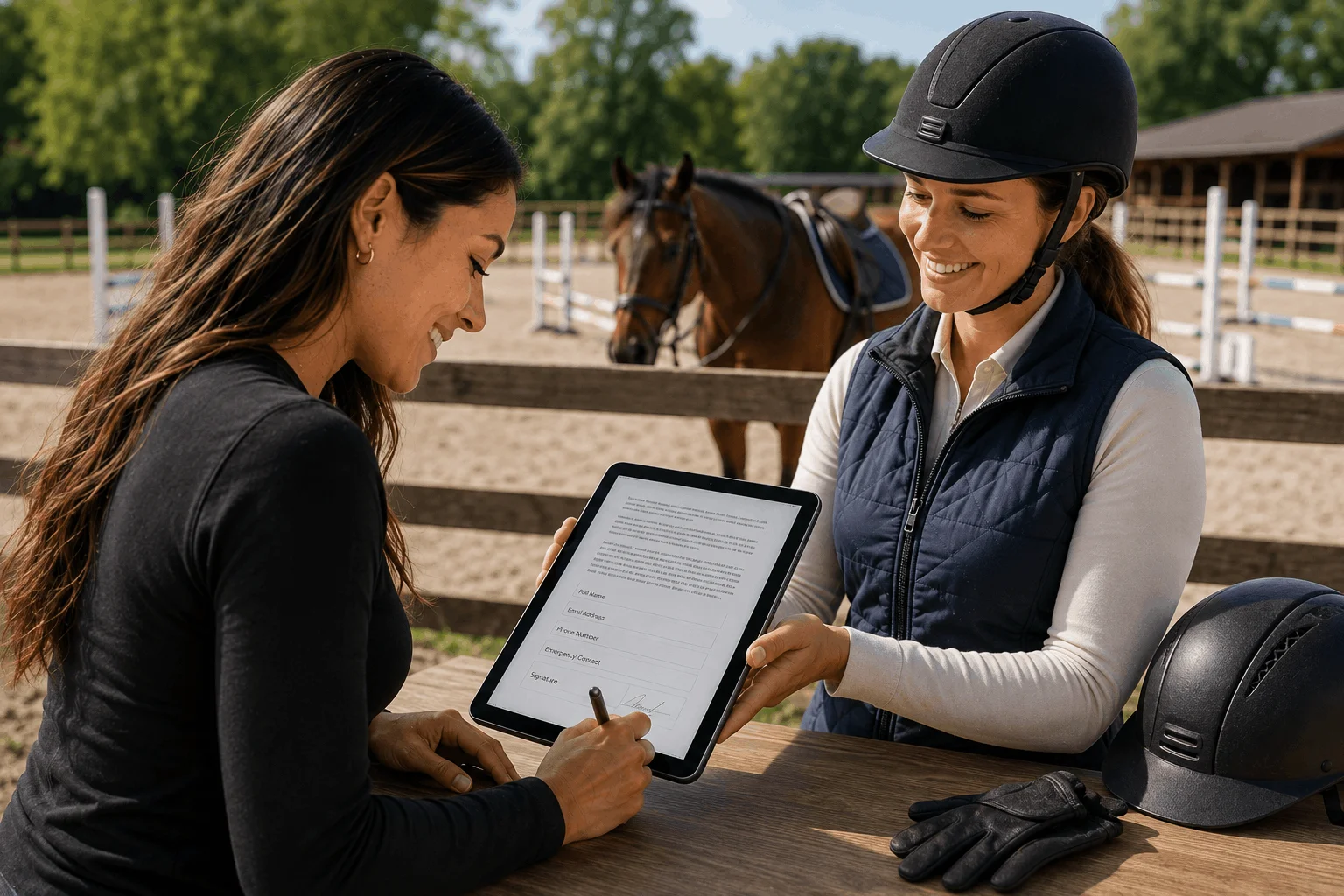
A horse riding waiver is the form a rider signs before a lesson, trail ride or other equestrian activity. It explains the risks of riding and handling horses, records the rider's experience and agreement to stable rules, and releases the business from certain claims arising from the ordinary risks of equine activities.
Riding schools, stables and trail-ride operators see first-time riders on holiday, children in weekly lessons, pony party guests, camp groups and experienced riders who lease or board horses. Horses are large animals that can spook, buck, kick or bite without warning, so almost every equestrian business asks riders to sign a waiver before they get near a horse.
This guide covers what a horse riding waiver is, what to include, how equine activity laws affect it, how to handle minors, a sample structure you can adapt, and how to collect horseback riding waivers online before riders arrive at the barn. It is general information, not legal advice. Waiver rules differ between countries and states, so have your final waiver reviewed for where you operate.
What is a horse riding waiver?
A horse riding waiver, also called a horseback riding waiver, equestrian waiver or equine release form, is a document in which the rider:
- acknowledges the risks of riding, handling and being around horses
- states their riding experience honestly
- agrees to follow the stable's rules and instructor directions
- confirms they are fit to ride and within any weight limit
- releases the business from certain claims, to the extent permitted by law
- signs and dates the form, or has a parent or guardian sign for them
Most riding schools ask regular students to sign once and keep the waiver on file, with a new signature each year or when the wording changes. Trail-ride operators and stables offering one-off rides usually ask every rider to sign before each booking.
Why riding businesses need a waiver
Even calm, well-schooled horses and experienced instructors can't remove every risk. A clear, signed waiver helps you:
- show that the rider was told about equine risks before they rode
- record the rider's stated experience, so you can match them to a suitable horse
- record agreement to rules such as wearing a helmet and staying with the group
- collect emergency contact and health information
- keep a record of parental consent for young riders
- limit certain claims, where local law allows it
A waiver is not a substitute for safe horses, sound tack, trained staff and insurance. Courts in many places won't enforce a waiver against gross negligence, such as putting a beginner on a horse you knew was dangerous, or using a saddle with a broken girth. For more on what can undermine a waiver, see what makes a liability waiver invalid.
Equine activity liability laws
Most US states have an equine activity liability act. These laws generally say that an equine professional isn't liable for injuries caused by the inherent risks of equine activities, with exceptions for things like faulty tack the business supplied, failing to match a rider to a suitable horse, or reckless conduct.
Many of these laws also require a specific warning, either on signs posted at the stable or in the written contracts riders sign, or both. Some states set out the exact wording and how it must be displayed, such as in bold or capital letters. If your state has a statute like this, copy its required warning into your waiver word for word, and display the signs as well.
Equine statutes and waivers work together, not instead of each other. The statute protects against inherent risks, while a waiver can record the rider's experience, rules and consent, and may cover claims the statute doesn't. Outside the US, similar protections are rarer, so the waiver and your insurance do more of the work. Check what applies where you operate.
What should a horse riding waiver include?
1. Rider details
- full name and date of birth
- phone number and email
- emergency contact name and phone number
- height and weight, if your horses have rider weight limits
- the activity booked, for example lesson, trail ride, pony ride or camp
2. Riding experience
Ask riders to describe their experience honestly, as this is what you use to choose a horse and a group. Common options:
- never ridden, or ridden only a few times
- can walk and trot with confidence
- can canter and control a horse in open spaces
- experienced, rides regularly or competes
Add a statement that the rider has described their ability truthfully, and that overstating it increases their risk.
3. Description of activities
Name what the waiver covers so there is no doubt about scope:
- riding lessons, in an arena or on the flat
- trail rides, hacks and beach rides
- jumping, cross-country and competitions
- grooming, tacking up, leading and feeding horses
- pony rides, pony parties and camps
- horse leasing or riding your own horse on the premises
If you run riding camps, see how camps and retreats collect waivers and forms from families.
4. Specific equine risks
Generic wording like "riding involves risk" is weaker than naming the real risks. A horse riding waiver usually lists:
- the tendency of horses to behave in ways that can cause injury, such as bucking, rearing, bolting, kicking, biting or stumbling
- horses spooking unpredictably at sounds, movements, animals or objects
- falling or being thrown from a horse
- being stepped on, crushed or kicked while on the ground
- tack or equipment failure, such as a stirrup leather or girth breaking
- uneven ground, holes, branches, water and weather on trails
- collisions with other horses and riders
- the rider's own mistakes, such as losing balance or failing to control the horse
5. Assumption of risk
The rider confirms they understand that horses are unpredictable, that no amount of training or care removes every risk, and that they choose to ride anyway.
6. Helmets and safety equipment
State your helmet policy clearly. Many riding schools require an approved riding helmet for every rider, at every age, and keep loan helmets for visitors. Also cover:
- suitable footwear with a small heel, not trainers or sandals
- body protectors for jumping or cross-country, if required
- no loose clothing, scarves or dangling jewellery
- what happens if a rider refuses to wear a helmet
7. Stable rules
Include the rules riders agree to follow, or link to them and have the rider confirm they have read them. Common rules:
- follow the instructor's or guide's directions at all times
- stay with the group and keep a safe distance between horses
- don't walk behind horses or enter stalls without staff
- don't feed horses unless staff allow it
- tell staff if you feel unsafe or the horse is behaving unusually
- no riding under the influence of alcohol or drugs
8. Health and fitness
Ask riders to confirm they are physically able to ride and to disclose conditions that matter, such as back or joint problems, recent surgery, heart conditions, epilepsy, pregnancy, allergies to horses or hay, or anything that affects balance. Only ask for the health information you actually need, and store it securely.
9. Release of liability
The release section states which claims the rider gives up, to the extent permitted by law. Keep it clear and visible, not buried in small print. If your state's equine activity act requires warning wording, include it here or right before the signature. Our release of liability form guide explains how release wording works.
10. Medical treatment consent
Allow staff to give first aid and call emergency services if needed, and state who is responsible for medical costs. Stables are often far from a hospital, so this matters more than in many other activities.
11. Photo and video consent
If you post photos of riders and lessons on social media or your website, ask for consent as a separate checkbox rather than bundling it into the release.
12. Signature and date
End with an agreement checkbox, the rider's signature and the date. For digital waivers, the signing date and time can be recorded automatically.
Horse riding waivers for minors
Children make up a large share of riders at most riding schools, from pony rides at five to weekly lessons and summer camps. For anyone under 18, or the age of majority where you operate:
- a parent or legal guardian should sign the waiver
- record the child's name, date of birth and riding experience
- record the guardian's name and contact details, and who can collect the child
- state your rules for young riders, such as minimum ages, lead-rein only for small children, or a parent present during pony rides
Some places limit how far a parent can waive a child's claims, so check local rules. Our guide to waivers for minors covers this in more detail.
Trail rides, leasing and boarding
Different horse services need different paperwork:
- Trail rides and holiday rides. Riders often book online and arrive in groups. Send the waiver link with the booking confirmation so every rider signs before they arrive, not at the mounting block.
- Horse leasing. A lease rider uses one of your horses more freely, sometimes without supervision. Use a waiver that covers unsupervised riding, alongside a lease agreement that sets out days, costs and care.
- Boarding. Owners who keep their own horse at your yard need a horse boarding agreement covering care, fees and liability for their horse, in addition to a waiver for riding on your premises.
For a general equine form that covers visitors, volunteers and handlers as well as riders, see the equine liability waiver template.
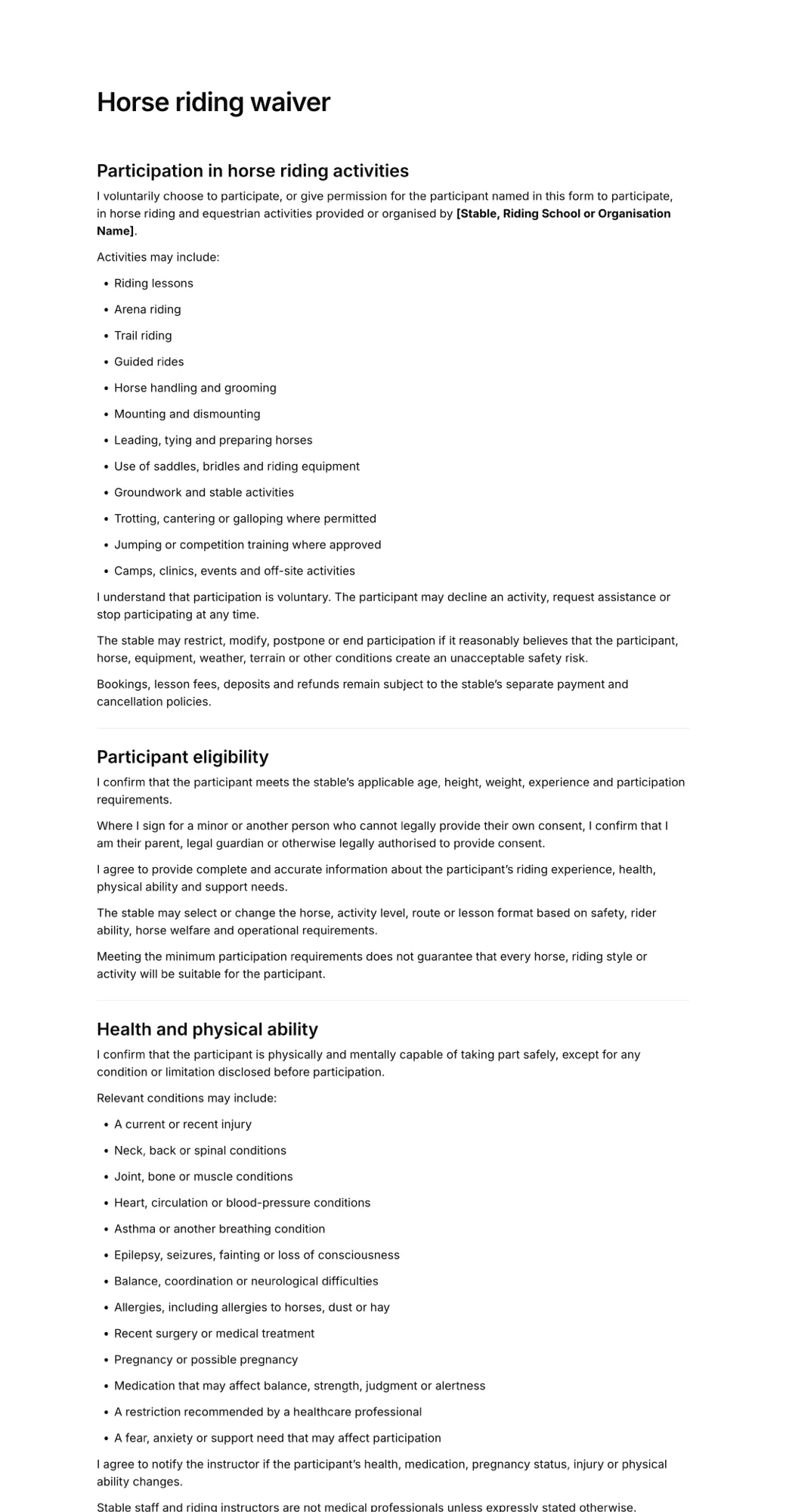
Horse riding waiver sample structure
Use this outline as a starting point. Replace the bracketed details with your own and adapt each section to your stable and location.
Horse Riding Waiver and Release of Liability
Business: [Stable Name], [address], [phone], [email].
Rider: full name, date of birth, phone, email, emergency contact, height and weight, activity booked.
Experience: I have described my riding experience truthfully as [never ridden / beginner / intermediate / experienced].
Activities: This waiver covers riding lessons, trail rides, handling, grooming and other equine activities with [Stable Name], on and off the premises.
Risks: I understand that horses are unpredictable and that riding and handling horses involve risks, including falls, kicks, bites, being stepped on, equipment failure, trail hazards and serious injury.
[State warning]: [Insert the warning wording required by your state's equine activity liability act, if any.]
Safety equipment: I will wear an approved riding helmet and suitable footwear at all times while riding.
Rules: I will follow instructor and guide directions and the stable rules, and tell staff if I feel unsafe.
Health: I am physically able to ride and have disclosed any condition that could affect my safety.
Release: To the extent permitted by law, I release [Stable Name], its owners, staff, instructors and volunteers from claims arising from the inherent risks of equine activities.
Medical consent: I consent to first aid and emergency medical treatment if needed.
Minors: If the rider is under [age], their parent or legal guardian signs below.
Agreement: I have read this waiver, understand it, and agree to its terms.
Signature and date.
Common mistakes in horse riding waivers
- Missing the state's required warning. If your equine activity act requires specific wording in contracts, leaving it out can cost you that protection.
- No experience question. Without a record of what the rider said about their ability, it's harder to show you matched them to a suitable horse.
- Covering only riding. Many injuries happen on the ground, while grooming, leading or tacking up.
- Helmet rules that aren't enforced. A waiver that requires helmets doesn't help if staff let riders go without one.
- One parent waiver for the whole family. Each child who rides should be named on a signed waiver.
- Old wording on file. Ask riders to re-sign each year or when you update your waiver.
- Paper forms left in the tack room. A waiver only helps if you can find it when you need it.
Paper vs online horse riding waivers
Paper waivers get muddy, wet and lost in barns, and holding a group of riders at the mounting block while everyone fills in a clipboard form delays the ride. With online horse riding waivers:
- riders and parents sign on their phone before they arrive
- the waiver link goes out automatically with lesson and trail ride bookings
- walk-ins scan a QR code at the yard office instead of filling in paper
- you can search every signed waiver by rider name and open it in seconds, even from the field
See how to create a QR code waiver for setting up a QR code at your yard.
How to create a horse riding waiver online
Here is how to set one up with AgreeDock:
Step 1: Start from a template or AI
Open the horse riding waiver or equine liability waiver template, or describe your stable to the AI waiver generator to get a draft written for your lessons, trail rides and rules.
Step 2: Add your risks, rules and state warning
Edit the activities, equine risks, helmet policy and stable rules to match your business, and paste in any warning wording your state's equine activity act requires.
Step 3: Add rider fields
Include contact and emergency details, height and weight, a riding experience question, health questions, a minor and guardian section, a photo consent checkbox, and an agreement checkbox above the signature.
Step 4: Share the link or QR code
Add the signing link to your booking confirmations and lesson reminders, and display the QR code at the yard office for walk-ins.
Step 5: Check before riders mount up
Every signed waiver appears in your Signatures list with the rider's answers and the exact wording they agreed to, and you can download each one as a PDF.
See how activity businesses use AgreeDock for waivers and bookings.
Frequently asked questions
What is a horse riding waiver?
A horse riding waiver is a form riders, or their parents, sign before lessons, trail rides or other equestrian activities. It explains the risks of riding and handling horses, records the rider's experience and agreement to stable rules, collects emergency and health details, and releases the business from certain claims to the extent permitted by law.
What should a horse riding waiver include?
Most include rider details and emergency contact, a riding experience question, the activities covered, specific equine risks, an assumption of risk, helmet and safety rules, stable rules, health questions, a release of liability, any warning required by state law, medical treatment consent, optional photo consent, and a signature and date.
Do I need a waiver if my state has an equine activity law?
Usually yes. Equine activity laws protect against inherent risks but have exceptions, and many require specific warning wording in your contracts to apply at all. A waiver records the rider's experience, rules and consent, and can include that required warning. Check your state's law and have your waiver reviewed by a local lawyer.
Are horse riding waivers enforceable?
Often, but not always. Enforceability depends on local law, how clearly the waiver is written, and what happened. Many courts won't enforce a waiver against gross negligence or reckless conduct, and some places limit waivers more broadly.
Can a parent sign a horse riding waiver for a child?
Yes, a parent or legal guardian should sign for any rider under 18, or the age of majority where you operate. Some places limit how far a parent can waive a child's claims, so check local rules.
How often should riders sign a waiver?
Regular students usually sign once a year and again whenever the wording changes. Trail-ride and one-off riders usually sign before each booking.
Can riders sign a horse riding waiver online?
Yes. Electronic signatures are recognised in many countries, including under the ESIGN Act and UETA in the United States. Riders can sign on their phone from a booking confirmation or by scanning a QR code at the yard, and you keep a signed record of each waiver.