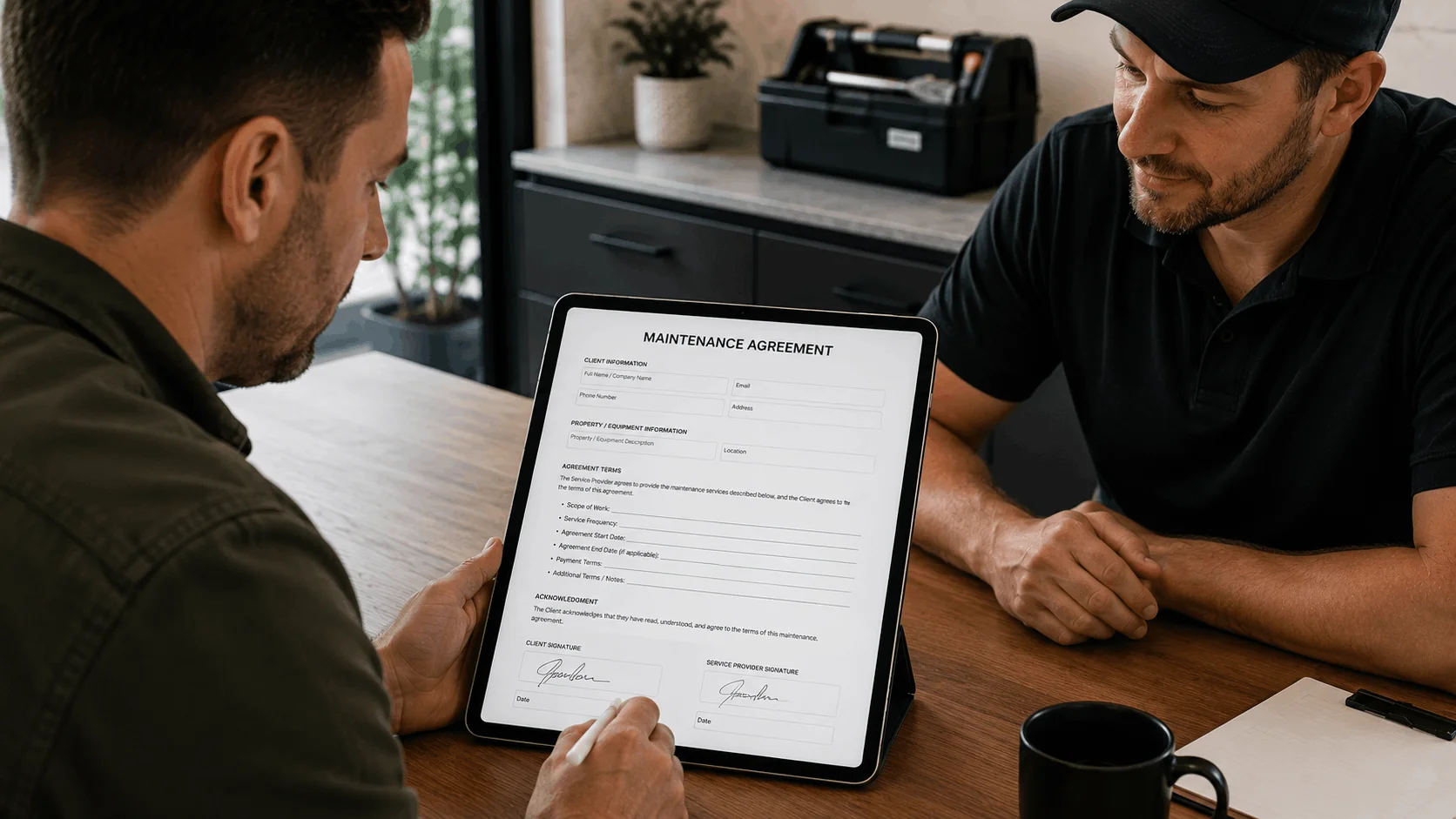
A maintenance agreement, also called a maintenance contract or service maintenance agreement, is a contract in which a provider agrees to inspect, service and repair a customer's property, equipment or systems for a set period, in return for an agreed fee.
Property managers, HVAC technicians, landscapers, IT providers, equipment dealers and facilities companies all rely on recurring maintenance work. A clear maintenance agreement turns that work into predictable revenue for the provider and predictable costs for the customer, and it prevents the most common disputes: what was included, how fast someone should respond, and who pays for parts.
This guide explains what a maintenance agreement is, the main types, what a maintenance contract should include, a sample structure you can adapt, and how to get maintenance agreements signed online. It is general information, not legal advice. Contract rules differ between countries and states, so have your final agreement reviewed for where you work.
What is a maintenance agreement?
A maintenance agreement is an ongoing contract between a service provider and a customer. Instead of agreeing a price every time something needs attention, the two parties agree in advance:
- which assets are covered, such as a building, an HVAC system, a fleet of vehicles or a software platform
- what maintenance is included and how often it happens
- how quickly the provider responds to problems
- what costs extra, such as parts, emergency call-outs or out-of-scope work
- how much the customer pays and when
- how long the agreement lasts, how it renews and how either side can end it
Most maintenance agreements combine preventive maintenance, which is scheduled work that stops problems happening, with corrective maintenance, which is repairs when something breaks.
Types of maintenance agreements
The structure is similar across industries, but the details change:
- Property and building maintenance. Common areas, plumbing, electrical, roofing and general repairs for landlords, property managers and commercial buildings.
- HVAC maintenance agreements. Seasonal inspections, filter changes and priority repairs for heating and cooling systems.
- Equipment and machinery maintenance. Servicing manufacturing, commercial kitchen, medical or fitness equipment, often with manufacturer schedules.
- IT and software maintenance. Updates, security patches, monitoring, backups and support hours for systems and applications.
- Landscaping and grounds maintenance. Mowing, pruning, seasonal clean-ups and snow removal on a fixed schedule.
- Vehicle and fleet maintenance. Regular servicing, inspections and repair priority for company vehicles.
- Appliance and home maintenance plans. Annual service visits and discounted repairs for homeowners.
Maintenance agreement vs service agreement vs warranty
These terms are often mixed up:
- A service agreement can cover any type of service, ongoing or one-off. A maintenance agreement is a type of service agreement focused on keeping something in working order over time.
- A warranty is the manufacturer's or seller's promise to fix defects for a period, usually included in the purchase price. A maintenance agreement is a separate, paid arrangement that can continue after the warranty ends.
What should a maintenance agreement include?
1. The parties
The legal names, addresses and contact details of the provider and the customer, and who the main contact is on each side.
2. Covered property, equipment or systems
List exactly what is covered: the address or site, equipment make, model and serial numbers, or the systems and software versions. Anything not listed is usually out of scope.
3. Scope of services
Describe the work included, for example inspections, cleaning, calibration, testing, minor repairs, software updates or seasonal services. Be specific, because "general maintenance" is the source of many disputes.
4. Maintenance schedule
State how often each task happens, such as monthly inspections, quarterly servicing or two seasonal visits a year, and how visits are booked.
5. Response times and service levels
Set out how quickly the provider will respond to requests, for example within four business hours for urgent faults and two business days for routine requests, and what counts as an emergency.
6. Exclusions
Name what is not included. Common exclusions are damage from misuse, accidents or weather, work on equipment the provider didn't install, upgrades, and repairs needed because the customer ignored the provider's recommendations.
7. Parts, materials and additional work
Explain who pays for replacement parts and materials, whether there is a markup or discount, and how out-of-scope work is quoted and approved before it starts.
8. Pricing and payment terms
State the fee, how it is calculated (monthly, quarterly, annual or per visit), when invoices are issued, payment due dates, and late payment terms. Any price increases on renewal should be explained here too.
9. Term and renewal
Give the start date, the length of the agreement and whether it renews automatically. If it auto-renews, say how much notice is needed to stop the renewal.
10. Termination
Explain how either party can end the agreement, the notice period, what happens to prepaid fees, and grounds for ending it immediately, such as non-payment or a serious breach.
11. Access and customer responsibilities
The customer agrees to provide safe access to the site or systems at agreed times, keep equipment in reasonable condition, and report problems promptly.
12. Liability, insurance and warranties
Set out each party's responsibility for damage or loss, any limits on liability, the insurance the provider carries, and any warranty on the provider's workmanship. These clauses depend heavily on local law and are worth having reviewed.
13. Signatures
Both parties sign and date the agreement. With digital agreements the signing date and time can be recorded automatically.
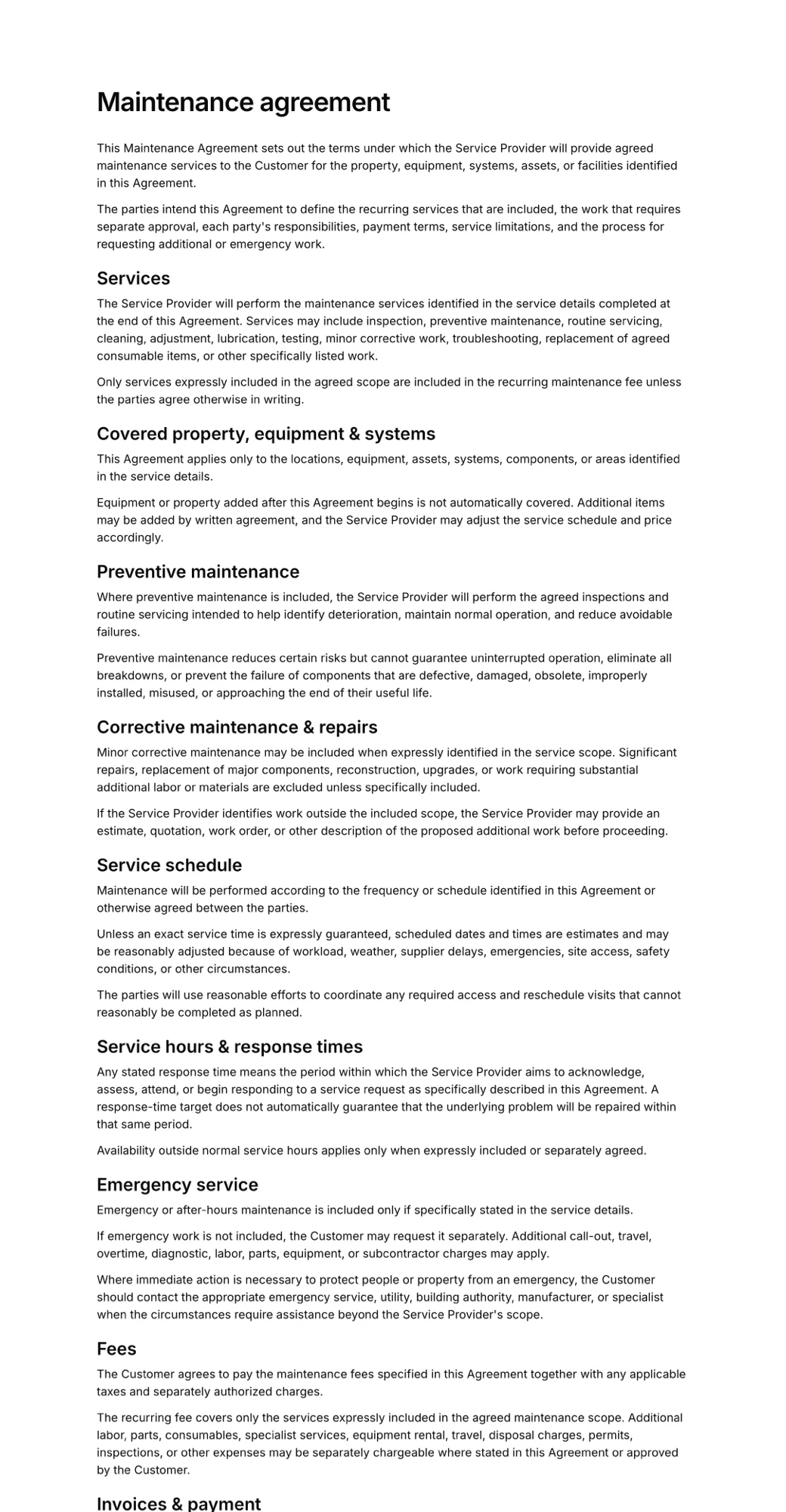
Maintenance agreement sample structure
Use this outline as a starting point and adapt each section. Replace the bracketed details with your own.
Maintenance Agreement
Parties: This agreement is between [Provider Name] ("Provider") and [Customer Name] ("Customer").
Covered assets: [site address, equipment list with make, model and serial numbers, or systems].
Services: Provider will perform [inspections, servicing, testing, minor repairs] as described in Schedule A.
Schedule: Maintenance visits take place [monthly / quarterly / twice a year], booked at least [number] days in advance.
Response times: Provider will respond to urgent faults within [time] and routine requests within [time].
Exclusions: The agreement does not cover [misuse, accidental damage, upgrades, equipment not listed].
Parts and extra work: Replacement parts are charged at [cost / cost plus percentage]. Work outside the scope is quoted and approved in writing first.
Fees: Customer will pay [amount] per [period], invoiced on [date], due within [number] days.
Term: This agreement starts on [date] and runs for [period]. It [renews automatically / does not renew] unless either party gives [number] days' written notice.
Termination: Either party may end the agreement with [number] days' written notice, or immediately for serious breach or non-payment.
Liability and insurance: [liability terms, insurance held by the Provider].
Signatures: signed and dated by both parties.
Common mistakes in maintenance contracts
- A vague scope. "Maintain the building" invites arguments about every job.
- No response times. Without them, the customer and provider will have very different ideas of "urgent".
- Parts left unclear. Many disputes are about who pays for a part, not the labour.
- Silent auto-renewal. Customers who don't realise a contract renews tend to dispute the invoice.
- No process for extra work. Unapproved out-of-scope work is hard to get paid for.
- Unsigned or lost copies. An agreement only helps if both sides can find the signed version.
Paper vs online maintenance agreements
Emailing PDFs back and forth or collecting wet signatures slows down every new customer and every renewal. With an online maintenance agreement, customers read and sign from any device, and you keep a signed, dated copy of the exact terms they accepted.
How to create a maintenance agreement online
Here is how to set one up with AgreeDock:
Step 1: Start from the template or AI
Open the maintenance agreement template, or describe your maintenance business to the AI waiver generator to get a draft written around your services.
Step 2: Fill in your terms
Add your covered services, schedule, response times, exclusions, pricing and renewal terms, and edit any section to match how you work.
Step 3: Add customer fields
Include the customer's contact details, the site address or equipment details, checkboxes for key terms such as auto-renewal, and a signature field.
Step 4: Send the signing link
Email the link to new customers or include it in your quote, and track who has signed in your Signatures list.
Step 5: Keep the signed copy
Each signed agreement keeps the exact wording the customer accepted, and you can download it as a PDF for your records.
You can also start from a ready-made catering contract or gear rental agreement if you run other service or rental work.
Frequently asked questions
What is a maintenance contract?
A maintenance contract is the same as a maintenance agreement: an ongoing contract in which a provider agrees to inspect, service and repair a customer's property, equipment or systems for a set period in return for an agreed fee.
What are the main types of maintenance agreements?
Common types include property and building maintenance, HVAC maintenance, equipment and machinery servicing, IT and software maintenance, landscaping and grounds maintenance, vehicle and fleet maintenance, and home or appliance maintenance plans.
What is the difference between preventive and corrective maintenance?
Preventive maintenance is scheduled work, such as inspections and servicing, done to stop problems happening. Corrective maintenance is repair work after something breaks. Most maintenance agreements include both and explain which repairs are covered by the fee.
How much should a maintenance agreement cost?
Pricing depends on the assets, how often visits happen, response times and whether parts are included. Providers usually charge a fixed monthly, quarterly or annual fee, and price parts and out-of-scope work separately.
How long does a maintenance agreement last?
Most run for one year, though some are monthly or multi-year. Many renew automatically unless either party gives notice, so the agreement should state the term, the renewal rule and the notice period clearly.
Who pays for replacement parts under a maintenance agreement?
It depends on the agreement. Some include parts up to a limit, some charge parts at cost or with a markup, and some exclude them entirely. State the rule in the agreement to avoid disputes.
Can a maintenance agreement be signed electronically?
Yes. Electronic signatures are recognised in many countries, including under the ESIGN Act and UETA in the United States. Customers can review the agreement and sign online, and you keep a signed record of the terms they accepted.
Do I need a lawyer to write a maintenance agreement?
Many small businesses start from a template and adapt it. For high-value contracts, or clauses on liability, insurance and termination, it is worth having a lawyer review the agreement for your location.