
A climbing gym waiver is the form a climber signs before using your walls. It explains the risks of bouldering, top rope and lead climbing, sets out the gym rules, and releases the gym from certain claims arising from the ordinary risks of climbing.
Climbing gyms see a lot of first-time visitors, birthday parties, school groups and regulars who come several times a week. Falls, bad landings, belay mistakes and falling holds are part of the sport, so almost every indoor climbing gym, bouldering wall and outdoor climbing guide asks climbers to sign a waiver before they start.
This guide covers what a climbing gym waiver is, what to include, how to handle minors and belay checks, a sample structure you can adapt, and how to collect rock climbing waivers online before climbers reach the front desk. It is general information, not legal advice. Waiver rules differ between countries and states, so have your final waiver reviewed for where you operate.
What is a climbing gym waiver?
A climbing gym waiver, also called a rock climbing waiver, bouldering waiver or climbing release form, is a document in which the climber:
- acknowledges the risks of climbing and using the facility
- agrees to follow the gym's rules and staff instructions
- confirms they are fit to climb
- releases the gym from certain claims, to the extent permitted by law
- signs and dates the form, or has a parent or guardian sign for them
Most gyms ask climbers to sign once and keep the waiver on file for a set period, such as a year, then ask them to sign again. Many also ask climbers to re-sign when the waiver wording changes.
Why climbing gyms need a waiver
Even well-run gyms with good matting, auto belays and trained staff can't remove every risk. A clear, signed waiver helps you:
- show that the climber was told about the risks before climbing
- record that they agreed to your rules, such as belay checks and bouldering zones
- collect emergency contact and health information
- keep a record of parental consent for children
- limit certain claims, where local law allows it
A waiver is not a substitute for safe operations, staff training, equipment checks and insurance. Courts in many places won't enforce a waiver against gross negligence or reckless conduct, and some places limit waivers more generally. For more on what can undermine a waiver, see what makes a liability waiver invalid.
What should a climbing gym waiver include?
1. Climber details
- full name and date of birth
- phone number and email
- emergency contact name and phone number
- climbing experience, for example first-time, bouldering only, top rope, lead
2. Description of activities
Name the activities the waiver covers so there is no doubt about scope:
- bouldering
- top rope climbing, including auto belays
- lead climbing
- training areas, such as campus boards, hangboards, system walls and fitness equipment
- classes, coaching, youth teams and parties
- outdoor trips or guided climbing, if you offer them
3. Specific climbing risks
Generic wording like "physical activity involves risk" is weaker than naming the real risks. A climbing waiver usually lists:
- falls, including falls onto matting, the floor, holds or other climbers
- awkward landings, sprains, fractures, dislocations and head injuries
- belay errors, rope and equipment failure, and auto belay misuse
- holds that spin, break or come loose
- being hit by falling climbers, holds, chalk or dropped equipment
- finger, shoulder and overuse injuries
- other climbers' actions in shared spaces
4. Assumption of risk
The climber confirms they understand the risks, that matting and safety systems reduce but don't eliminate them, and that they choose to climb anyway.
5. Gym rules and safety instructions
Include the rules climbers agree to follow, or link to them and have the climber confirm they have read them. Common rules:
- complete orientation before climbing
- pass a belay check before belaying, and a lead check before lead climbing
- clip in to auto belays correctly and check before every climb
- don't walk or sit under climbers in bouldering areas
- climb down or jump only as instructed, and stay off the top of walls
- supervise children at all times
- no climbing under the influence of alcohol or drugs
6. Belay and lead certification
If you allow top rope or lead climbing, state that climbers must pass your belay test, that you can re-test or withdraw belay permission at any time, and that climbers are responsible for checking their own and their partner's knots, harness and device.
7. Health and fitness
Ask climbers to confirm they are physically able to climb, and give them space to note conditions that matter, such as heart conditions, recent injuries, pregnancy or epilepsy. Only ask for the health information you actually need.
8. Equipment
Cover rented and personal equipment:
- rented shoes, harnesses and belay devices are inspected, but climbers should check them before use
- climbers using their own equipment are responsible for its condition
- report damaged equipment or loose holds to staff straight away
9. Release of liability
The release section states which claims the climber gives up, to the extent permitted by law. Keep it clear and visible, not buried in small print. Our release of liability form guide explains how release wording works.
10. Medical treatment consent
Allow staff to give first aid and call emergency services if needed, and state who is responsible for medical costs.
11. Photo and video consent
If you post photos of climbers on social media or your website, ask for consent as a separate checkbox rather than bundling it into the release.
12. Signature and date
End with an agreement checkbox, the climber's signature and the date. For digital waivers, the signing date and time can be recorded automatically.
Climbing waivers for minors
Kids and teenagers make up a big part of most climbing gyms' visitors, through parties, school groups, youth teams and holiday camps. For anyone under 18, or the age of majority where you operate:
- a parent or legal guardian should sign the waiver
- record the minor's name and date of birth, and the guardian's name and contact details
- state your supervision rules, such as an adult who has passed a belay check must belay children, or children under a certain age must be supervised in bouldering areas
- for parties and groups, ask each parent to sign before the event rather than one organiser signing for everyone
Some places limit how far a parent can waive a child's claims, so check local rules. Our guide to waivers for minors covers this in more detail.
Climbing gym waiver sample structure
Use this outline as a starting point. Replace the bracketed details with your own and adapt each section to your gym and location.
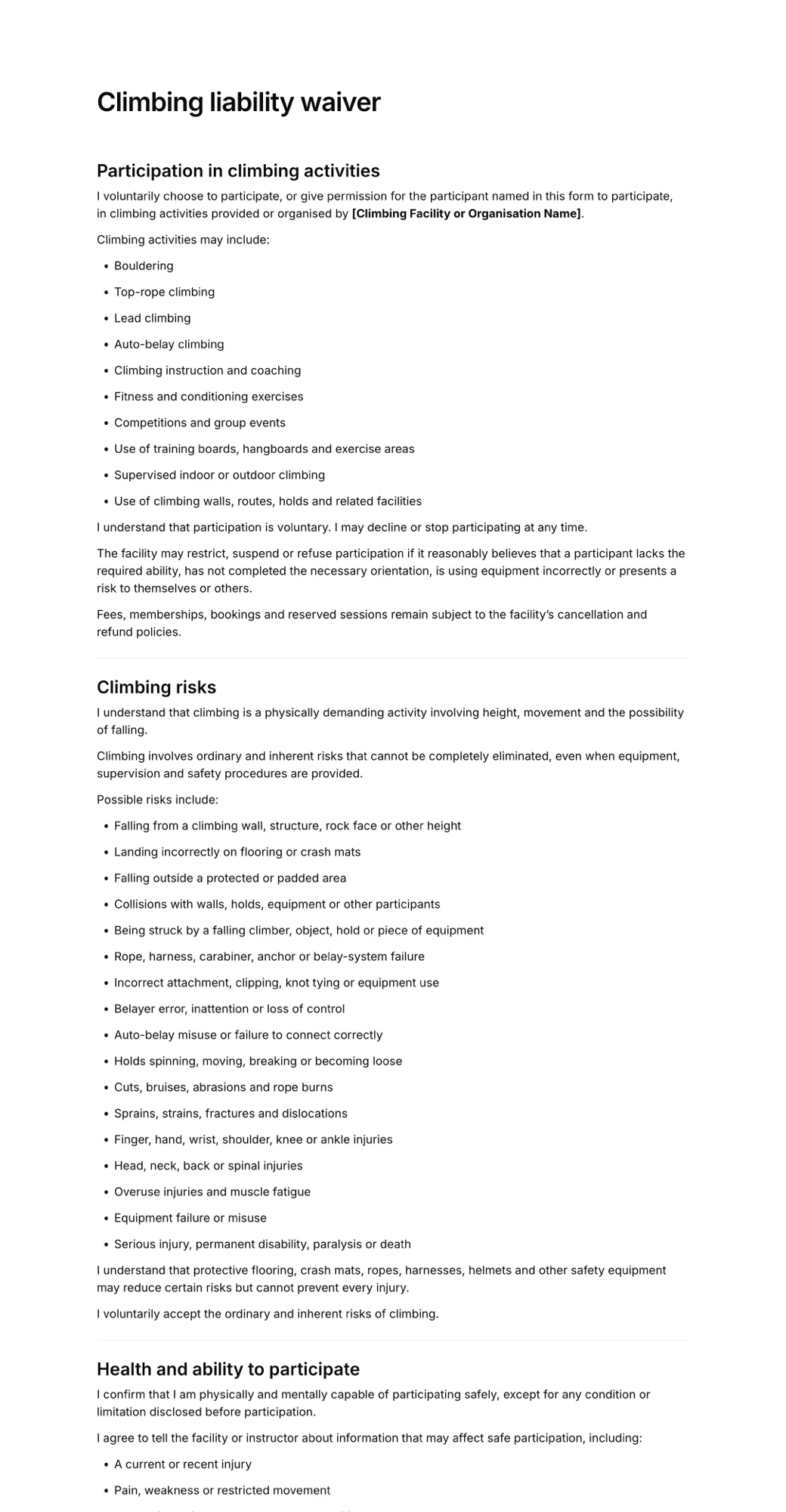
Climbing Waiver and Release of Liability
Gym: [Gym Name], [address], [phone], [email].
Climber: full name, date of birth, phone, email, emergency contact, climbing experience.
Activities: This waiver covers bouldering, top rope, auto belay and lead climbing, training areas, classes and events at [Gym Name].
Risks: I understand that climbing involves risks, including falls, awkward landings, belay and equipment failure, loose or spinning holds, being hit by other climbers or objects, and serious injury.
Rules: I will complete orientation, follow the gym rules and staff instructions, belay or lead climb only after passing the gym's checks, and check my equipment before every climb.
Health: I am physically able to climb and have disclosed any condition that could affect my safety.
Release: To the extent permitted by law, I release [Gym Name], its owners, staff and volunteers from claims arising from the ordinary risks of climbing and using the facility.
Medical consent: I consent to first aid and emergency medical treatment if needed.
Minors: If the climber is under [age], their parent or legal guardian signs below.
Agreement: I have read this waiver, understand it, and agree to its terms.
Signature and date.
Common mistakes in climbing gym waivers
- Generic risk wording. A waiver that never mentions falls, belaying or bouldering is harder to rely on.
- Not covering every area. If the waiver only mentions bouldering, a top rope or training-area injury may fall outside it.
- One parent signing for a whole party. Each child needs consent from their own parent or guardian.
- No record of belay checks. Note who passed and when, so permission to belay is clear.
- Old wording on file. Ask regulars to re-sign when you update your waiver or after it expires.
- Paper forms you can't find. A waiver only helps if you can locate it when you need it.
Paper vs online climbing waivers
Paper waivers create queues at the front desk on busy evenings and weekends, and they are easy to lose or fill in illegibly. With online climbing waivers:
- climbers sign on their phone before they arrive, so check-in is quicker
- walk-ins scan a QR code at reception instead of using a clipboard
- parents sign for their children before parties and school visits
- you can search every signed waiver by name and open it in seconds
See how to create a QR code waiver for setting up a front-desk QR code.
How to create a climbing gym waiver online
Here is how to set one up with AgreeDock:
Step 1: Start from a template or AI
Open the climbing waiver template, or describe your gym to the AI waiver generator to get a draft written for your walls, classes and rules.
Step 2: Add your rules and risks
Edit the activities, risks, belay rules and supervision policy to match your gym, and add a link to your full gym rules if you have one.
Step 3: Add climber fields
Include contact and emergency details, experience level, health questions, a minor and guardian section, a photo consent checkbox, and an agreement checkbox above the signature.
Step 4: Share the link or QR code
Add the signing link to booking confirmations and party invitations, and display the QR code at reception for walk-ins.
Step 5: Check before climbers start
Every signed waiver appears in your Signatures list with the climber's answers and the exact wording they agreed to, and you can download each one as a PDF.
See how activity businesses use AgreeDock for climbing, trampoline and adventure park waivers.
Frequently asked questions
What is a climbing gym waiver?
A climbing gym waiver is a form climbers sign before using the gym. It explains the risks of bouldering, top rope and lead climbing, records their agreement to the gym rules, collects emergency contact details, and releases the gym from certain claims to the extent permitted by law.
What should a rock climbing waiver include?
Most include climber details and emergency contact, the activities covered, specific climbing risks, an assumption of risk, gym rules, belay and lead check requirements, health questions, equipment terms, a release of liability, medical treatment consent, optional photo consent, and a signature and date.
Are climbing gym waivers enforceable?
Often, but not always. Enforceability depends on local law, how clearly the waiver is written, and what happened. Many courts won't enforce a waiver against gross negligence or reckless conduct, and some places limit waivers more broadly. Have your waiver reviewed by a local lawyer.
Do children need a waiver to climb?
Yes, most gyms require a waiver for every climber. For minors, a parent or legal guardian signs on their behalf. For parties and school groups, ask each child's parent or guardian to sign before the visit.
How often should climbers sign a waiver?
Many gyms ask climbers to sign once a year, and again whenever the waiver wording changes. Regulars on memberships often re-sign at renewal.
Does a bouldering gym need a different waiver?
Not necessarily. One climbing waiver can cover bouldering and roped climbing if it names each activity and its risks. A bouldering-only gym can use a shorter waiver focused on falls, landings and shared floor space.
Can climbers sign a waiver online?
Yes. Electronic signatures are recognised in many countries, including under the ESIGN Act and UETA in the United States. Climbers can sign on their phone before they arrive or by scanning a QR code at reception, and you keep a signed record of each waiver.