
Example · sample answers
IV therapy consent form
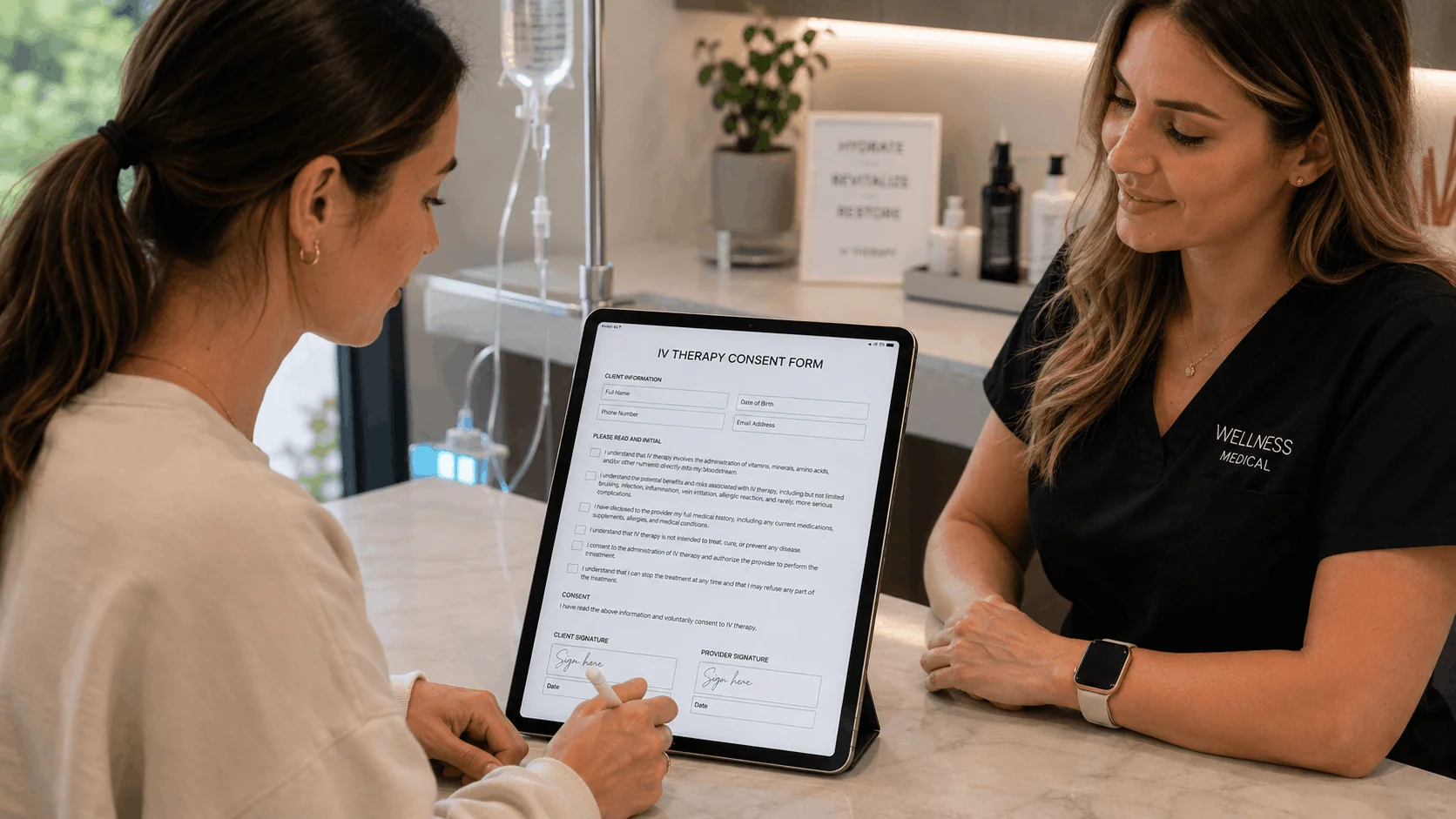
IV Therapy Consent Form
Please complete this consultation before receiving intravenous (IV) therapy. Accurate information about your health, medications, allergies, previous reactions, fluid status, and treatment goals helps the treating healthcare professional determine whether IV therapy is appropriate and select a suitable solution, additives, volume, and infusion rate.
About IV therapy
IV therapy involves placing a catheter into a vein so that fluids, electrolytes, vitamins, minerals, medications, or other specifically prescribed substances can be delivered directly into the bloodstream.
The contents of an IV infusion can vary substantially. The treating healthcare professional should identify the exact base fluid, additives, doses, total volume, intended infusion rate, and reason for treatment before administration.
IV therapy should be ordered, prepared, administered, and monitored only within the professional scope, prescribing authority, pharmacy requirements, infection-control standards, and other laws applicable to the treatment location.
Individual assessment
IV fluids and additives are not appropriate in the same amount or formulation for every person. Fluid and electrolyte needs can be affected by age, body size, oral intake, illness, medications, kidney function, heart function, liver function, blood pressure, pregnancy, laboratory results, and other medical circumstances.
The treating healthcare professional may recommend further assessment, vital signs, laboratory testing, medical clearance, a different treatment, oral hydration, postponement, or no IV treatment depending on the clinical circumstances.
IV catheter placement
IV treatment requires insertion of a needle and flexible catheter into a vein, usually in the hand or arm.
Temporary pain, stinging, tenderness, minor bleeding, bruising, or a small hematoma may occur at the insertion site. More than one attempt may occasionally be required to obtain suitable intravenous access.
Rare complications may include injury or irritation to a vein, nerve, or nearby tissue.
Infiltration & extravasation
An IV catheter can move out of the vein or fluid can leak into surrounding tissue. This is known as infiltration. If a medication or solution capable of causing tissue injury leaks outside the vein, the complication may be referred to as extravasation.
Possible symptoms include swelling, tightness, coolness or warmth, discomfort, burning, tenderness, leaking around the catheter, or changes in skin appearance.
I agree to immediately report pain, burning, swelling, leaking, numbness, or another unusual sensation around the IV site.
Phlebitis & vein irritation
The vein may become irritated or inflamed during or after IV therapy. Possible signs include pain, tenderness, warmth, redness, swelling, or firmness along the vein.
The IV may need to be slowed, stopped, removed, or restarted at another site if the catheter or infused solution causes significant irritation.
Infection
Because an IV catheter passes through the skin and provides direct vascular access, infection is possible.
The healthcare provider should use appropriate aseptic and safe injection practices, sterile equipment, and properly prepared intravenous products.
Possible signs of infection include increasing pain, warmth, swelling, spreading redness, drainage, fever, chills, or worsening illness. Serious bloodstream infection or sepsis is uncommon but potentially life-threatening.
Allergic & infusion reactions
Any medication, vitamin, mineral, solution component, preservative, or other substance administered intravenously may potentially cause an adverse or allergic reaction.
Possible reactions may include itching, rash, hives, flushing, nausea, dizziness, headache, swelling, changes in blood pressure, palpitations, or other symptoms depending on the substance administered.
A severe allergic reaction or anaphylaxis can cause difficulty breathing, wheezing, throat or tongue swelling, severe dizziness, low blood pressure, collapse, or loss of consciousness and requires emergency medical treatment.
Fluid overload
Receiving more intravenous fluid than the body can appropriately handle may cause fluid overload.
Fluid overload may cause swelling, increased blood pressure, shortness of breath, or accumulation of fluid in the lungs or other tissues.
The risk may be greater in people with kidney impairment, heart failure, significant cardiovascular disease, liver disease, existing edema, or other conditions affecting fluid balance.
Electrolyte & metabolic changes
IV fluids and additives can alter sodium, potassium, magnesium, calcium, glucose, acid-base balance, or other physiological measurements depending on the formulation administered.
An inappropriate dose, concentration, rate, or formulation can cause clinically significant electrolyte or metabolic abnormalities. Certain clients may therefore require laboratory testing or additional medical assessment before or during treatment.
Heart, kidney & liver conditions
Kidney, heart, and liver conditions can materially affect the body's ability to handle fluids, electrolytes, medications, vitamins, minerals, and other infused substances.
I agree to disclose known kidney disease, reduced kidney function, dialysis, heart failure, significant heart disease, liver disease, unexplained swelling, medically prescribed fluid restriction, or other conditions affecting fluid balance.
Medications & supplements
Prescription medicines, non-prescription medicines, vitamins, supplements, and other treatments may interact with ingredients in an IV infusion or affect kidney function, electrolyte balance, blood pressure, heart rhythm, bleeding, or other physiological responses.
I agree to provide an accurate medication and supplement history. I understand that I should not stop prescribed medication solely to receive IV therapy unless directed by the healthcare professional responsible for that medication.
Pregnancy & breastfeeding
The safety and appropriateness of an IV treatment during pregnancy or breastfeeding depend on the reason for treatment and the specific fluids, medications, vitamins, minerals, or other ingredients being administered.
I agree to disclose pregnancy, possible pregnancy, plans for pregnancy, and breastfeeding before treatment so the healthcare professional can evaluate the proposed formulation appropriately.
Compounded IV preparations
Some IV therapies may contain compounded preparations. A compounded medication is prepared for a particular clinical purpose and is different from a commercially manufactured drug product.
If a compounded preparation is proposed, the treating professional should identify the relevant ingredients and source and comply with applicable prescribing, pharmacy, sterile-compounding, storage, and administration requirements.
I understand that compounded products should not automatically be described as FDA-approved or otherwise regulator-approved merely because individual ingredients are commercially available.
Sterility & product quality
Products intended for intravenous administration must be appropriate for sterile use. Contamination of an injectable product with microorganisms, endotoxins, particulates, or unsuitable ingredients can cause serious illness.
The treatment provider is responsible for obtaining, storing, preparing, and administering IV products according to applicable sterile-product and medication requirements.
Treatment benefits & limitations
The expected benefit of IV therapy depends on the reason for treatment and the ingredients administered.
No particular improvement in energy, hydration, recovery, immunity, appearance, athletic performance, hangover symptoms, general wellness, or another outcome is guaranteed unless there is an established medical indication and an appropriate evidence-based expectation for the treatment being provided.
IV therapy should not be represented as a substitute for emergency care, diagnosis, treatment of serious illness, adequate nutrition, or ordinary oral hydration when those are more appropriate.
Alternative options
Depending on the circumstances, alternatives may include oral fluids, oral vitamins or medications, dietary measures, observation, laboratory testing, treatment by another healthcare professional, or no treatment.
I understand that I may ask about reasonable alternatives before deciding whether to proceed.
Monitoring during treatment
The healthcare professional may monitor my symptoms, IV site, infusion rate, pulse, blood pressure, oxygen saturation, respiratory status, or other measurements depending on the treatment and my medical circumstances.
The infusion may be slowed, paused, changed, or stopped if I develop symptoms, the IV site becomes unsuitable, my vital signs change, or the healthcare professional determines that continuing is not appropriate.
When treatment may be postponed or declined
Treatment may be postponed, modified, or declined if the healthcare professional identifies a contraindication, significant abnormal vital sign, concerning symptom, active medical emergency, unsuitable vascular access, known ingredient allergy, significant fluid-balance concern, insufficient clinical information, or another circumstance that makes proceeding inappropriate.
Emergency symptoms
I agree to immediately report chest pain, difficulty breathing, wheezing, severe dizziness, fainting, rapidly increasing swelling, severe headache, significant palpitations, widespread hives, throat or tongue swelling, severe nausea or vomiting, confusion, intense pain or burning at the IV site, or another severe or rapidly worsening symptom.
A severe allergic reaction, significant breathing difficulty, loss of consciousness, serious chest symptoms, seizure, or another medical emergency may require emergency medical services and transfer to a higher level of care.
Aftercare
After the IV catheter is removed, mild tenderness or bruising may occur. I agree to follow instructions regarding pressure on the site, dressing removal, hydration, activity, and any product-specific aftercare.
I understand that increasing redness, warmth, swelling, drainage, significant persistent pain, fever, shortness of breath, or another concerning symptom after leaving the clinic should be reported and medically assessed when appropriate.
Client information
Client contact details
- First name
- Jordan
- Last name
- Smith
- Phone
- (555) 014-2298
- jordan.smith@example.com
Date of birth
April 12, 1990
Reason for IV therapy
What is the primary reason for today's IV therapy?
- Clinically assessed dehydration or fluid replacement
- Medically prescribed infusion
- Vitamin, mineral, or nutrient infusion
- Elective hydration or wellness infusion
- Recovery-related hydration
- Other
- To be determined after clinical assessment
Describe your symptoms, treatment goals, or reason for requesting IV therapy.
Current symptoms
Are you currently experiencing any of the following? Select all that apply.
- Chest pain
- Significant shortness of breath
- Severe or worsening abdominal pain
- Repeated or uncontrolled vomiting
- Significant diarrhea
- Fever or chills
- Fainting or near-fainting
- Confusion or altered mental status
- Severe headache
- New weakness or numbness
- Significant swelling of the legs or body
- Very little or no urine output
- Severe allergic symptoms
- Other significant current symptom
- None of these
Provide details about any significant current symptoms.
None.
Previous IV therapy
Have you received IV hydration or infusion therapy before?
- No
- Yes
- Unsure
Have you ever experienced any of the following during or after an IV? Select all that apply.
- Difficulty obtaining IV access
- Fainting or near-fainting
- Significant bruising or bleeding
- Infiltration or significant swelling around the IV
- Phlebitis or vein inflammation
- Infection
- Allergic or infusion reaction
- Shortness of breath or fluid-overload symptoms
- Significant blood-pressure or heart-rate change
- Other significant reaction
- No significant previous reaction
- No previous IV therapy
Describe any previous IV complication, reaction, treatment, and outcome.
None.
Allergies
Do you have known medication, food, supplement, injectable-product, latex, adhesive, or antiseptic allergies?
- No known relevant allergies
- Yes
- Unsure
List all known allergies and describe previous reactions.
Have you ever had anaphylaxis or another severe allergic reaction requiring emergency treatment?
- No
- Yes
- Unsure
Medical history
Do any of the following medical considerations apply? Select all that apply.
- Kidney disease or reduced kidney function
- Dialysis
- History of kidney stones
- Heart failure
- Other significant heart disease
- Heart rhythm or arrhythmia condition
- High blood pressure
- Low blood pressure
- Liver disease
- Diabetes
- Electrolyte disorder
- Medically prescribed fluid restriction
- Significant swelling or edema
- Bleeding or clotting disorder
- Condition affecting the immune system
- Current significant infection
- Seizure disorder
- G6PD deficiency
- Other relevant medical condition
- None of these
Provide details about any medical condition relevant to IV therapy.
None.
Fluid balance
Do any of the following currently apply? Select all that apply.
- Unusually low fluid intake
- Recent significant vomiting
- Recent significant diarrhea
- Heavy sweating or heat exposure
- Current fluid restriction
- New or worsening swelling
- Recent rapid weight increase from fluid retention
- Reduced urine output
- None of these
Provide details about recent fluid loss, intake, swelling, or fluid restrictions.
Medications & supplements
List current prescription medicines, over-the-counter medicines, vitamins, supplements, herbal products, injections, and other relevant treatments.
Do you currently take any of the following? Select all that apply.
- Diuretic or water pill
- Blood-pressure medication
- Heart-rhythm medication
- Anticoagulant or blood thinner
- Insulin or diabetes medication
- Kidney-related medication
- Prescription electrolyte supplement
- Other medication that affects fluid or electrolyte balance
- None of these
- Unsure
Pregnancy & breastfeeding
Do any of the following apply?
- No
- Currently pregnant
- Planning pregnancy
- May be pregnant
- Currently breastfeeding
- Unsure
- Prefer not to say
- Not applicable
Medical restrictions
Has a healthcare professional advised you to avoid or restrict IV fluids, electrolytes, vitamins, supplements, or any proposed ingredient?
- No
- Yes
- Unsure
If yes or unsure, provide any relevant medical guidance or restrictions.
None.
Proposed IV treatment
Base IV solution
- 0.9% sodium chloride / normal saline
- Lactated Ringer's or balanced crystalloid
- Dextrose-containing IV fluid
- Other commercially manufactured IV fluid
- Compounded base solution
- To be determined by treating professional
Planned total IV fluid volume
Planned infusion rate or approximate duration
What categories of additives are planned? Select all that apply.
- No additives — IV fluid only
- Vitamin preparation
- Mineral or electrolyte
- Prescription medication
- Anti-nausea medication
- Other medication
- Compounded ingredient or formulation
- Other additive
List every proposed additive, exact dose, concentration, and route-specific formulation.
Does the infusion include a compounded preparation?
- No
- Yes
- Unsure or to be confirmed before administration
If compounded, identify the preparation, compounding pharmacy or facility, and relevant product information.
None.
Clinical assessment
Pre-treatment blood pressure
Pre-treatment pulse
Pre-treatment oxygen saturation, if assessed
Pre-treatment temperature, if assessed
Relevant examination, laboratory results, clinical assessment, or treatment modifications
IV treatment record
IV catheter site
IV catheter size, if recorded
Exact IV fluid, ingredients, medications, vitamins, minerals, doses, manufacturers, and formulation administered
Relevant lot, batch, expiration, or pharmacy information
Actual volume administered
Infusion start and completion time
Infusion monitoring, reactions, interventions, and treatment notes
Ordering or authorizing clinician
Healthcare professional administering IV
Acknowledgment & consent
I confirm that I have disclosed relevant medical conditions, medications, supplements, allergies, pregnancy or breastfeeding status, previous IV reactions, fluid restrictions, and other information requested by the treating healthcare professional to the best of my knowledge.
I understand which IV fluid and additives are proposed and have had an opportunity to ask about their intended purpose, doses, alternatives, and product-specific risks.
I understand that IV catheter placement may cause temporary pain, bleeding, bruising, tenderness, hematoma, or difficulty obtaining vascular access.
I understand that possible IV-site complications include infiltration, extravasation, phlebitis, vein irritation, swelling, infection, and injury or irritation to surrounding tissue.
I agree to immediately report pain, burning, swelling, leaking, numbness, significant tenderness, or another unusual sensation around the IV site.
I understand that any IV fluid, vitamin, mineral, medication, or other additive can potentially cause an adverse reaction or allergic reaction and that severe reactions may require emergency treatment.
I understand that receiving an inappropriate amount or composition of IV fluid can cause fluid overload, swelling, blood-pressure changes, pulmonary edema, electrolyte imbalance, or other metabolic complications.
I understand that kidney disease, heart failure or other significant heart disease, liver disease, fluid restrictions, and certain medications may increase the risks associated with IV fluids or additives.
I understand that sterile preparation and safe injection practices are important because contaminated IV products or equipment can cause serious infections, including bloodstream infection or sepsis.
If a compounded preparation is used, I understand that compounded medications are different from commercially manufactured approved drug products and have had an opportunity to ask about the preparation and its source.
I understand that no particular wellness, energy, hydration, recovery, immunity, cosmetic, athletic, or other outcome can be guaranteed from elective IV therapy.
I understand that IV therapy does not replace emergency medical treatment, diagnosis of serious symptoms, appropriate nutrition, or oral hydration when those are more appropriate.
I agree to immediately report chest pain, breathing difficulty, severe dizziness, fainting, hives, throat or tongue swelling, significant palpitations, severe headache, confusion, rapidly increasing swelling, or another severe or unexpected symptom during treatment.
I understand that the healthcare professional may modify the fluid, additives, volume, infusion rate, slow or stop treatment, request additional assessment, postpone treatment, or decline treatment if proceeding is not considered medically appropriate.
I understand that I may ask for the infusion to be stopped and may withdraw my consent to continued IV treatment at any time.
If a medical emergency occurs and I am unable to participate in decisions, I authorize the healthcare team to provide reasonable emergency assistance and contact emergency medical services when clinically appropriate.
I have had the opportunity to discuss the proposed IV treatment, exact fluids and additives, expected benefits, reasonable alternatives, material risks, possible complications, monitoring, and aftercare with the treating healthcare professional and voluntarily consent to IV therapy.
Client signature
Treating healthcare professional signature