
Example · sample answers
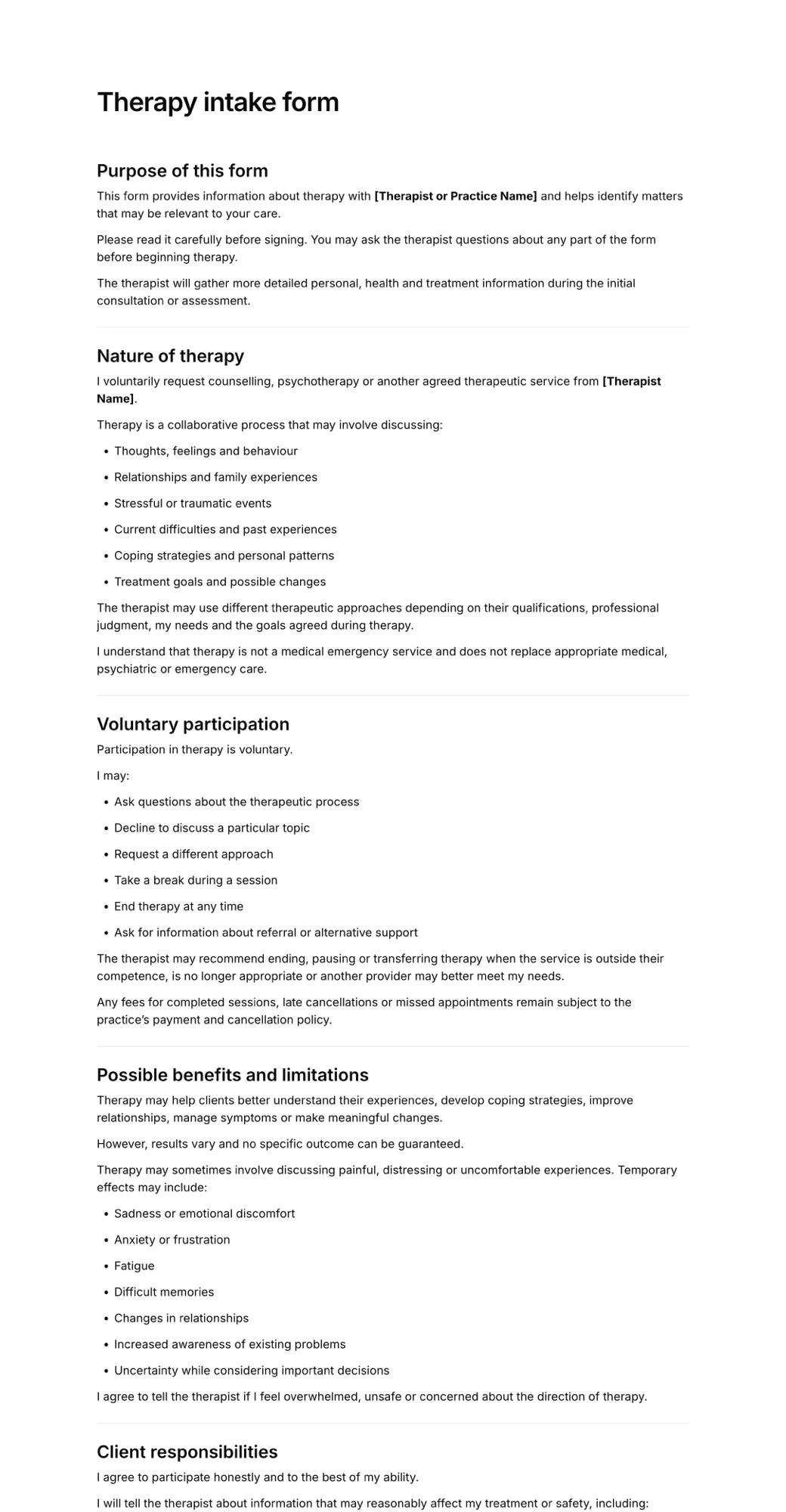
Therapy intake form
Purpose of this form
This form provides information about therapy with [Therapist or Practice Name] and helps identify matters that may be relevant to your care.
Please read it carefully before signing. You may ask the therapist questions about any part of the form before beginning therapy.
The therapist will gather more detailed personal, health and treatment information during the initial consultation or assessment.
Nature of therapy
I voluntarily request counselling, psychotherapy or another agreed therapeutic service from [Therapist Name].
Therapy is a collaborative process that may involve discussing:
Thoughts, feelings and behaviour
Relationships and family experiences
Stressful or traumatic events
Current difficulties and past experiences
Coping strategies and personal patterns
Treatment goals and possible changes
The therapist may use different therapeutic approaches depending on their qualifications, professional judgment, my needs and the goals agreed during therapy.
I understand that therapy is not a medical emergency service and does not replace appropriate medical, psychiatric or emergency care.
Voluntary participation
Participation in therapy is voluntary.
I may:
Ask questions about the therapeutic process
Decline to discuss a particular topic
Request a different approach
Take a break during a session
End therapy at any time
Ask for information about referral or alternative support
The therapist may recommend ending, pausing or transferring therapy when the service is outside their competence, is no longer appropriate or another provider may better meet my needs.
Any fees for completed sessions, late cancellations or missed appointments remain subject to the practice’s payment and cancellation policy.
Possible benefits and limitations
Therapy may help clients better understand their experiences, develop coping strategies, improve relationships, manage symptoms or make meaningful changes.
However, results vary and no specific outcome can be guaranteed.
Therapy may sometimes involve discussing painful, distressing or uncomfortable experiences. Temporary effects may include:
Sadness or emotional discomfort
Anxiety or frustration
Fatigue
Difficult memories
Changes in relationships
Increased awareness of existing problems
Uncertainty while considering important decisions
I agree to tell the therapist if I feel overwhelmed, unsafe or concerned about the direction of therapy.
Client responsibilities
I agree to participate honestly and to the best of my ability.
I will tell the therapist about information that may reasonably affect my treatment or safety, including:
Relevant mental or physical health conditions
Current medication and significant medication changes
Previous or current mental health treatment
Hospitalisation or emergency mental health care
Substance use that may affect therapy
Thoughts of harming myself or another person
Major changes in my wellbeing or personal circumstances
Any concern about my ability to safely participate
The therapist is not responsible for consequences caused by important information that I intentionally conceal or provide inaccurately.
Confidentiality
Information discussed during therapy will generally be treated as confidential and handled according to applicable privacy laws, professional standards and the practice’s privacy notice.
The therapist may discuss cases during professional supervision or consultation to support safe and effective practice. Where reasonably possible, identifying information should be limited.
Confidential information may be disclosed without my permission where permitted or required by applicable law, including situations involving:
A serious or immediate risk of harm to me or another person
Suspected abuse, neglect or exploitation where reporting is legally required
A valid court order or another binding legal requirement
A medical or mental health emergency
Professional or regulatory investigations
Other circumstances where disclosure is legally required or permitted
Where reasonably possible and safe, the therapist should discuss a proposed disclosure with me before sharing information.
I understand that confidentiality rules and reporting obligations vary by country, region, profession and client age.
Records and privacy
The therapist or practice may create and retain records relating to:
Contact and identifying information
Appointment history
Intake and assessment information
Treatment goals and plans
Session or progress notes
Relevant communications
Risk assessments
Referrals and professional consultations
Billing and payment records
Records will be handled according to the practice’s privacy notice, professional requirements and applicable data-protection laws.
The practice will retain records for the period required by applicable law, regulation, insurance or professional standards.
Requests to access, correct, transfer or delete records will be handled according to applicable law and the practice’s policies.
Communication outside sessions
Therapy-related communication may take place by telephone, email, text message, video platform or another agreed method.
I understand that ordinary email and text messaging may not be fully secure.
Unless otherwise agreed, electronic communication should be limited to matters such as:
Scheduling
Cancellations
Administrative questions
Sharing agreed resources
Brief practical updates
The therapist may not read or respond to messages immediately, outside business hours or while unavailable.
Sensitive, urgent or complex therapeutic matters should normally be discussed during a scheduled session.
Online therapy
Where sessions take place remotely, I agree to:
Participate from a reasonably private and safe location
Use a suitable device and internet connection
Avoid recording sessions without prior permission
Tell the therapist if another person is present
Provide my current location when reasonably needed for emergency planning
Avoid participating while driving or performing another unsafe activity
I understand that online therapy may be interrupted by technical problems and may involve privacy risks outside the therapist’s control.
If a connection fails, the therapist and I will follow the practice’s agreed backup communication procedure.
Emergencies and crisis support
The therapist and practice do not provide continuous monitoring, emergency response or a 24-hour crisis service unless expressly agreed in writing.
If I believe that I or another person is in immediate danger, I should contact the emergency services available in my location or attend an appropriate emergency facility.
For urgent support outside scheduled sessions, I should use the crisis, medical or emergency resources available where I am located.
Sending a message to the therapist does not guarantee that it will be seen or answered in time to respond to an emergency.
The therapist may contact an emergency contact, healthcare provider or emergency service when reasonably necessary and legally permitted to protect me or another person from serious harm.
Appointments, cancellations and fees
Sessions will normally last [Session Duration] and cost [Session Fee and Currency], unless another arrangement has been agreed.
Payment is due [Payment Terms].
Appointments cancelled with less than [Cancellation Period] notice, or appointments that are missed without notice, may be charged according to the practice’s cancellation policy.
The therapist may cancel or reschedule a session because of illness, emergency, professional obligations or another reasonable circumstance.
Details of fees, refunds, insurance, reimbursement and payment responsibilities should be provided separately where applicable.
Professional boundaries
The therapeutic relationship is professional and exists for the purpose of providing therapy.
Sexual, romantic, threatening, abusive or seriously inappropriate behaviour is not acceptable and may result in the session or therapeutic relationship ending.
Physical contact will not form part of therapy unless it is professionally appropriate, clearly explained and agreed in advance.
The therapist will follow the ethical and professional standards applicable to their role and qualifications.
Medication and medical care
Unless the therapist is separately qualified and acting in an appropriate medical role, the therapist does not prescribe medication, diagnose physical illness or provide medical treatment.
I will consult an appropriately qualified healthcare professional about medication, physical symptoms or medical concerns.
I will not stop or change prescribed medication solely because of something discussed in therapy without consulting the relevant prescribing professional.
Ending therapy
Either I or the therapist may decide to end therapy.
Where appropriate, ending therapy may include:
Reviewing progress
Discussing remaining concerns
Planning ongoing support
Providing referrals or alternative resources
Arranging a final session
The therapist may end therapy immediately where continued treatment would be unsafe, inappropriate, outside their competence or seriously affected by threats, abuse, non-payment or repeated breaches of agreed boundaries.
Final declaration
By completing and signing this form, I confirm that:
I have read and understood this form.
I had an opportunity to ask questions.
I understand the nature and limitations of therapy.
I understand that therapeutic results cannot be guaranteed.
I understand the confidentiality policy and its limitations.
I understand that the therapist is not an emergency service.
I understand the communication, appointment and cancellation expectations.
I agree to provide relevant and accurate information.
I understand that I may pause or end therapy.
I voluntarily consent to participating in therapy.
I understand that this form does not remove rights or protections that cannot legally be waived.
Client completion
Contact details
- First name
- Jordan
- Last name
- Smith
- Phone
- (555) 014-2298
- jordan.smith@example.com
What would you like support with
- Anxiety, stress or feeling overwhelmed
- Low mood, depression or loss of motivation
- Grief, bereavement or significant life changes
- Trauma or difficult past experiences
- Relationships, family or communication
- Work, education or financial stress
- Self-esteem, confidence or identity
- Sleep difficulties
- Anger or emotional regulation
- Substance use or addictive behaviour
- Eating, body image or health-related concerns
- Thoughts of self-harm, suicide or harming another person
- I currently receive support from another mental health professional.
- I take medication that may be relevant to my treatment.
- I have another concern or would prefer to discuss it privately.
- I am seeking an initial consultation and am not yet sure.
Selecting an option does not provide the therapist with enough information to respond to an emergency. If you or another person is in immediate danger, contact the emergency services or crisis support available in your location.
I have read, understood and agree to the Therapy Intake and Informed Consent Form above. I confirm that the information I provide is accurate and voluntarily consent to participating in therapy.
Signature