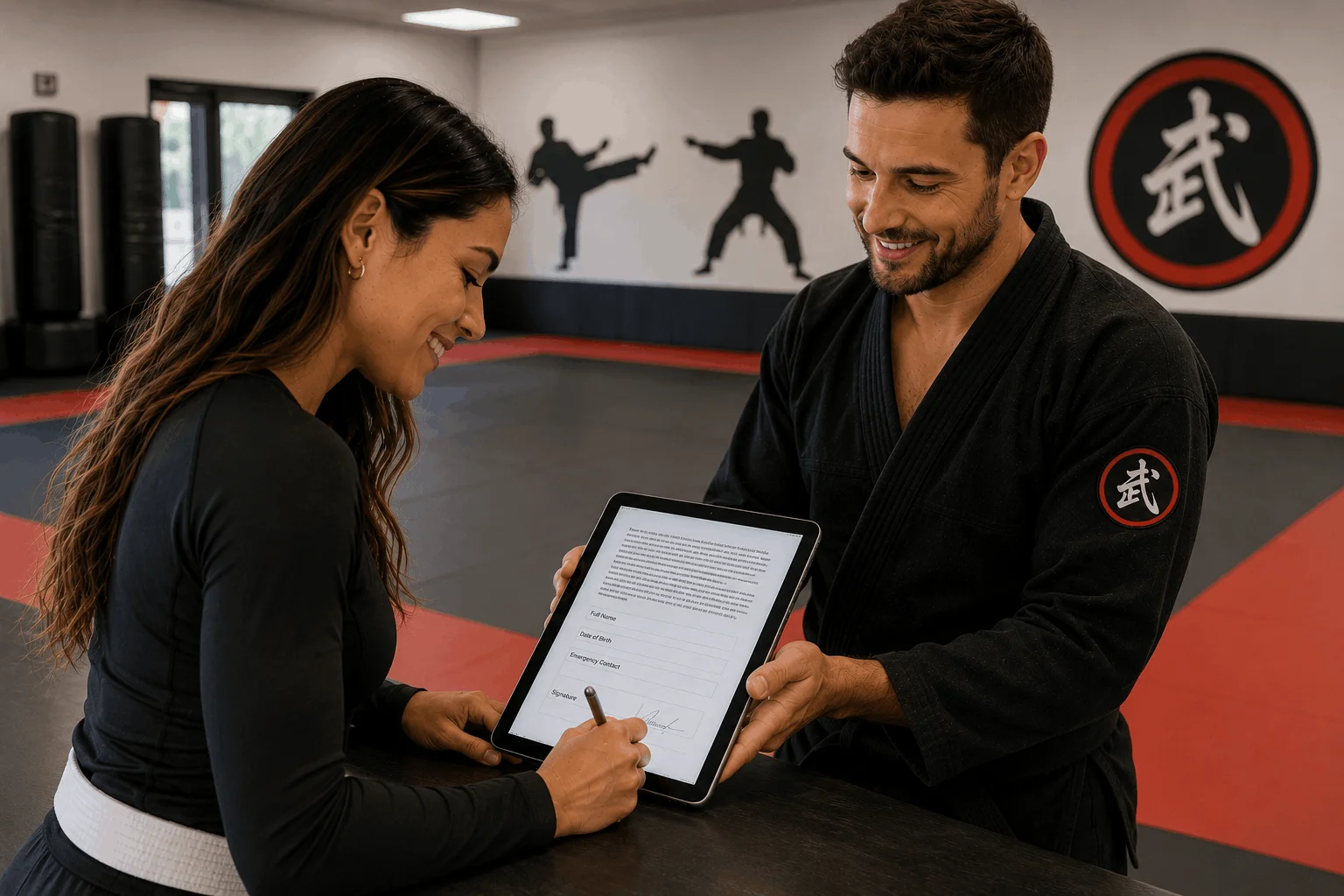
A martial arts waiver is the form a student signs before training at a dojo, academy or gym. It explains the risks of martial arts training, records the student's health and experience, confirms they will follow the instructor's rules, and releases the school from certain claims arising from the ordinary risks of training.
Karate dojos, taekwondo academies, Brazilian jiu-jitsu gyms, MMA gyms, judo clubs, boxing and kickboxing clubs all teach skills that involve striking, throwing, joint locks or chokes. Students range from four-year-olds in a little dragons class to adults preparing for amateur fights, and injuries happen even in well-run classes. That's why almost every martial arts school asks students to sign a waiver before their first class.
This guide covers what a martial arts waiver is, what to include, how to handle sparring, gradings and competitions, waivers for children, a sample structure you can adapt, and how to collect martial arts waivers online before students step on the mat. It is general information, not legal advice. Waiver rules differ between countries and states, so have your final waiver reviewed for where you operate.
What is a martial arts waiver?
A martial arts waiver, also called a martial arts liability waiver, dojo waiver or martial arts release form, is a document in which the student:
- acknowledges the risks of martial arts training, including contact with other students
- discloses health conditions and past injuries that could affect training
- agrees to follow the instructor's directions and the school's rules
- confirms they take part voluntarily
- releases the school from certain claims, to the extent permitted by law
- signs and dates the form, or has a parent or guardian sign for them
Most schools ask members to sign once when they join and keep the waiver on file, with a new signature each year or when the wording changes. Seminars, open mats and trial classes usually need a signed waiver from every visitor, including students from other schools.
Why martial arts schools need a waiver
Even with good instructors, mats and protective gear, contact training can't be made risk free. A clear, signed waiver helps you:
- show that the student was told about the risks of training and sparring
- record health conditions and injuries before the student starts
- record agreement to rules such as tapping out, controlling contact and wearing protective gear
- collect emergency contact details
- keep a record of parental consent for children and teens
- limit certain claims, where local law allows it
A waiver is not a substitute for qualified instructors, safe facilities and insurance. Courts in many places won't enforce a waiver against gross negligence, such as letting an untrained student spar full contact with a much heavier, experienced fighter, or ignoring a suspected concussion. For more on what can undermine a waiver, see what makes a liability waiver invalid.
What should a martial arts waiver include?
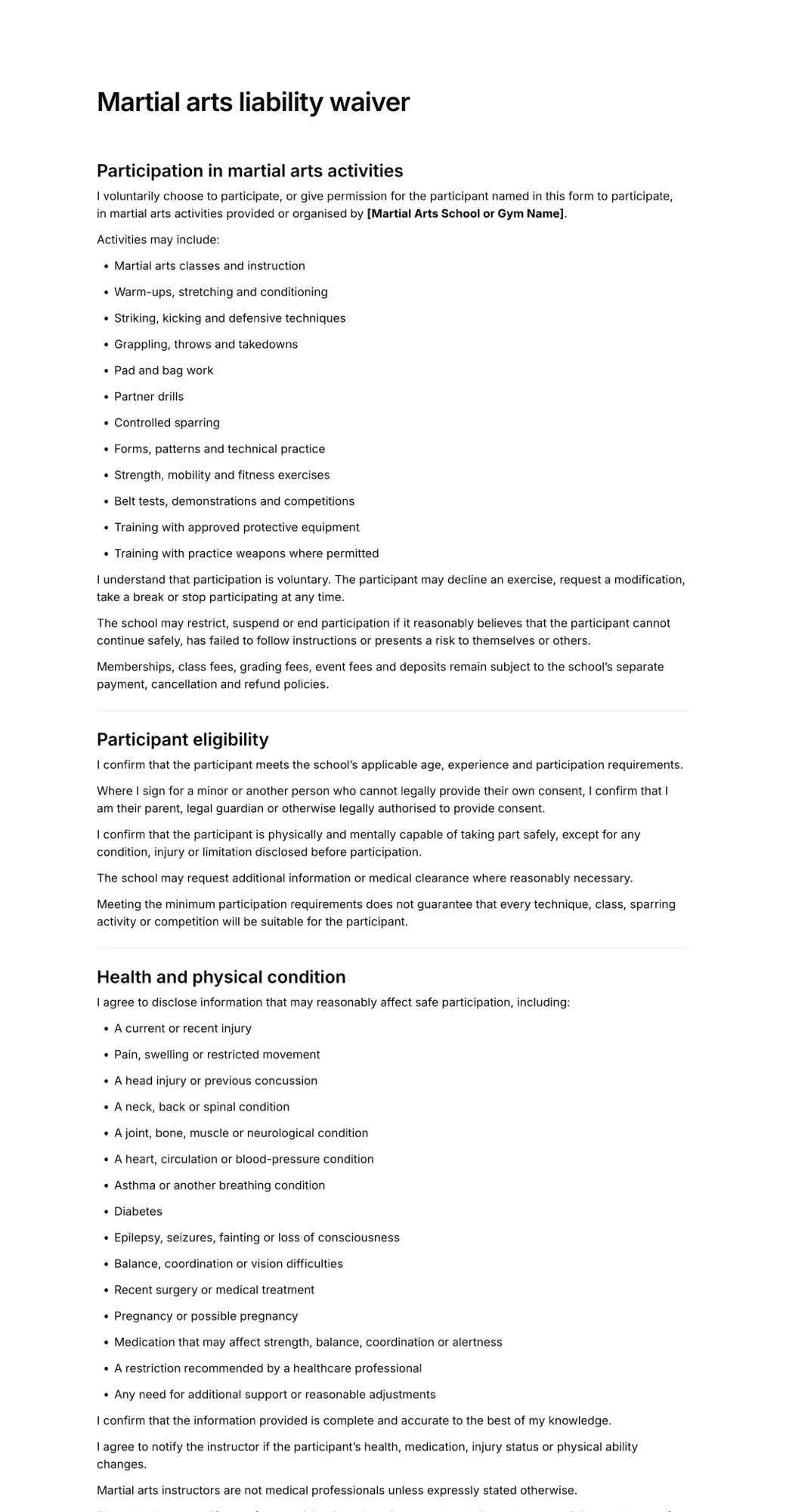
1. Student details
- full name and date of birth
- phone number and email
- emergency contact name and phone number
- current rank or belt, and the school or style they trained in before, if any
- the programme they are joining, for example kids' karate, adult BJJ or competition team
2. Description of activities
Name what the waiver covers so there is no doubt about scope:
- regular classes, drills and conditioning
- partner work, including strikes, throws, takedowns, joint locks and chokes
- sparring and rolling, at whatever contact level your school uses
- belt gradings and testing
- tournaments, competitions and inter-club events
- seminars, open mats, camps and private lessons
- training with weapons, if your style uses them
3. Specific martial arts risks
Generic wording like "physical activity involves risk" is weaker than naming the real risks. A martial arts waiver usually lists:
- bruises, cuts, sprains, strains and dislocations
- broken bones, including fingers, toes, ribs and the nose
- head injuries and concussion from strikes, falls or throws
- joint injuries from locks, and loss of consciousness from chokes
- injuries caused by training partners, including accidental contact
- skin infections such as ringworm, impetigo and staph, especially in grappling arts
- heat exhaustion, dehydration and overexertion
- in rare cases, serious or permanent injury, or death
4. Assumption of risk
The student confirms they understand that martial arts involve physical contact, that injuries can happen even when everyone follows the rules, and that they choose to train anyway. It helps to add that they can stop any drill or round at any time, and that they should tap out or tell their partner and instructor when something hurts.
5. Sparring and contact rules
Sparring is where most serious injuries happen, so set out your rules clearly:
- students only spar when the instructor allows it
- contact level is agreed and controlled, and beginners start with light or no contact
- partners respect the tap and stop immediately
- no strikes to banned targets, such as the back of the head or the groin, unless your style allows it
- students tell the instructor about any head knock, dizziness or headache, and stop training
If you run a separate competition or fight team with harder sparring, consider a separate waiver or an extra section that names the higher level of contact.
6. Protective equipment
State what gear is required and who provides it:
- mouthguard for all sparring
- gloves, shin guards, headgear and groin protection, as your style requires
- a clean uniform or gi for every session
- no jewellery, piercings or watches on the mat
- short, clean fingernails and toenails
7. Hygiene rules
Skin infections spread quickly on shared mats, so many schools include:
- shower before class and wash the gi after every session
- wear footwear off the mat and never walk on the mat in street shoes
- don't train with an open wound, rash or suspected skin infection
- tell the instructor about any contagious condition
8. Health and fitness
Ask students to confirm they are fit to train and to disclose conditions that matter, such as heart conditions, high blood pressure, asthma, epilepsy, diabetes, previous concussions, recent surgery, joint or back problems, or pregnancy. Ask about injuries they are currently training around. Only ask for the health information you actually need, and store it securely. If your gym liability waiver already covers fitness training at your facility, make sure the martial arts waiver adds the contact-specific risks.
9. Release of liability
The release section states which claims the student gives up, to the extent permitted by law. Name the school, its owners, instructors, assistant instructors and volunteers, and keep the wording clear and visible, not buried in small print. Our release of liability form guide explains how release wording works.
10. Medical treatment consent
Allow staff to give first aid and call emergency services if needed, and state who is responsible for medical costs. Many schools also state that a student with a suspected concussion won't be allowed back on the mat until cleared.
11. Photo and video consent
Schools often film gradings, technique videos and competitions for social media. Ask for consent as a separate checkbox rather than bundling it into the release, especially for children.
12. Signature and date
End with an agreement checkbox, the student's signature and the date. For digital waivers, the signing date and time can be recorded automatically.
Martial arts waivers for minors
Children's classes are the core of many martial arts schools, from preschool programmes to teen competition squads. For anyone under 18, or the age of majority where you operate:
- a parent or legal guardian should sign the waiver
- record the child's name, date of birth, rank and any health conditions
- record the guardian's name and contact details, and who can collect the child
- state your rules for children, such as age-appropriate contact, no head contact under a certain age, or matching partners by size and age
Some places limit how far a parent can waive a child's claims, so check local rules. Our guide to waivers for minors covers this in more detail.
Gradings, competitions and seminars
Different events need slightly different paperwork:
- Belt gradings. Gradings often include harder sparring, breaking boards or multiple fights in a row. Make sure your waiver names gradings and testing, or ask students to sign a short grading waiver.
- Competitions. Tournament organisers usually require their own waiver. Your school's waiver should still cover travel with the team, warm-ups and coaching at the event.
- Seminars and open mats. Visiting students and guest instructors haven't signed your membership waiver. Ask every visitor to sign before they train, and record their rank and home school.
- Trial classes. First-timers are the least experienced students on the mat, so a trial class waiver is just as important as a member waiver.
For a general form that covers several sports and activities, see the sports waiver form template. Karate schools can also start from the karate liability waiver template.
Martial arts waiver sample structure
Use this outline as a starting point. Replace the bracketed details with your own and adapt each section to your school, style and location.
Martial Arts Waiver and Release of Liability
School: [School Name], [address], [phone], [email].
Student: full name, date of birth, phone, email, emergency contact, current rank, programme.
Activities: This waiver covers classes, drills, partner work, sparring, gradings, competitions, seminars and other activities with [School Name], on and off the premises.
Risks: I understand that martial arts training involves physical contact and risks, including bruises, sprains, broken bones, concussion, joint injuries, skin infections, injuries caused by training partners and serious injury.
Sparring: I will only spar when the instructor allows it, at the agreed contact level, and I will respect the tap.
Protective equipment: I will wear a mouthguard and any other required protective gear during sparring.
Hygiene: I will train in a clean uniform and won't train with a contagious skin condition or open wound.
Rules: I will follow instructor directions and the school rules, and tell the instructor if I am injured or feel unwell.
Health: I am physically able to train and have disclosed any condition or injury that could affect my safety.
Release: To the extent permitted by law, I release [School Name], its owners, instructors, assistants and volunteers from claims arising from the inherent risks of martial arts training.
Medical consent: I consent to first aid and emergency medical treatment if needed.
Minors: If the student is under [age], their parent or legal guardian signs below.
Agreement: I have read this waiver, understand it, and agree to its terms.
Signature and date.
Common mistakes in martial arts waivers
- Not mentioning sparring. A waiver that talks about "exercise" but never mentions contact, strikes or chokes is easier to challenge after a sparring injury.
- No health questions. Without a record of past concussions or injuries, you can't show the student was asked.
- Forgetting gradings and competitions. Higher-risk events should be named in the waiver.
- Visitors who never sign. Seminar guests and drop-ins are often the ones who skip the paperwork.
- One parent waiver for the whole family. Each child who trains should be named on a signed waiver.
- Old wording on file. Ask students to re-sign each year or when you update your waiver.
- Paper forms in a filing box. A waiver only helps if you can find it when you need it.
Paper vs online martial arts waivers
Paper waivers pile up at the front desk, get lost between the office and the filing cabinet, and slow down trial classes when parents arrive five minutes before the start. With online martial arts waivers:
- students and parents sign on their phone before the first class
- the waiver link goes out automatically with trial class and membership bookings
- seminar guests and drop-ins scan a QR code at the door instead of filling in paper
- you can search every signed waiver by student name and open it in seconds, even at a tournament
See how to create a QR code waiver for setting up a QR code at your school.
How to create a martial arts waiver online
Here is how to set one up with AgreeDock:
Step 1: Start from a template or AI
Open the martial arts waiver or karate liability waiver template, or describe your school to the AI waiver generator to get a draft written for your style, classes and rules.
Step 2: Add your risks and rules
Edit the activities, risks, sparring rules, protective equipment and hygiene rules to match your school and style.
Step 3: Add student fields
Include contact and emergency details, current rank, health questions, a minor and guardian section, a photo consent checkbox, and an agreement checkbox above the signature.
Step 4: Share the link or QR code
Add the signing link to your trial class confirmations and membership sign-up, and display the QR code at the front desk for drop-ins and seminar guests.
Step 5: Check before students step on the mat
Every signed waiver appears in your Signatures list with the student's answers and the exact wording they agreed to, and you can download each one as a PDF.
See how gyms and fitness studios use AgreeDock for waivers and intake forms.
Frequently asked questions
What is a martial arts waiver?
A martial arts waiver is a form students, or their parents, sign before training at a martial arts school. It explains the risks of training and sparring, records health information and agreement to the school's rules, collects emergency details, and releases the school from certain claims to the extent permitted by law.
What should a martial arts waiver include?
Most include student details and emergency contact, the activities covered, specific martial arts risks, an assumption of risk, sparring and contact rules, protective equipment and hygiene rules, health questions, a release of liability, medical treatment consent, optional photo consent, and a signature and date.
Do I need a separate waiver for sparring or competitions?
Not always, but your waiver should clearly name sparring, gradings and competitions if students take part in them. Schools with a competition or fight team often add a separate section or waiver for harder contact. Tournament organisers usually ask for their own waiver too.
Are martial arts waivers enforceable?
Often, but not always. Enforceability depends on local law, how clearly the waiver is written, and what happened. Many courts won't enforce a waiver against gross negligence or reckless conduct, and some places limit waivers more broadly.
Can a parent sign a martial arts waiver for a child?
Yes, a parent or legal guardian should sign for any student under 18, or the age of majority where you operate. Some places limit how far a parent can waive a child's claims, so check local rules.
How often should students sign a martial arts waiver?
Members usually sign when they join, then again each year and whenever the wording changes. Trial students, drop-ins and seminar guests should sign before they train.
Can students sign a martial arts waiver online?
Yes. Electronic signatures are recognised in many countries, including under the ESIGN Act and UETA in the United States. Students and parents can sign on their phone from a booking confirmation or by scanning a QR code at the door, and you keep a signed record of each waiver.