
Example · sample answers
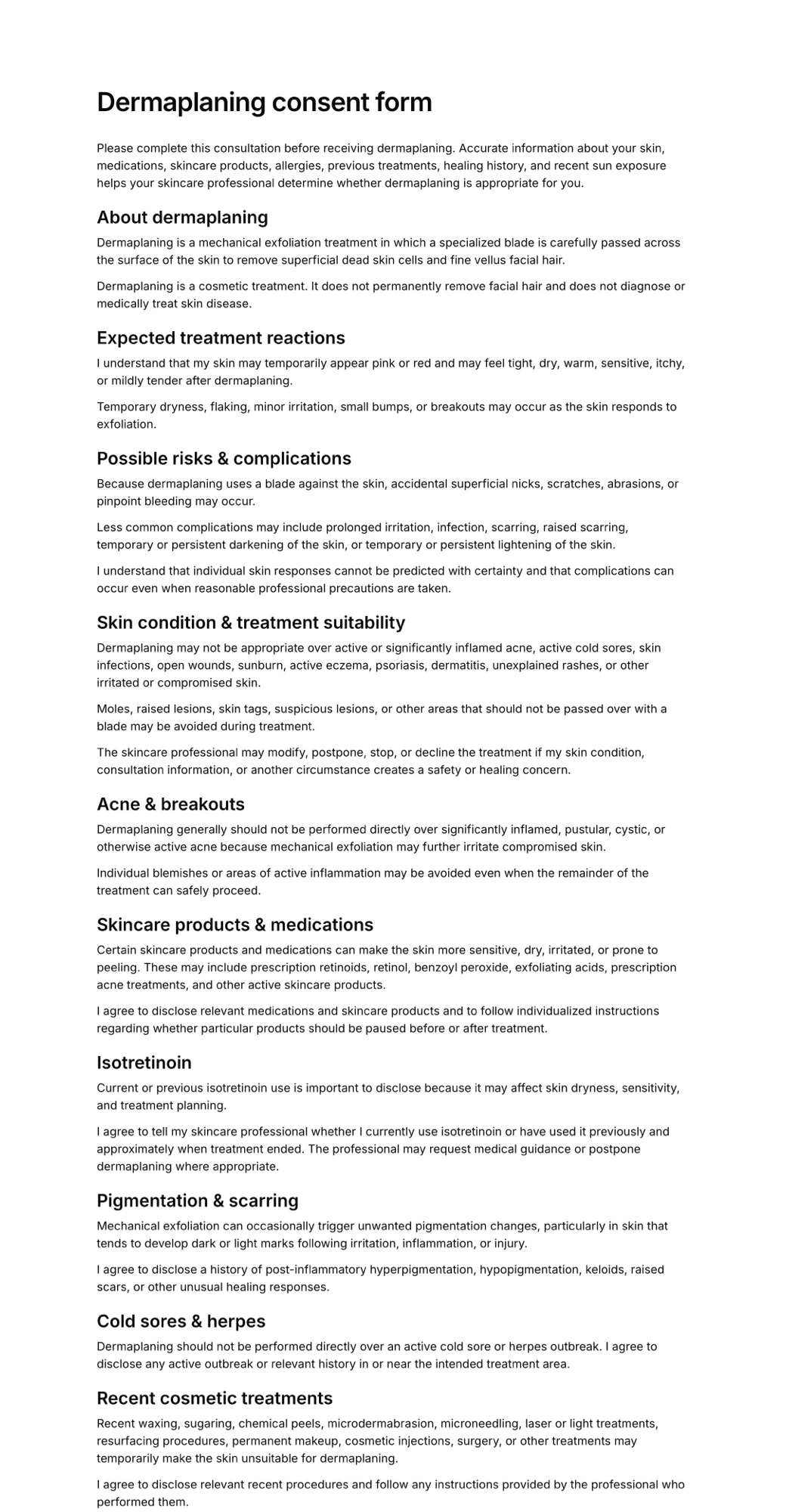
Dermaplaning consent form
Dermaplaning Consent Form
Please complete this consultation before receiving dermaplaning. Accurate information about your skin, medications, skincare products, allergies, previous treatments, healing history, and recent sun exposure helps your skincare professional determine whether dermaplaning is appropriate for you.
About dermaplaning
Dermaplaning is a mechanical exfoliation treatment in which a specialized blade is carefully passed across the surface of the skin to remove superficial dead skin cells and fine vellus facial hair.
Dermaplaning is a cosmetic treatment. It does not permanently remove facial hair and does not diagnose or medically treat skin disease.
Expected treatment reactions
I understand that my skin may temporarily appear pink or red and may feel tight, dry, warm, sensitive, itchy, or mildly tender after dermaplaning.
Temporary dryness, flaking, minor irritation, small bumps, or breakouts may occur as the skin responds to exfoliation.
Possible risks & complications
Because dermaplaning uses a blade against the skin, accidental superficial nicks, scratches, abrasions, or pinpoint bleeding may occur.
Less common complications may include prolonged irritation, infection, scarring, raised scarring, temporary or persistent darkening of the skin, or temporary or persistent lightening of the skin.
I understand that individual skin responses cannot be predicted with certainty and that complications can occur even when reasonable professional precautions are taken.
Skin condition & treatment suitability
Dermaplaning may not be appropriate over active or significantly inflamed acne, active cold sores, skin infections, open wounds, sunburn, active eczema, psoriasis, dermatitis, unexplained rashes, or other irritated or compromised skin.
Moles, raised lesions, skin tags, suspicious lesions, or other areas that should not be passed over with a blade may be avoided during treatment.
The skincare professional may modify, postpone, stop, or decline the treatment if my skin condition, consultation information, or another circumstance creates a safety or healing concern.
Acne & breakouts
Dermaplaning generally should not be performed directly over significantly inflamed, pustular, cystic, or otherwise active acne because mechanical exfoliation may further irritate compromised skin.
Individual blemishes or areas of active inflammation may be avoided even when the remainder of the treatment can safely proceed.
Skincare products & medications
Certain skincare products and medications can make the skin more sensitive, dry, irritated, or prone to peeling. These may include prescription retinoids, retinol, benzoyl peroxide, exfoliating acids, prescription acne treatments, and other active skincare products.
I agree to disclose relevant medications and skincare products and to follow individualized instructions regarding whether particular products should be paused before or after treatment.
Isotretinoin
Current or previous isotretinoin use is important to disclose because it may affect skin dryness, sensitivity, and treatment planning.
I agree to tell my skincare professional whether I currently use isotretinoin or have used it previously and approximately when treatment ended. The professional may request medical guidance or postpone dermaplaning where appropriate.
Pigmentation & scarring
Mechanical exfoliation can occasionally trigger unwanted pigmentation changes, particularly in skin that tends to develop dark or light marks following irritation, inflammation, or injury.
I agree to disclose a history of post-inflammatory hyperpigmentation, hypopigmentation, keloids, raised scars, or other unusual healing responses.
Cold sores & herpes
Dermaplaning should not be performed directly over an active cold sore or herpes outbreak. I agree to disclose any active outbreak or relevant history in or near the intended treatment area.
Recent cosmetic treatments
Recent waxing, sugaring, chemical peels, microdermabrasion, microneedling, laser or light treatments, resurfacing procedures, permanent makeup, cosmetic injections, surgery, or other treatments may temporarily make the skin unsuitable for dermaplaning.
I agree to disclose relevant recent procedures and follow any instructions provided by the professional who performed them.
Sun exposure
Dermaplaning should not be performed over sunburned skin. Recently exfoliated skin may also be more sensitive to environmental exposure during recovery.
I agree to disclose recent significant sun exposure or sunburn and to follow the skincare professional's recommendations regarding sun protection after treatment.
Combined treatments
Dermaplaning may sometimes be combined with a facial, mask, superficial peel, or other skincare treatment. Combining exfoliating procedures may increase skin sensitivity or alter the expected reaction.
Consent to dermaplaning does not automatically authorize a chemical peel, microneedling, laser treatment, or another procedure involving materially different risks. Separate consent should be obtained where appropriate.
Facial hair
Dermaplaning temporarily removes fine vellus hair from the treated area. I understand that this hair will grow back as part of its normal growth cycle and that dermaplaning is not a permanent hair-removal procedure.
Results & expectations
I understand that dermaplaning may temporarily make the skin feel smoother and may improve the appearance of dull or rough surface skin, but individual results vary.
No specific result, improvement in a skin condition, duration of results, or response to treatment has been guaranteed.
Aftercare
I understand that my skin may temporarily be more sensitive following dermaplaning. I agree to follow the written and verbal aftercare instructions provided for my skin and any additional treatments performed.
Aftercare may include gentle cleansing, moisturizing, sun protection, avoiding unnecessary rubbing or exfoliation, and temporarily avoiding retinoids, exfoliating acids, scrubs, or other irritating skincare products.
If I experience increasing pain, significant swelling, blistering, persistent bleeding, spreading redness, signs of infection, significant pigment changes, or another concerning reaction, I understand that I should contact the treatment provider and seek appropriate medical care when necessary.
Client information
Client contact details
- First name
- Jordan
- Last name
- Smith
- Phone
- (555) 014-2298
- jordan.smith@example.com
Date of birth
April 12, 1990
Treatment goals
What are your main reasons for receiving dermaplaning? Select all that apply.
- Remove fine facial hair
- Improve the feel of rough or dry surface skin
- Improve the appearance of dull skin
- Improve the appearance of uneven texture
- Prepare skin for another skincare treatment
- Improve makeup application
- General facial exfoliation
- Other
Describe your skin concerns, goals, or expected result.
Previous dermaplaning
Have you previously received professional dermaplaning?
- No, this is my first treatment
- Yes
- Unsure
Approximate date of your most recent dermaplaning treatment, if applicable
Have you ever experienced prolonged irritation, infection, significant breakouts, pigmentation changes, scarring, or another unexpected reaction after dermaplaning or mechanical exfoliation?
- No
- Yes
- Unsure
If yes or unsure, describe the previous reaction.
None.
Current skin condition
Do any of the following currently apply in or near the treatment area? Select all that apply.
- Inflamed or active acne
- Cystic or pustular acne
- Active cold sore or herpes outbreak
- Eczema
- Psoriasis
- Dermatitis
- Rosacea or significant redness
- Active skin infection
- Open cut, wound, or abrasion
- Rash or unexplained irritation
- Sunburn
- Recently damaged or peeling skin
- Moles, raised lesions, or skin tags in the treatment area
- Suspicious or changing skin lesion
- Other active skin condition
- None of these
Provide details about any current skin condition or area that should be avoided.
None.
Pigmentation & healing
Do any of the following apply to your skin or healing history? Select all that apply.
- Skin commonly develops dark marks after irritation, acne, cuts, or burns
- History of post-inflammatory hyperpigmentation
- History of light areas after skin irritation or injury
- History of keloid scars
- History of raised or hypertrophic scars
- Slow or poor wound healing
- Other unusual healing response
- None of these
Provide details about any pigmentation, scarring, or healing concern selected above.
None.
Cold sores
Do you currently have a cold sore or herpes outbreak in or near the treatment area?
- No
- Yes
- Unsure
Current skincare
Which active skincare products are you currently using in the treatment area? Select all that apply.
- Prescription retinoid such as tretinoin
- Retinol or over-the-counter retinoid
- Glycolic or lactic acid
- Salicylic acid
- Other exfoliating acids
- Benzoyl peroxide
- Prescription acne treatment
- Hydroquinone or another pigmentation treatment
- Physical scrub or exfoliating device
- Other active skincare
- None of these
List relevant skincare products or active ingredients and when you most recently used them.
None.
Medications & health considerations
List medications, medical treatments, or health conditions that may affect your skin, bleeding, sensitivity, or healing and that your skincare professional should know about.
Are you currently taking, or have you previously taken, isotretinoin for acne?
- Never used isotretinoin
- Currently taking isotretinoin
- Previously used isotretinoin
- Unsure
If previously used, approximately when was your last isotretinoin dose?
None.
Do you take medication that increases bleeding or bruising?
- No
- Yes
- Unsure
Has a healthcare professional advised you to avoid or postpone exfoliating or skin-resurfacing treatments?
- No
- Yes
- Unsure
If yes or unsure, provide any relevant guidance or restrictions.
None.
Allergies & sensitivities
Do you have any known allergies or sensitivities relevant to the facial products that may be used with this treatment?
- No known allergies or sensitivities
- Yes
- Unsure
List relevant allergies, sensitivities, or previous reactions to skincare, cosmetics, antiseptics, adhesives, latex, or other treatment products.
None.
Recent cosmetic treatments
Have you recently received any of the following in or near the intended treatment area? Select all that apply.
- Facial waxing or sugaring
- Chemical peel
- Microdermabrasion
- Previous dermaplaning
- Microneedling
- Laser or IPL treatment
- Radiofrequency or other energy-based treatment
- Permanent makeup or cosmetic tattooing
- Botulinum toxin treatment
- Dermal filler
- Facial surgery or medical procedure
- Other professional skin treatment
- None of these
Provide the type and approximate date of any recent treatment selected above.
Sun exposure
Has the treatment area recently had significant sun exposure or sunburn?
- No
- Significant recent sun exposure
- Currently sunburned
- Unsure
If applicable, provide approximate dates and details of recent sun exposure or sunburn.
None.
Combined treatment
Is another treatment planned during the same appointment?
- No — dermaplaning only
- Standard facial or mask
- Chemical peel
- Another exfoliating treatment
- Other treatment
- Unsure
If another treatment is planned, describe it and any separate consent that applies.
None.
Additional information
Is there anything else your skincare professional should know before beginning dermaplaning?
None.
Acknowledgment & consent
I confirm that I have disclosed relevant skin conditions, medications, skincare products, allergies, previous treatments, scarring or pigmentation concerns, and recent sun exposure to the best of my knowledge.
I understand that dermaplaning mechanically exfoliates the skin and may cause temporary redness, sensitivity, dryness, tightness, irritation, flaking, or breakouts.
I understand that the use of a blade creates a risk of superficial nicks, scratches, abrasions, or pinpoint bleeding.
I understand that less common complications may include infection, scarring, prolonged irritation, hyperpigmentation, or hypopigmentation.
I understand that dermaplaning should not be performed directly over active infection, open wounds, sunburn, active cold sores, significantly inflamed acne, or other skin that the professional considers unsuitable.
I understand that retinoids, exfoliating acids, benzoyl peroxide, acne treatments, and other active skincare products may increase skin sensitivity and have disclosed relevant products.
I understand that dermaplaning temporarily removes fine facial hair and that the hair will grow again as part of its normal growth cycle.
I understand that individual results vary and that no specific skin improvement, appearance, or duration of results has been guaranteed.
I understand that my skincare professional may avoid particular areas, modify the treatment, stop treatment, postpone it, or decline it if they believe proceeding could create an unreasonable risk.
I agree to tell my skincare professional immediately if I experience significant pain, burning, or another unexpected sensation during treatment.
I agree to follow the aftercare instructions provided, including recommendations concerning gentle skincare, active ingredients, exfoliation, moisturizing, and sun protection.
I understand that consent to dermaplaning does not automatically include consent to a chemical peel, microneedling, laser procedure, or another treatment involving materially different risks.
I have had the opportunity to discuss the treatment, expected results, relevant risks, alternatives, and aftercare with my skincare professional and voluntarily consent to dermaplaning.
Client signature