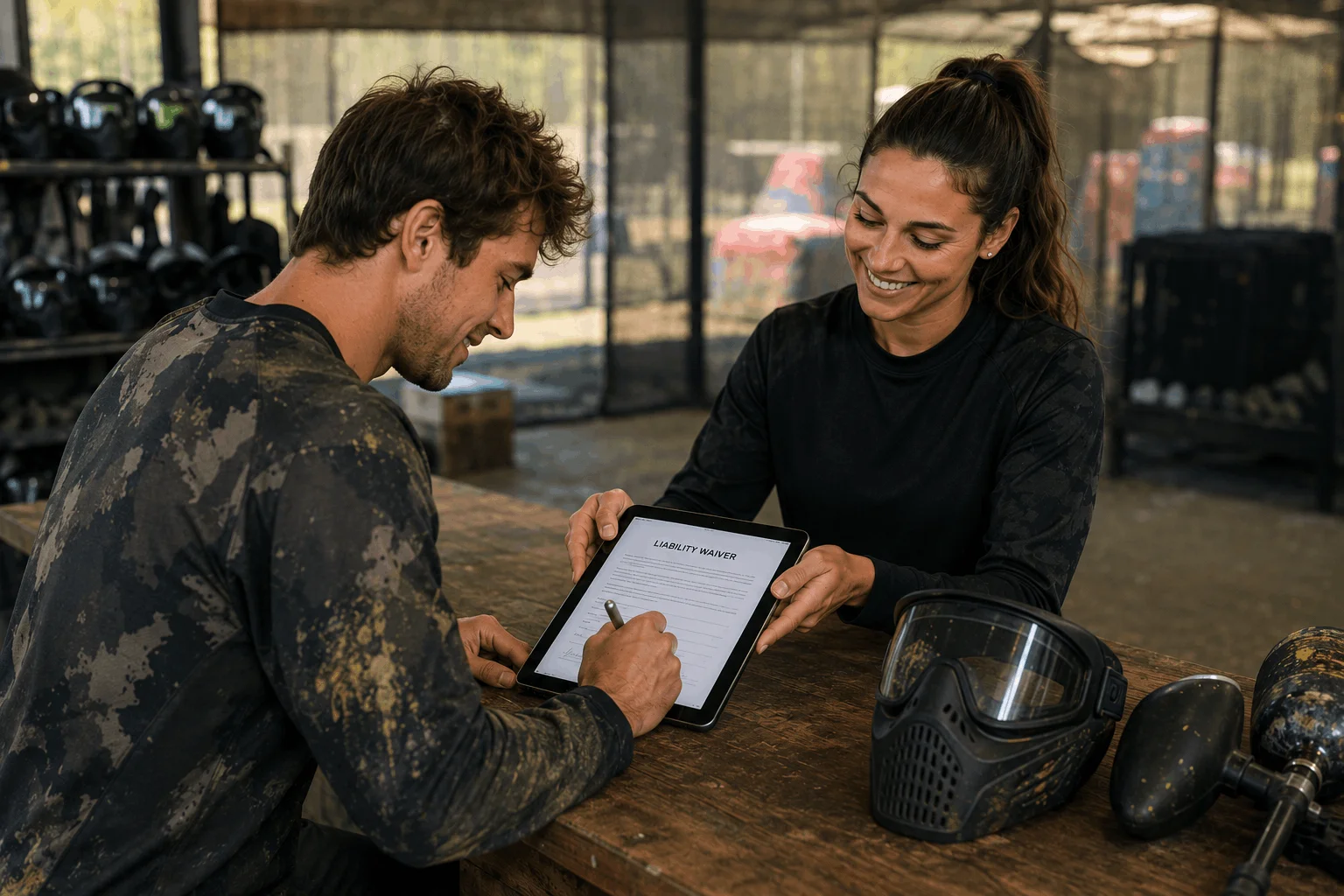
A paintball waiver is the form a player signs before playing at a paintball field or park. It explains the risks of paintball, confirms the player will wear a mask and follow the field rules, records health and emergency details, and releases the field from certain claims arising from the ordinary risks of the game.
Outdoor woodland fields, indoor arenas, speedball parks and mobile paintball operators all put players in fast-moving games where paintballs travel at close to 300 feet per second. Most injuries are bruises, welts and twisted ankles, but a paintball to an unprotected eye can cause permanent damage. That's why almost every paintball field asks every player to sign a waiver before they get a marker.
This guide covers what a paintball waiver is, what to include, how to handle rental equipment, groups and children, a sample structure you can adapt, and how to collect paintball waivers online before players arrive. It is general information, not legal advice. Waiver rules differ between countries and states, so have your final waiver reviewed for where you operate.
What is a paintball waiver?
A paintball waiver, also called a paintball liability waiver or paintball release form, is a document in which the player:
- acknowledges the risks of playing paintball, including being hit by paintballs
- agrees to wear a mask at all times in the playing area
- confirms they will follow the field rules and the referees' directions
- discloses health conditions that could affect their safety
- confirms they take part voluntarily
- releases the field from certain claims, to the extent permitted by law
- signs and dates the form, or has a parent or guardian sign for them
Walk-on players, group bookings, birthday parties and corporate events usually all sign the same waiver. Some fields keep a signed waiver on file for regulars and ask them to re-sign each year or when the wording changes.
Why paintball fields need a waiver
Even with good referees, chronographed markers and well-maintained masks, paintball can't be made risk free. A clear, signed waiver helps you:
- show that the player was told about the risks of the game
- record agreement to mask rules, velocity limits and no-shoot zones
- record health conditions before the player goes on the field
- collect emergency contact details
- keep a record of parental consent for children and teens
- limit certain claims, where local law allows it
A waiver is not a substitute for safe equipment, trained referees and insurance. Courts in many places won't enforce a waiver against gross negligence, such as handing out cracked masks, letting markers shoot far above the field's velocity limit, or ignoring players who take their mask off on the field. For more on what can undermine a waiver, see what makes a liability waiver invalid.
What should a paintball waiver include?
1. Player details
- full name and date of birth
- phone number and email
- emergency contact name and phone number
- booking or group name, if they are part of a party or event
- whether they are using rental equipment or their own
2. Description of activities
Name what the waiver covers so there is no doubt about scope:
- paintball games on all fields and in all game zones
- walking and running on uneven ground, through woods, buildings and obstacles
- use of rental markers, masks, hoppers, air tanks and other equipment
- use of personal equipment brought by the player
- low-impact paintball, gel ball or children's games, if you offer them
- staging areas, the chrono station, car parks and other areas of the site
3. Specific paintball risks
Generic wording such as "physical activity carries some risk" is weaker than naming what can actually happen. Common paintball risks include:
- being hit by paintballs, causing bruises, welts and broken skin
- eye injury, hearing damage or dental injury if a mask is removed or fails
- slips, trips and falls on wet, muddy or uneven ground
- collisions with other players, trees, bunkers and obstacles
- sprains, strains and broken bones from running and diving
- heat exhaustion, dehydration or cold-related illness
- allergic reactions, including to paint fill
- injury from compressed air or CO2 tanks if mishandled
- insect bites and contact with plants in woodland fields
4. Assumption of risk
State that the player understands these risks, accepts them voluntarily, and knows that some risks can't be removed without changing the nature of the game.
5. Mask and safety rules
Mask rules are the most important part of any paintball waiver. Most fields include:
- masks must be worn at all times in the playing area and anywhere markers are uncovered
- never lift or remove the mask on the field, even to clean it; leave the field first
- barrel covers or barrel socks must be on whenever the player leaves the field
- no shooting in the staging area, car park or any no-shoot zone
- markers must pass the chronograph and stay under the field's velocity limit
- minimum shooting distance and surrender rules for close range
- no blind firing, overshooting or shooting players who are out
- no alcohol or drugs before or during play
6. Rental and personal equipment
If you rent out markers, masks and air, state that the player must:
- inspect equipment before use and report any damage
- use it only as instructed by staff
- return it in the same condition, apart from normal wear
- pay for loss or damage caused by misuse, if that is your policy
If players bring their own markers, state that personal equipment must be chronographed before play and that the field can refuse equipment it considers unsafe. For longer rentals or gear that leaves the site, see our equipment rental agreement guide.
7. Health and fitness
Ask players to confirm they are fit to play and to disclose conditions that matter, such as heart conditions, asthma, epilepsy, recent surgery, joint problems or pregnancy. Many fields advise pregnant players not to take part. Only ask for the health information you actually need, and store it securely.
8. Release of liability
The release section states which claims the player gives up, to the extent permitted by law. Name the field, its owners, staff, referees and volunteers, and keep the wording clear and visible, not buried in small print. Our release of liability form guide explains how release wording works.
9. Medical treatment consent
Allow staff to give first aid and call emergency services if needed, and state who is responsible for medical costs.
10. Photo and video consent
Fields often film games and take group photos for social media. Ask for consent as a separate checkbox rather than bundling it into the release, especially for children.
11. Signature and date
End with an agreement checkbox, the player's signature and the date. For digital waivers, the signing date and time can be recorded automatically.
Paintball waivers for minors
Birthday parties and youth groups make up a large share of bookings at many fields. For any player under 18, or the age of majority where you operate:
- a parent or legal guardian should sign the waiver
- record the child's name, date of birth and any health conditions
- record the guardian's name and contact details
- state your minimum age and any rules for younger players, such as low-impact paintball, adult supervision or separate games for children
Some places limit how far a parent can waive a child's claims, so check local rules. Our guide to waivers for minors covers this in more detail.
Groups, parties and corporate events
Group bookings are where waivers most often go missing. A few habits help:
- Send the link with the booking. Ask the organiser to forward the waiver link to every player, so people sign before they arrive instead of queueing at the gate.
- One waiver per player. A single signature from the organiser doesn't cover everyone else in the group. Each player, or each child's parent, should sign.
- Check before the safety briefing. Match signed waivers against the booking list before anyone gets a marker.
- Stag and hen parties. Remind groups about your alcohol rules when they book, and state in the waiver that staff can refuse anyone who appears intoxicated.
If you also run laser tag or other attractions, see the laser tag waiver and adventure park waiver templates. Our trampoline park waiver guide covers a similar walk-in and party setup.
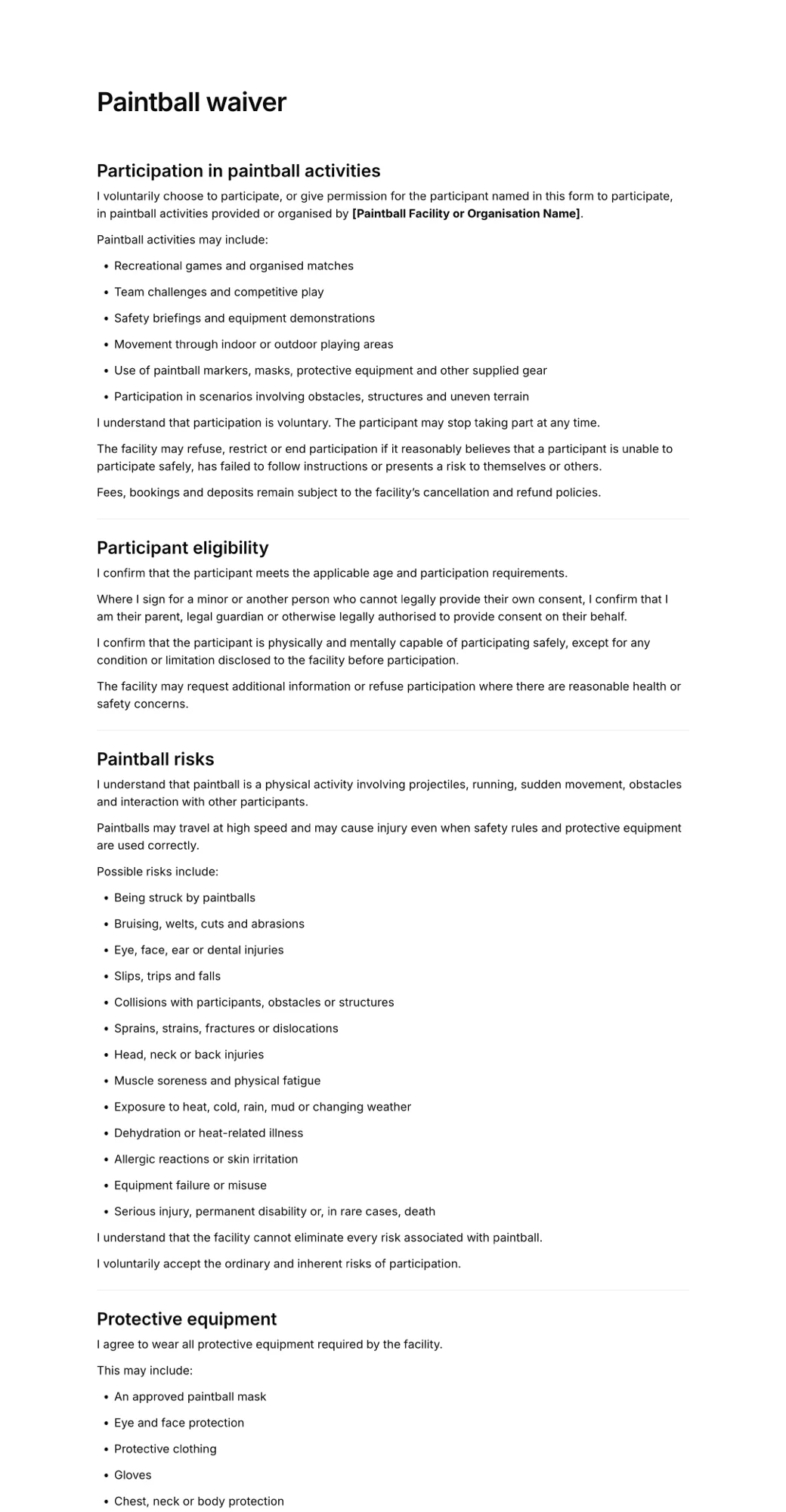
Paintball waiver sample structure
Use this outline as a starting point. Replace the bracketed details with your own and adapt each section to your field and location.
Paintball Waiver and Release of Liability
Field: [Field Name], [address], [phone], [email].
Player: full name, date of birth, phone, email, emergency contact, booking or group name.
Activities: This waiver covers paintball games, the use of rental and personal equipment, and all other activities at [Field Name].
Risks: I understand that paintball involves risks, including bruises and welts from paintballs, eye and dental injury, slips and falls, collisions, sprains, broken bones, heat illness and serious injury.
Masks: I will wear a mask at all times in the playing area and won't remove it until I have left the field.
Field rules: I will follow the referees' directions, keep my marker under the velocity limit, use a barrel cover off the field, and won't shoot in no-shoot zones.
Equipment: I will inspect any rental equipment before use, report damage, and use it only as instructed.
Health: I am physically able to play and have disclosed any condition that could affect my safety.
Alcohol and drugs: I am not under the influence of alcohol or drugs.
Release: To the extent permitted by law, I release [Field Name], its owners, staff, referees and volunteers from claims arising from the inherent risks of paintball.
Medical consent: I consent to first aid and emergency medical treatment if needed.
Minors: If the player is under [age], their parent or legal guardian signs below.
Agreement: I have read this waiver, understand it, and agree to its terms.
Signature and date.
Common mistakes in paintball waivers
- Vague mask rules. "Wear safety equipment" is weaker than "never remove your mask in the playing area".
- Not naming paintball risks. A waiver that never mentions being hit by paintballs or eye injury is easier to challenge.
- One signature for the whole group. Every player should sign their own waiver.
- Ignoring personal equipment. Players who bring their own markers should still agree to chrono and field rules.
- No minimum age or parent signature. Children's parties need a guardian signature for every child.
- Old wording on file. Ask regulars to re-sign each year or when you update your waiver.
- Paper forms that get wet and muddy. A waiver only helps if you can find and read it later.
Paper vs online paintball waivers
Paper waivers slow down check-in when a group of 20 arrives at once, get rained on in the staging area, and are hard to find months later. With online paintball waivers:
- players and parents sign on their phone before they arrive
- the waiver link goes out automatically with every booking
- walk-ons scan a QR code at the gate instead of filling in paper
- you can search every signed waiver by player name and open it in seconds
See how to create a QR code waiver for setting up a QR code at your field.
How to create a paintball waiver online
Here is how to set one up with AgreeDock:
Step 1: Start from a template or AI
Open the paintball waiver template, or describe your field to the AI waiver generator to get a draft written for your games, equipment and rules.
Step 2: Add your risks and rules
Edit the activities, risks, mask rules, velocity limits and equipment terms to match your field.
Step 3: Add player fields
Include contact and emergency details, booking or group name, health questions, a minor and guardian section, a photo consent checkbox, and an agreement checkbox above the signature.
Step 4: Share the link or QR code
Add the signing link to your booking confirmations and party invitations, and display the QR code at the gate for walk-on players.
Step 5: Check before the safety briefing
Every signed waiver appears in your Signatures list with the player's answers and the exact wording they agreed to, and you can download each one as a PDF.
See how activity businesses use AgreeDock for waivers.
Frequently asked questions
What is a paintball waiver?
A paintball waiver is a form players, or their parents, sign before playing at a paintball field. It explains the risks of paintball, records agreement to mask and field rules, collects health and emergency details, and releases the field from certain claims to the extent permitted by law.
What should a paintball waiver include?
Most include player details and emergency contact, the activities covered, specific paintball risks, an assumption of risk, mask and safety rules, rental and personal equipment terms, health questions, a release of liability, medical treatment consent, optional photo consent, and a signature and date.
Does every player in a group need to sign?
Yes. A waiver signed by the organiser covers only the organiser. Each player should sign their own waiver, and a parent or guardian should sign for each child.
Are paintball waivers enforceable?
Often, but not always. Enforceability depends on local law, how clearly the waiver is written, and what happened. Many courts won't enforce a waiver against gross negligence, such as providing damaged masks or ignoring safety rules, and some places limit waivers more broadly.
Can a parent sign a paintball waiver for a child?
Yes, a parent or legal guardian should sign for any player under 18, or the age of majority where you operate. Some places limit how far a parent can waive a child's claims, so check local rules.
Can players sign a paintball waiver online?
Yes. Electronic signatures are recognised in many countries, including under the ESIGN Act and UETA in the United States. Players and parents can sign on their phone from a booking confirmation or by scanning a QR code at the gate, and you keep a signed record of each waiver.