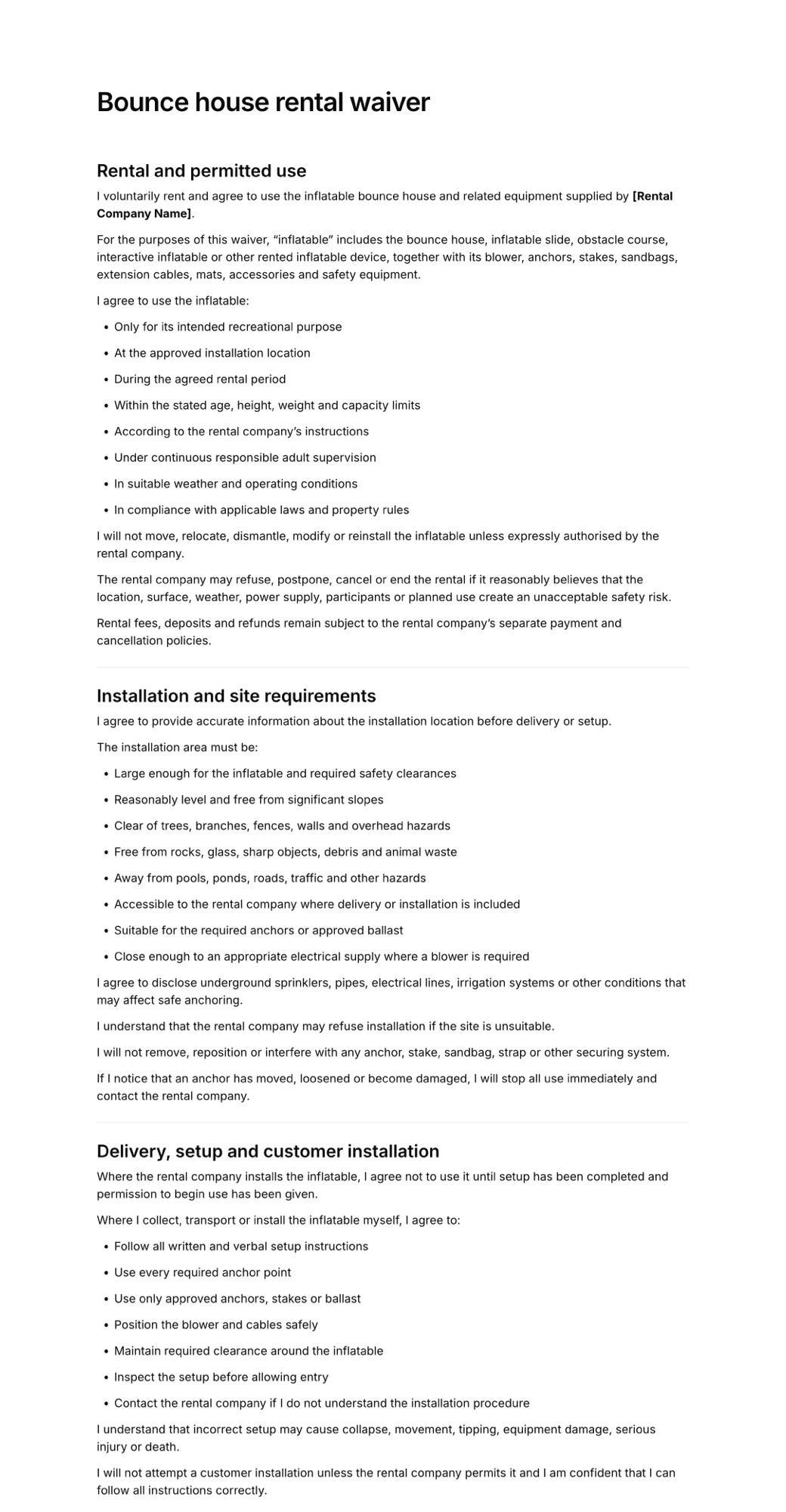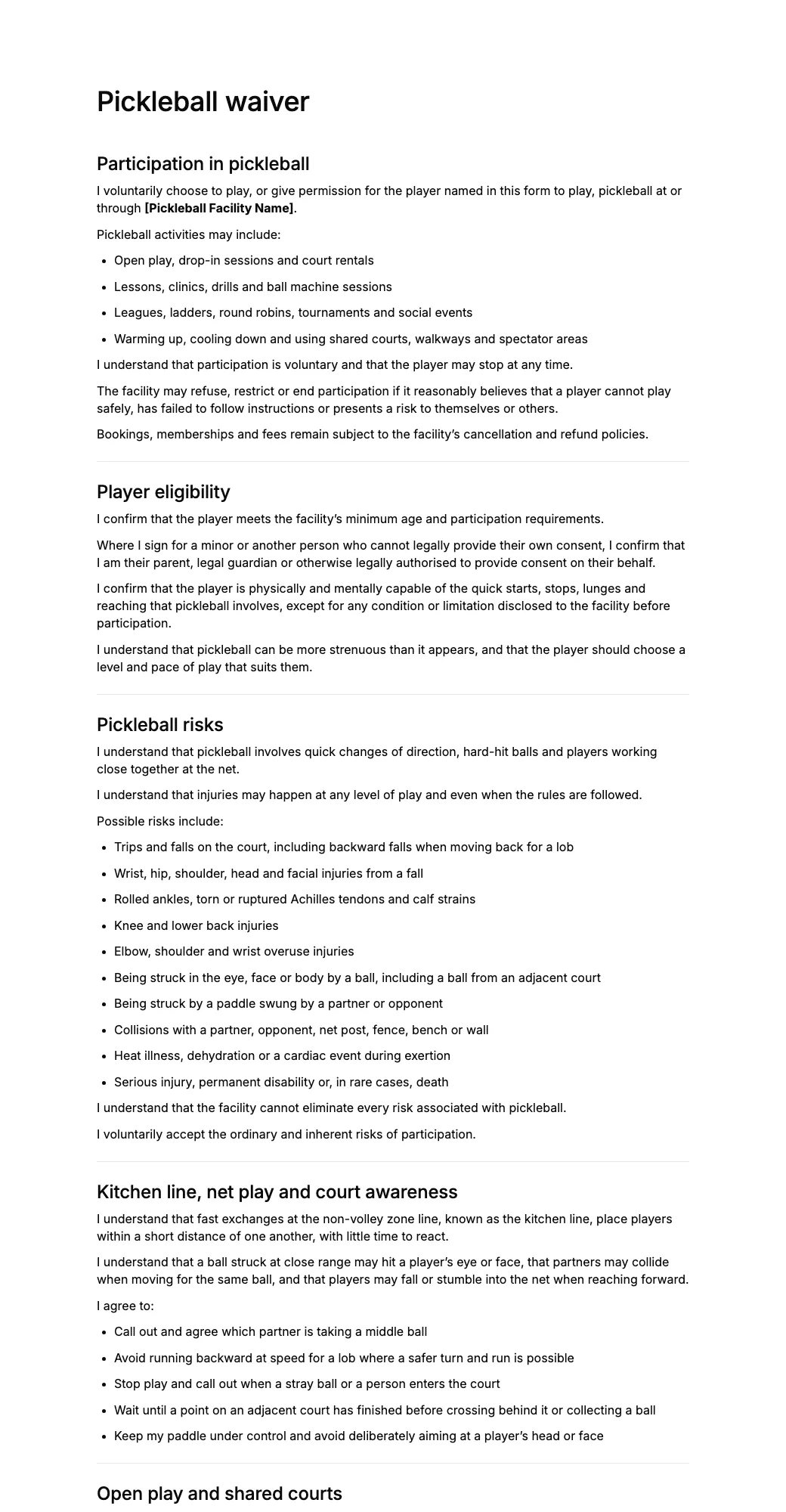
A pickleball waiver is the form a player signs before using courts, joining open play, taking a lesson or entering a league or tournament. It explains the physical risks of pickleball, records health information and emergency contacts, confirms the player will follow court rules and etiquette, and releases the club or facility from certain claims arising from the ordinary risks of the game.
Pickleball is easy to learn, which is exactly why it attracts so many new players. It's also why injuries are common. Players who haven't moved quickly in years lunge for dinks, backpedal for lobs and collide with partners at the kitchen line. Ankle sprains, falls, wrist fractures, Achilles injuries and eye injuries from fast balls all show up regularly. A clear, signed waiver gives your club or facility a record that players understood the risks and agreed to your rules before stepping on court.
This guide covers what a pickleball waiver is, what to include, how open play, leagues, lessons and tournaments differ, how to handle juniors, a sample structure you can adapt, and how to collect waivers online. It is general information, not legal advice. Waiver rules differ between countries and states, so have your final waiver reviewed for where you operate.
What is a pickleball waiver?
A pickleball waiver, also called a pickleball liability waiver, pickleball release form or court waiver, is a document in which the player:
- confirms the sessions, programs or events they're signing up for
- acknowledges the physical risks of playing pickleball
- agrees to follow court rules, etiquette and staff instructions
- discloses health conditions relevant to strenuous exercise
- consents to emergency medical treatment if needed
- releases the club, facility or organizer from certain claims, to the extent permitted by law
- signs and dates the form
Many clubs combine the waiver with membership sign-up or court booking, so players complete registration, rules and the release in one step.
Who needs a pickleball waiver?
Any organization that lets people play on its courts or runs pickleball programs should consider one:
- dedicated indoor pickleball facilities and franchises
- tennis and racquet clubs that converted or lined courts for pickleball
- community centers, HOAs and parks departments running open play
- gyms, YMCAs and country clubs with pickleball courts
- coaches and academies offering clinics and private lessons
- league organizers and tournament directors
- retirement and 55+ communities with resident courts
- bars and entertainment venues with social pickleball
Why pickleball facilities need a waiver
A waiver doesn't replace safe courts, good lighting or insurance, but it does several useful jobs:
- Shows informed consent. It records that players were told about the risks of pickleball before playing.
- Collects health information. Many players are older adults, so knowing about heart conditions, joint replacements or balance issues matters.
- Records emergency contacts. You have someone to call if a player falls or collapses during open play.
- Sets expectations. Court rotation, paddle stacking, footwear and conduct rules are agreed in writing.
- Limits certain claims. Where local law allows, a well-written release can reduce exposure for ordinary injuries.
Courts in many places won't enforce a waiver against gross negligence, such as ignoring a known wet patch on an indoor court or a broken fence panel. For what can undermine a waiver, see what makes a liability waiver invalid.
What should a pickleball waiver include?
1. Player details
Collect the player's full name, date of birth, phone and email. Add a skill rating field (self-rated or DUPR) if you use it to group players. For juniors, add the parent or guardian's name and contact details.
2. Activities covered
Describe what the waiver covers. A broad but specific list helps avoid gaps:
- open play and drop-in sessions
- court reservations and private play
- beginner clinics, group lessons and private coaching
- leagues, ladders and round robins
- tournaments and exhibition matches
- ball machine and drill sessions
- social events held at the facility
3. Specific risks
Generic wording like "sports involve risk" is weaker than naming the risks. Common pickleball injuries include:
- ankle sprains and knee injuries from quick lateral movement
- falls, especially when backpedaling for lobs
- wrist, hip and shoulder fractures from falls
- Achilles tendon and calf strains
- tennis or pickleball elbow and other overuse injuries
- eye injuries from balls or paddles at close range
- collisions with partners, opponents, nets, posts or fences
- slips on wet, dusty or uneven court surfaces
- heat illness, dehydration and sun exposure on outdoor courts
- cardiac events and exertion-related illness
4. Eye protection
Eye injuries are one of the more serious pickleball risks because players stand close together at the kitchen line. Include a clear statement that protective eyewear is recommended, or required for juniors or certain programs if that's your policy, and that the player chooses whether to wear it.
5. Assumption of risk
A short statement where the player confirms they understand the risks above, that pickleball is physically demanding, and that they choose to take part voluntarily and at their own pace.
6. Health and fitness
Ask about:
- heart conditions, high blood pressure or recent surgery
- joint replacements, balance issues or osteoporosis
- asthma, diabetes or other conditions staff should know about
- recent or ongoing injuries
- medications that affect balance or exertion
Include a commitment to tell the facility if anything changes, and a statement that the player has consulted a doctor if they have any doubts about exercising. Keep questions focused on safe participation and store answers securely.
7. Court rules and etiquette
Reference the rules players must follow, such as:
- court-appropriate, non-marking shoes (no running shoes on indoor courts if that's your rule)
- paddle stacking and court rotation during open play
- waiting for play to stop before crossing behind courts
- calling "ball on court" and stopping play for stray balls
- no hanging on nets or leaning on posts
- reporting wet spots, damaged surfaces or hazards to staff
- respectful conduct and no abusive language
8. Equipment and loaner gear
If you lend paddles, balls or eyewear, state that players should inspect them before use and report damage. Players using their own gear are responsible for its condition. If you rent equipment, our gear rental agreement template covers deposits and damage.
9. Photo and video consent
Clubs post tournament photos, league results and highlight clips. Ask for photo and video consent as a separate checkbox, so players can opt out without refusing the whole waiver. Our photo consent form template covers this in more detail.
10. Medical treatment consent
Authorize staff to provide first aid, call emergency services and seek treatment if the player is hurt and can't consent. Many facilities also note whether an AED is on site.
11. Release of liability
The release states which claims the player gives up, to the extent permitted by law. Name the club, facility owner, staff, coaches, volunteers and any landlord or municipality that owns the courts. Keep the wording clear, visible and in plain language. Our release of liability form guide explains how release wording works.
12. Signature and date
Collect the player's signature, or a parent or guardian's for anyone under 18, with the date. An electronic signature with a timestamp is easier to store and find than a clipboard of paper forms.
Open play, leagues, lessons and tournaments
Different programs bring different risks and different people, so make sure your waiver covers each one.
- Open play and drop-ins. The highest volume of new, one-time players. Make signing fast with a QR code at the door, and check before players join the paddle stack.
- Lessons and clinics. Coaches run drills that push players to move more than usual. Name coaches and contractors in the release.
- Leagues and ladders. Regular players sign once per season. Use the renewal to refresh health information and contacts.
- Tournaments. Out-of-town players, guests, volunteers and spectators. Collect waivers at registration, not at check-in on the morning of the event. If you also host spectators or social events, the event liability waiver template works for attendees.
If you rent courts from a city, school or club, the property owner may require its own waiver or ask to be named in yours. Check before your season starts.
Junior pickleball waivers
Pickleball is growing fast in schools and youth programs. For junior players:
- collect the parent or guardian's full name, relationship and contact details
- have the guardian sign on the child's behalf
- include medical treatment consent signed by the guardian
- consider requiring protective eyewear for all juniors
- list who can pick up younger children after camps or clinics
Some places limit how far a parent can waive a child's injury claims, so the release may not be enforceable everywhere. The waiver is still valuable for informed consent, health information and rule agreement. Our guide to waivers for minors covers this in more detail.
Pickleball waiver sample structure
Here's a simple structure you can adapt:
- Club name and title: "Pickleball Waiver and Release of Liability"
- Player information: name, date of birth, contact details, skill rating
- Parent or guardian information: for players under 18
- Activities covered: open play, lessons, leagues, tournaments
- Risks of pickleball: a specific list for your courts
- Eye protection statement: recommended or required
- Assumption of risk: voluntary participation statement
- Health information: conditions, injuries, medications
- Court rules and etiquette: footwear, rotation, safety rules
- Photo and video consent: separate yes or no checkbox
- Medical treatment consent: permission for emergency care
- Release of liability: clear, visible release wording
- Emergency contact: name, relationship, phone
- Signature and date: player or guardian
The pickleball waiver template follows this structure and can be edited for your courts and programs. For multi-sport facilities, the sports waiver form is a broader starting point.
Common mistakes in pickleball waivers
- Using a tennis waiver as-is. It won't mention the kitchen line, close-range volleys or paddle stacking.
- Skipping eye protection. Eye injuries are one of the most serious risks and deserve their own line.
- Ignoring older players' health. A waiver with no health questions misses the information staff need most.
- Only covering reservations. A waiver that says "court rental" may not cover clinics, leagues or tournaments.
- Forgetting the property owner. If you run on city or school courts, they may need to be named too.
- Paper forms at the door. Clipboards slow down open play and create incomplete, unreadable forms.
Paper vs online pickleball waivers
Open play brings dozens of players through the door in the first ten minutes. Paper waivers create a queue at the desk, missing fields and a growing box of forms. Online waivers work better for most clubs:
- players sign on their phone before arriving, or by scanning a QR code at the door
- required fields stop incomplete forms
- you can search signed waivers by player name in seconds
- tournament directors collect waivers during registration
- renewals are easy at the start of each league season
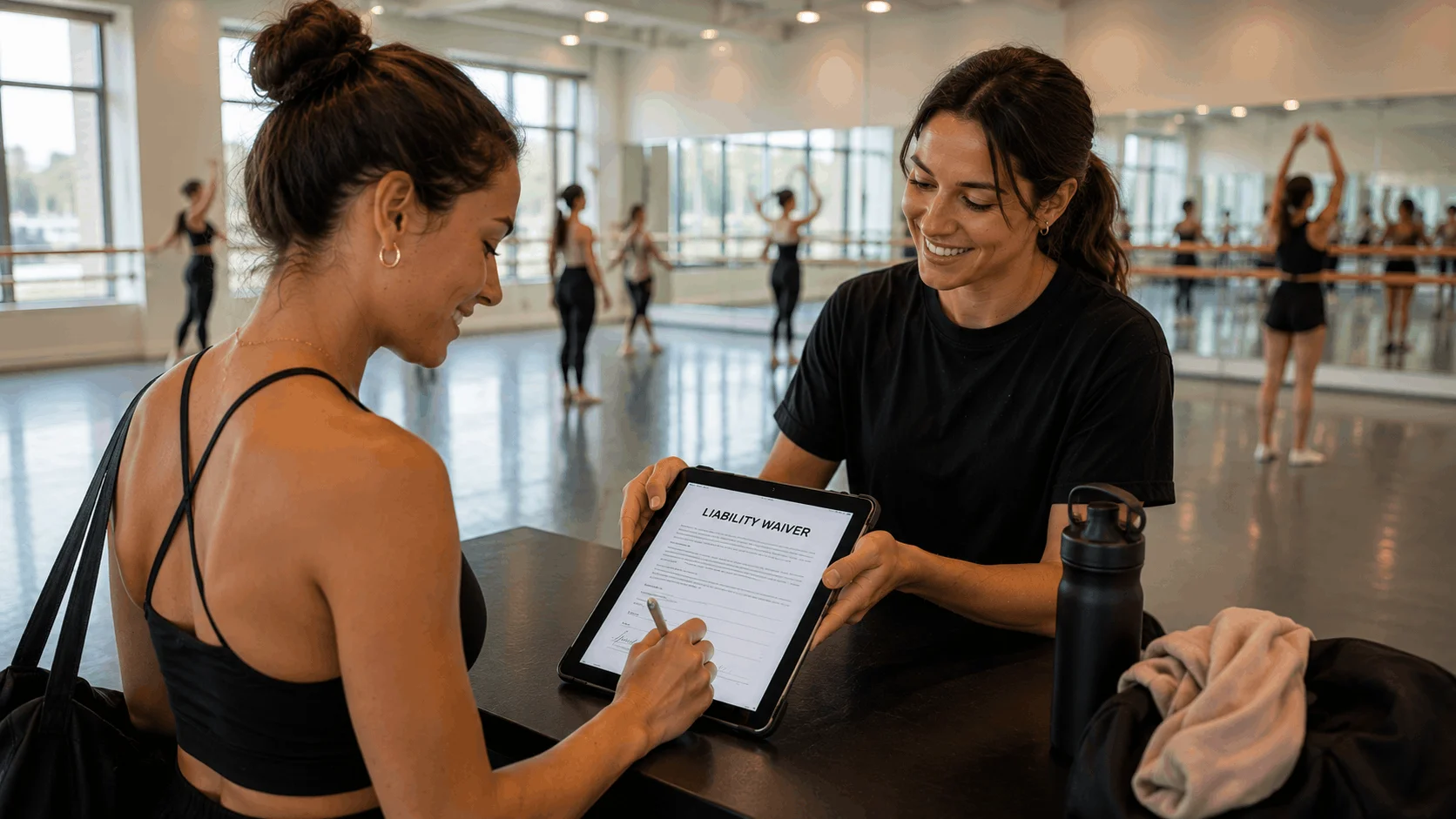
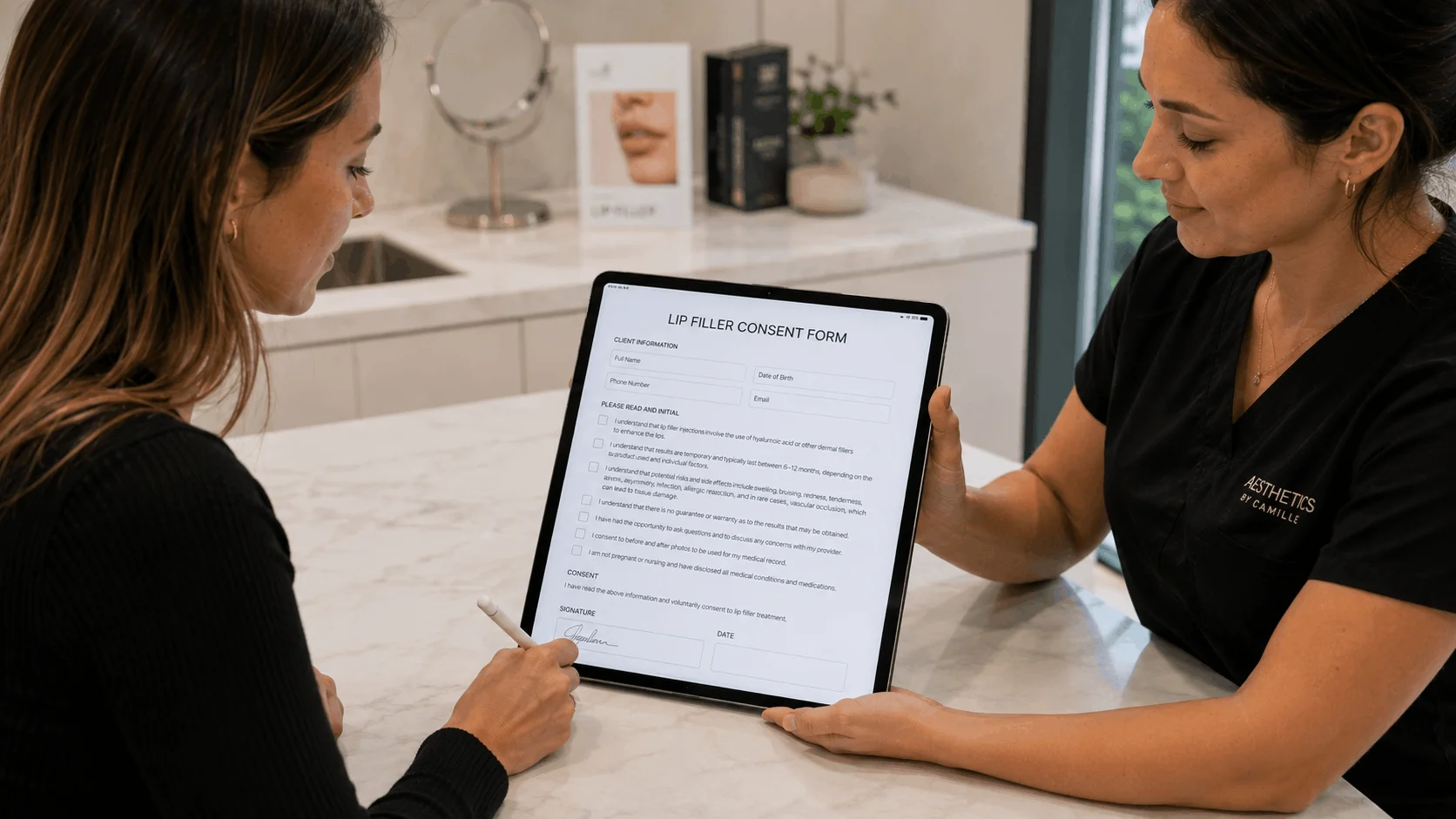
Set up a waiver kiosk on a tablet at the front desk for walk-ins, or post a QR code on the court gate. See how to create a QR code waiver for the setup, and our roundup of the best waiver apps if you're comparing tools.
How to create a pickleball waiver online
You can set up an online pickleball waiver in a few minutes with AgreeDock.
Step 1: Start from a template or AI
Open the pickleball waiver template, or describe your facility and programs to the AI waiver generator to get a draft written for your courts.
Step 2: List your programs and risks
Edit the activities, risk list and court rules so they match what you actually offer, including indoor or outdoor courts, clinics, leagues and tournaments.
Step 3: Add player and guardian fields
Add date of birth, skill rating, health questions, guardian details for juniors, an eye protection acknowledgment and a separate photo consent checkbox.
Step 4: Share the link or QR code
Add the waiver link to your booking confirmation, league registration or tournament sign-up, and print a QR code for the court gate.
Step 5: Check before play
Before a player joins open play or a match, confirm a signed waiver is on file. Each signed waiver is saved with a timestamp and can be downloaded as a PDF.
Frequently asked questions
Do pickleball clubs need a waiver?
Most pickleball clubs and facilities use one. A waiver records that players understood the risks, collects health information and emergency contacts, confirms agreement to court rules and, where local law allows, limits certain claims. Your insurer or the court owner may also require signed waivers.
What should a pickleball waiver include?
Most include player details, the activities covered, specific pickleball risks, an eye protection statement, an assumption of risk, health questions, court rules, photo and video consent, medical treatment consent, a release of liability, an emergency contact, and a signature and date.
Does a pickleball waiver cover tournaments?
Only if it says so. Mention tournaments, leagues and events in the waiver, or collect a tournament-specific waiver during registration. The venue hosting the tournament may also require its own waiver.
Should a pickleball waiver mention eye protection?
Yes. Eye injuries from balls and paddles at close range are one of the more serious pickleball risks. State whether protective eyewear is recommended or required, and have players acknowledge it.
How often should players sign a new pickleball waiver?
Many clubs collect a waiver once a year or at the start of each league season, and again when they add new programs such as tournaments or junior clinics. Drop-in players sign on their first visit.
Can pickleball waivers be signed online?
Yes. Electronic signatures are recognized in many countries, including under the ESIGN Act and UETA in the United States. Players can sign on their phone when booking or by scanning a QR code at the court, and you keep a timestamped record of each waiver.