A summer camp waiver is the form a parent or guardian signs before a child attends camp. It explains the risks of camp activities, records the child's medical and emergency details, gives consent for treatment and trips, and releases the camp from certain claims arising from the ordinary risks of taking part.
Day camps, overnight camps, sports camps, church camps, scout camps and school holiday programmes all look after other people's children, often around water, climbing walls, campfires and buses. A single session can cover dozens of activities and hundreds of families. That's why most camps ask a parent or guardian to complete a waiver for every child before the first day.
This guide covers what a summer camp waiver is, what to include, how to handle medication, trips and staff, a sample structure you can adapt, and how to collect camp waivers online before arrival day. It is general information, not legal advice. Waiver rules and camp licensing requirements differ between countries and states, so have your final waiver reviewed for where you operate.
What is a summer camp waiver?
A summer camp waiver, also called a camp liability waiver, camp release form or camp permission form, is a document in which the parent or guardian:
- acknowledges the risks of the camp's activities
- provides the child's medical information and emergency contacts
- confirms the child can take part, and notes any limits
- consents to first aid and emergency medical treatment
- gives permission for activities and trips
- agrees to the camp's rules on behaviour and pick-up
- releases the camp from certain claims, to the extent permitted by law
- signs and dates the form
Campers aged 18 or over, such as those at adult or family camps, usually sign for themselves. Most camps collect a new waiver for each season, because a child's health details, contacts and activities can all change from one year to the next.
Why summer camps need a waiver
Even with trained staff and careful planning, camp activities can't be made risk free. A clear, signed waiver helps you:
- show that parents were told about the activities and their risks
- have allergy, medication and health details on hand before the child arrives
- know who to call in an emergency and who can collect the child
- keep a record of consent for treatment, trips and photos
- set out your rules on behaviour and sending a child home
- limit certain claims, where local law allows it
A waiver is not a substitute for trained staff, proper supervision, safeguarding procedures and insurance. Courts in many places won't enforce a waiver against gross negligence, such as leaving children unsupervised at a lake or ignoring a known allergy. Some places also limit how far a parent can give up a child's own claims, which is one more reason to treat the waiver as only one part of your safety planning. For more on what can undermine a waiver, see what makes a liability waiver invalid.
What should a summer camp waiver include?
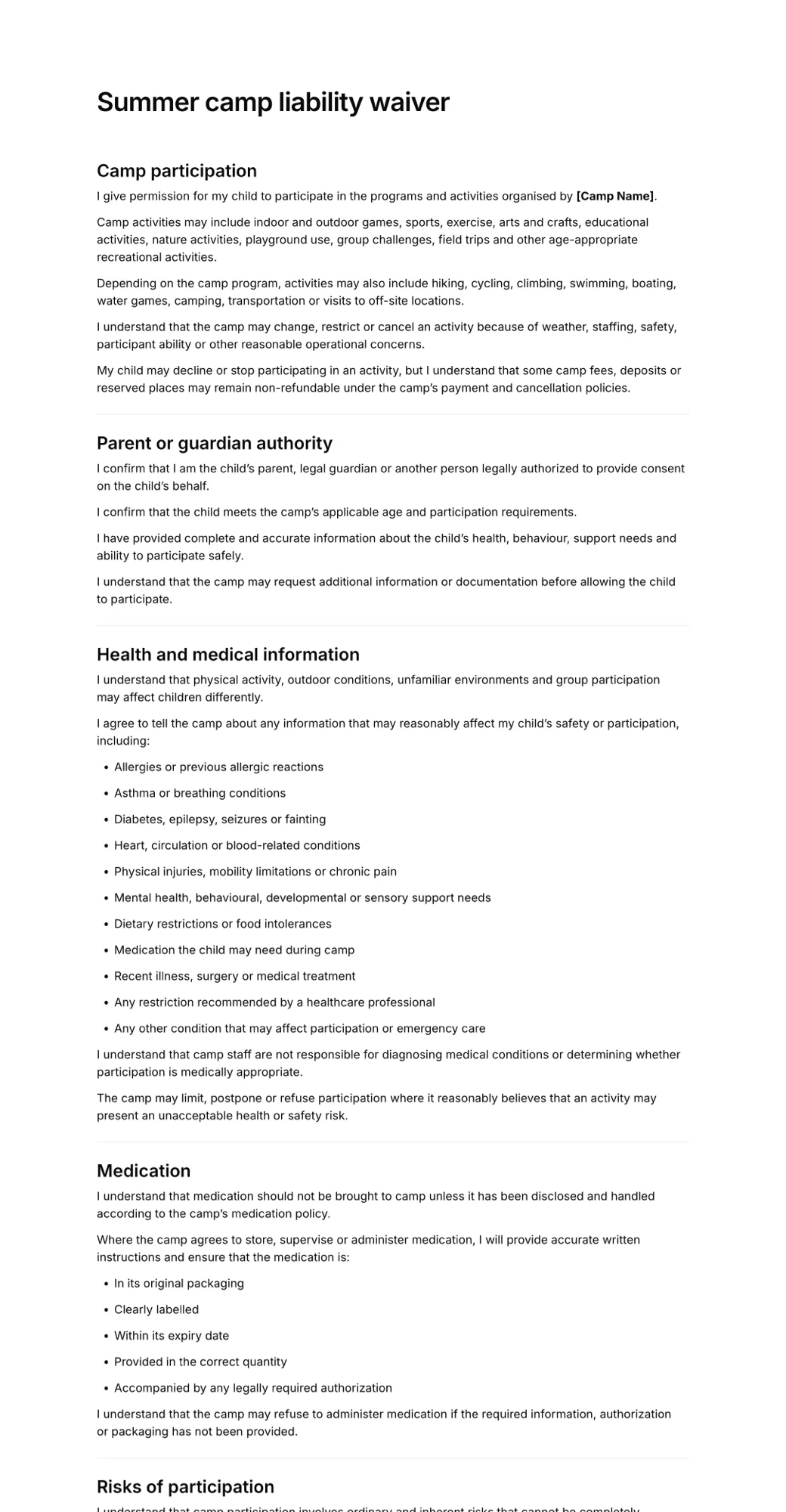
1. Camper and family details
- camper's full name, date of birth and age group
- session dates and whether it is a day or overnight place
- parent or guardian names, phone numbers and email
- home address
- at least two emergency contacts besides the signing parent
2. Description of activities
Name what the waiver covers so families know what their child will be doing:
- sports, games and outdoor play
- swimming, boating, canoeing or other water activities
- hiking, climbing, ropes courses and archery
- arts, crafts, cooking and campfires
- overnight stays in cabins or tents, if you offer them
- off-site trips and transport by bus or van
3. Specific camp risks
Generic wording such as "activities carry some risk" is weaker than naming what can actually happen. Common camp risks include:
- slips, trips, falls, sprains and broken bones
- drowning or near drowning during water activities
- sunburn, heat exhaustion and dehydration
- insect bites, ticks and contact with plants or wildlife
- allergic reactions, including to food, stings or plants
- burns from campfires or cooking
- injuries caused by other campers
- illness spreading among campers
- road accidents during transport
- changing weather, including storms
4. Assumption of risk
State that the parent understands these risks on the child's behalf and agrees to the child taking part, and that some risks can't be removed without changing the nature of the activities.
5. Medical information
This is usually the section staff rely on most. Ask for:
- allergies and the reaction they cause, including food, medication and insect stings
- medical conditions such as asthma, diabetes, epilepsy or heart conditions
- recent injuries, surgery or illness
- dietary needs
- doctor's name and phone number
- health insurance details, if your camp needs them
- immunisation records, if your licence or local rules require them
- anything else that would help staff care for the child, including additional support needs
Only ask for the health information you actually need, limit who can see it, and store it securely. Some camps and some licensing rules also require a separate health form or a doctor's signature, so check what applies to you.
6. Medication
State whether staff can store or give medication, and collect what they would need to do so:
- the name of each medication, the dose and when it is taken
- written permission for staff to give it
- whether the child carries their own inhaler or adrenaline auto-injector
- your rules on original packaging and handing medication to staff
7. Emergency treatment consent
Allow staff to give first aid and arrange emergency treatment if the parent can't be reached, and state who is responsible for medical costs. Say that the camp will try to contact the parent as soon as it reasonably can.
8. Swimming and activity limits
Ask whether the child can swim, what level they are at, and whether there are any activities they should not take part in. Many camps run their own swim check on the first day and state that the result decides which water activities a child can join.
9. Trips and transport
If campers leave the site, ask for permission for off-site trips and travel in camp vehicles, public transport or hired coaches. If children travel far from home or without a parent, the minor travel consent form may also be useful.
10. Behaviour and pick-up rules
Set out your expectations clearly:
- behaviour rules, and when a child can be sent home
- who is allowed to collect the child, and how staff will check their identity
- what to do about custody orders or people who must not collect the child
- your rules on phones, valuables and items not allowed at camp
- what happens with late pick-ups
11. Release of liability
The release section states which claims are given up, to the extent permitted by law. Name the camp, its owners or parent organisation, directors, staff and volunteers, and keep the wording clear and visible, not buried in small print. Our release of liability form guide explains how release wording works.
12. Photo and video consent
Camps often share photos with families and on social media. Ask for consent as a separate checkbox rather than bundling it into the release, and make sure staff know which children have not given consent. A standalone photo consent form can also work.
13. Signature and date
End with an agreement checkbox, the parent or guardian's signature and the date. For digital waivers, the signing date and time can be recorded automatically.
Who signs a summer camp waiver?
For any camper under 18, or the age of majority where you operate:
- a parent or legal guardian should sign, not a grandparent, older sibling or carpool driver, unless they have legal authority to do so
- each child should be named on a signed waiver, including siblings at the same camp
- record who signed and their relationship to the child
- if parents share custody, your policy should say whether one signature is enough
Some places limit how far a parent can waive a child's claims, so check local rules. Our guide to waivers for minors covers this in more detail. For general permission outside camp activities, see the parental consent form template.
Staff, volunteers and other camps
Campers aren't the only people to think about:
- Staff and volunteers. Counsellors and helpers should sign their own forms. The volunteer liability waiver template is a useful starting point, alongside your safeguarding checks and training records.
- Church and youth group camps. Faith-based groups can start from the church activity liability waiver if the event is run by a congregation.
- Sports camps. Name the sport and its specific risks, such as contact, concussion or equipment. The sports waiver form template covers this.
- Outside providers. Climbing centres, water parks and other venues on your trips may ask for their own waivers, so tell parents early and collect them before the trip.
Summer camp waiver sample structure
Use this outline as a starting point. Replace the bracketed details with your own and adapt each section to your camp and location.
Summer Camp Waiver and Release of Liability
Camp: [Camp Name], [address], [phone], [email].
Camper: full name, date of birth, session dates, day or overnight place.
Parent or guardian: full name, relationship to camper, phone, email, address.
Emergency contacts: two names, phone numbers and relationships to the camper.
Activities: This waiver covers all camp activities, including [sports, swimming, hiking, crafts, overnight stays], and trips and transport organised by [Camp Name].
Risks: I understand that camp activities involve risks, including falls, broken bones, water accidents, heat illness, insect bites, allergic reactions, illness, injuries caused by other campers and serious injury.
Medical information: I have listed my child's allergies, conditions, medication and dietary needs, and I will tell the camp about any changes before the session starts.
Medication: I give permission for staff to store and give the medication listed, as directed.
Emergency treatment: If I can't be reached, I consent to first aid and emergency medical treatment for my child, and I accept responsibility for medical costs.
Trips: I give permission for my child to take part in off-site trips and travel in vehicles arranged by the camp.
Rules: My child will follow staff directions and camp rules. I understand that the camp may send my child home for serious or repeated behaviour problems.
Pick-up: Only the people I have listed may collect my child, and staff may ask for identification.
Release: To the extent permitted by law, I release [Camp Name], its owners, staff and volunteers from claims arising from the inherent risks of camp activities.
Photo consent (optional): I agree to photos and videos of my child being used for [camp communications and social media].
Agreement: I am the parent or legal guardian of the camper. I have read this waiver, understand it, and agree to its terms.
Signature and date.
Common mistakes in summer camp waivers
- Listing activities too vaguely. "Fun outdoor activities" tells a parent little if their child will be canoeing or climbing.
- Allergy details staff never see. Medical answers only help if the right people can find them quickly, including on trips.
- No medication instructions. Without written details and permission, staff are left guessing.
- Forgetting trips and transport. Off-site activities should be named in the waiver or covered by a separate form.
- Only one emergency contact. If the parent is unreachable, staff need someone else to call.
- No pick-up rules. Record who can collect each child and how staff will check.
- Using last year's form. Health details and contacts change, so collect new information each season.
- Paper forms left at base camp. A form in the office doesn't help staff on a hike or at a water park.
Paper vs online summer camp waivers
Paper packets get lost in school bags, arrive incomplete on the first morning, and create a long queue at check-in. With online summer camp waivers:
- parents complete the waiver on their phone when they register, not on arrival day
- required fields mean fewer forms with missing allergy or emergency details
- you can see who still needs to sign and send reminders before the session starts
- staff can look up a signed waiver by camper name and open it in seconds
For late forms, keep a QR code at the check-in table. See how to create a QR code waiver for how to set one up.
How to create a summer camp waiver online
Here is how to set one up with AgreeDock:
Step 1: Start from a template or AI
Open the summer camp liability waiver template, or describe your camp to the AI waiver generator to get a draft written for your activities, age groups and rules.
Step 2: Add your activities and rules
Edit the activities, risks, trips, medication policy, behaviour rules and pick-up rules to match your camp.
Step 3: Add camper and parent fields
Include camper and guardian details, emergency contacts, medical and allergy questions, swimming ability, a photo consent checkbox, and an agreement checkbox above the signature.
Step 4: Share the link
Add the signing link to your registration confirmation and reminder emails, and keep a QR code at check-in for late forms.
Step 5: Check before arrival day
Every signed waiver appears in your Signatures list with the parent's answers and the exact wording they agreed to, and you can download each one as a PDF.
See how camps and retreats use AgreeDock for waivers and registration forms.
Frequently asked questions
What is a summer camp waiver?
A summer camp waiver is a form a parent or guardian signs before a child attends camp. It explains the risks of camp activities, records medical and emergency details, gives consent for treatment and trips, and releases the camp from certain claims to the extent permitted by law.
What should a summer camp waiver include?
Most include camper and parent details, emergency contacts, the activities covered, specific risks, an assumption of risk, medical and medication information, emergency treatment consent, trip permission, behaviour and pick-up rules, a release of liability, optional photo consent, and a signature and date.
Who should sign a summer camp waiver?
A parent or legal guardian should sign for any camper under 18, or the age of majority where you operate. Other relatives or carers should only sign if they have legal authority to do so. Adult campers usually sign for themselves.
Are summer camp waivers enforceable?
Often, but not always. Enforceability depends on local law, how clearly the waiver is written, and what happened. Many courts won't enforce a waiver against gross negligence, and some places limit how far a parent can waive a child's claims.
Do camps need a new waiver every year?
Most camps collect a new waiver each season. A child's health, emergency contacts and planned activities can all change, and your wording may have been updated since the last time the family signed.
Do I need a separate form for field trips?
Not always. Your waiver can cover trips and transport if it names them clearly. If a trip involves extra risk, such as water sports or overnight travel, or it wasn't planned when families signed, ask for separate permission.
Can parents sign a summer camp waiver online?
Yes. Electronic signatures are recognised in many countries, including under the ESIGN Act and UETA in the United States. Parents can sign on their phone from a registration confirmation or by scanning a QR code at check-in, and you keep a signed record of each waiver.