A haunted museum waiver is the form a visitor signs before entering a haunted museum, paranormal exhibit or ghost tour. It explains what the visit involves, warns about disturbing content and sensory effects, confirms the visitor will follow the museum's rules, and releases the museum from certain claims arising from the ordinary risks of the visit.
Haunted museums sit somewhere between a history museum and a scare attraction. Visitors walk through dim, often old buildings, past objects linked to death and crime, while guides tell stories designed to unsettle them. Most visits end with nothing worse than a fright, but people do trip on dark stairs, panic in tight rooms and react badly to strobe lights or fog. That's why many haunted attractions ask visitors to sign a waiver before they go in.
This guide covers what a haunted museum waiver is, what to include, how to handle age limits and paranormal events, a sample structure you can adapt, and how to collect waivers online before visitors arrive. It is general information, not legal advice. Waiver rules differ between countries and states, so have your final waiver reviewed for where you operate.
What is a haunted museum waiver?
A haunted museum waiver, also called a haunted museum liability waiver or paranormal museum release form, is a document in which the visitor:
- acknowledges the physical and emotional risks of the visit
- confirms they have seen the warnings about content and effects
- agrees not to touch exhibits and to follow staff instructions
- discloses health conditions and sensitivities that could affect their safety
- confirms they take part voluntarily
- releases the museum from certain claims, to the extent permitted by law
- signs and dates the form, or has a parent or guardian sign for them
Daytime visitors, private groups and people booked on after-hours ghost hunts can usually sign versions of the same waiver, with the event-specific details adjusted.
Why haunted museums need a waiver
Even with good lighting on the stairs and well-trained guides, a haunted museum can't be made risk free, because darkness and unease are part of what people pay for. A clear, signed waiver helps you:
- show that the visitor was told about the content and effects
- record agreement to no-touch rules and closed areas
- record sensitivities such as photosensitive epilepsy before the visit
- collect contact details for each visitor
- keep a record of parental consent where you admit minors
- limit certain claims, where local law allows it
A waiver is not a substitute for safe premises, fire safety and insurance. Courts in many places won't enforce a waiver against gross negligence, such as blocked exits, unlit and damaged stairs, or an actor who grabs a visitor. For more on what can undermine a waiver, see what makes a liability waiver invalid.
What should a haunted museum waiver include?
1. Visitor details
- full name and contact details
- date of birth or age confirmation, if you have an age limit
- emergency contact name and phone number
- booking or group name, if they are part of a party or event
2. Description of the visit
Name what the waiver covers so there is no doubt about scope:
- guided and self-guided tours of the museum
- exhibits and stories involving death, crime, the occult or reported hauntings
- lighting, sound and special effects
- live actors, if you use them
- ghost hunts, seances, and after-hours or overnight events
- stairs, basements, car parks and other areas of the site
3. Content warnings
This is what sets a haunted museum waiver apart from most attraction waivers. Tell visitors plainly what they may see and hear, such as human remains, crime-related objects, religious or occult items, and descriptions of suicide, murder or abuse. It also helps to say that recent bereavement or past trauma can make this content harder to deal with, and that anyone can leave at any time.
4. A clear statement on paranormal claims
Your marketing may lean on the museum's reputation, but your waiver should stay factual. Say that the museum presents stories and reports that may not be verifiable, and that no paranormal experience is promised or guaranteed. This sets expectations and avoids a waiver that appears to confirm claims you can't prove. Check that your refund terms and ticket pages say the same thing.
5. Specific physical and sensory risks
Generic wording such as "some activities carry risk" is weaker than naming what can actually happen. Common risks include:
- slips, trips and falls on stairs, uneven floors and thresholds
- knocks from low ceilings, doorways and display cases
- bumps from other visitors, particularly when people are startled
- fear, anxiety, panic or distress during or after the visit
- fainting, dizziness, headaches or nausea
- reactions to strobe lights, fog, dust, mould or scents
- exposure to cold, heat or poor ventilation in older parts of the building
6. Assumption of risk
State that the visitor understands these risks, accepts them voluntarily, and knows that some can't be removed without changing the nature of the experience.
7. Museum rules
Most haunted museums include rules like these:
- don't touch, lean on or reach over exhibits unless staff invite you to
- don't remove objects, or leave items or offerings behind
- stay out of closed and out-of-bounds areas, and stay with your group on guided tours
- don't touch or block guides and actors
- no spirit boards, candles or investigation tools unless the event allows them
- treat human remains, religious items and memorial objects with respect
- no alcohol or drugs before or during the visit
8. Photography and recording
State where photos, video and audio recording are allowed, and whether flash is banned. If you use cameras or record events, tell visitors. Privacy rules on recording vary by location, so check what notice you need to give. Ask for marketing photo consent as a separate checkbox rather than bundling it into the release.
9. Health and sensitivities
Ask visitors to disclose what matters, such as photosensitivity, epilepsy, heart conditions, asthma, claustrophobia, anxiety, mobility limits or pregnancy. A simple checklist of sensitivities works well, because it prompts people who wouldn't think to mention them. Only ask for the health information you actually need, and store it securely.
10. Release of liability
The release section states which claims the visitor gives up, to the extent permitted by law. Name the museum, its owners, guides, curators, actors and staff, and keep the wording clear and visible, not buried in small print. Our release of liability form guide explains how release wording works.
11. Medical treatment consent
Allow staff to give first aid and call emergency services if needed, and state who is responsible for medical costs.
12. Signature and date
End with an agreement checkbox, the visitor's signature and the date. For digital waivers, the signing date and time can be recorded automatically.
Age limits and minors
Haunted attractions set very different age limits, with published minimums ranging from around 12 to 18. Pick a limit that fits your content, then apply it consistently:
- state the minimum age on your ticket page, in your confirmation email and in the waiver
- ask for proof of age at the door if you enforce a limit, and say you may refuse entry
- require a responsible adult to stay with any child you admit
- have a parent or legal guardian sign for any visitor under 18, or the age of majority where you operate
- record the child's name, age and any sensitivities, plus the guardian's contact details
Some places limit how far a parent can waive a child's claims, so check local rules. Our guide to waivers for minors covers this in more detail.
Ghost hunts and after-hours events
Paranormal investigations carry more risk than a daytime visit, so cover them explicitly or use a separate version of the waiver:
- Darkness. Say that lights may be off and name the areas visitors can enter, such as basements or attics.
- Staying with the group. Lone vigils are popular, but they mean nobody is nearby if someone falls or panics. State your rules and how to call for help.
- Equipment. Say whether visitors can bring their own tools and who is responsible for any equipment you lend out.
- Overnight stays. Cover sleeping arrangements, fatigue and when visitors can leave.
- Recording. If the event is filmed or streamed, get clear consent from everyone taking part.
If your venue also runs a scare attraction or themed games, the escape room waiver template covers similar effects and locked-room rules.
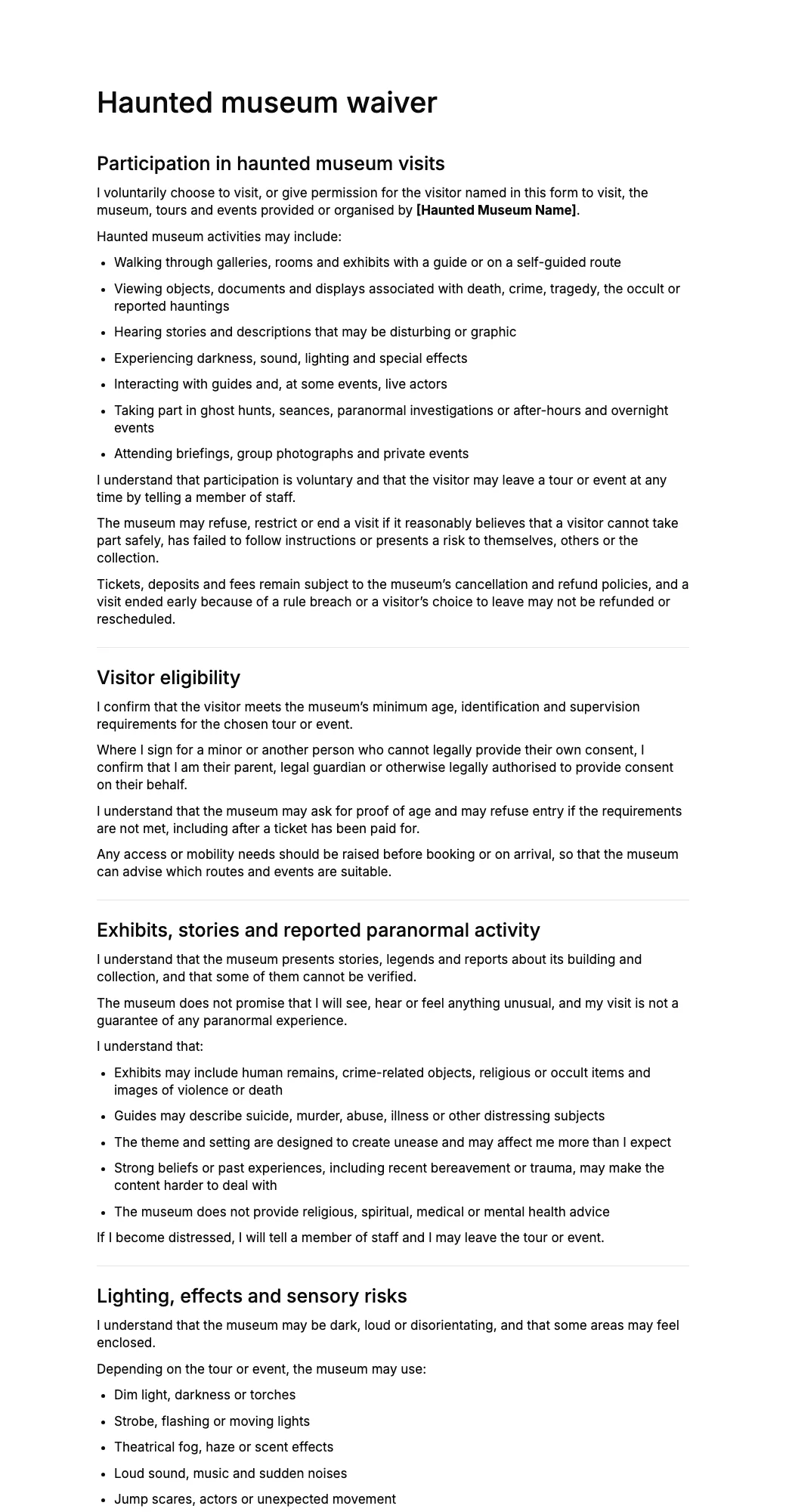
Haunted museum waiver sample structure
Use this outline as a starting point. Replace the bracketed details with your own and adapt each section to your museum and location.
Haunted Museum Waiver and Release of Liability
Museum: [Museum Name], [address], [phone], [email].
Visitor: full name, age or date of birth, phone, email, emergency contact, booking or group name.
Activities: This waiver covers tours, exhibits, events and all other activities at [Museum Name].
Content: I understand that the museum displays and describes disturbing subjects, including death, crime and the occult, and that I may leave at any time.
Paranormal claims: I understand that the museum's stories may not be verifiable and that no paranormal experience is promised or guaranteed.
Risks: I understand that a visit involves risks, including falls on stairs and uneven floors, knocks from low doorways, panic and distress, reactions to strobe lights or fog, and serious injury.
Rules: I won't touch exhibits unless invited, enter closed areas, touch guides or actors, or record where recording isn't allowed.
Health: I have disclosed any condition or sensitivity that could affect my safety.
Alcohol and drugs: I am not under the influence of alcohol or drugs.
Release: To the extent permitted by law, I release [Museum Name], its owners, guides, actors and staff from claims arising from the inherent risks of the visit.
Medical consent: I consent to first aid and emergency medical treatment if needed.
Minors: If the visitor is under [age], their parent or legal guardian signs below.
Agreement: I have read this waiver, understand it, and agree to its terms.
Signature and date.
Common mistakes in haunted museum waivers
- Treating it as a joke. Spooky wording is fun on a poster, but a waiver written in character is harder to understand and easier to challenge.
- Vague content warnings. "May be frightening" tells visitors far less than naming human remains or descriptions of violence.
- Forgetting the building. Old stairs and low doorways are often a bigger physical risk than anything in the exhibits.
- Relying on the waiver alone. Post warnings at booking and at the door as well, especially for strobe lights and fog.
- One signature for the whole group. Every visitor should sign their own waiver, and a guardian should sign for each child.
- Using a daytime waiver for ghost hunts. After-hours events should be named and described.
- Old wording on file. Ask repeat visitors to re-sign when you add new exhibits, effects or events.
Paper vs online haunted museum waivers
Paper waivers hold up timed entries when a tour group arrives together, are hard to fill in at a dim entrance, and are difficult to find months later. With online haunted museum waivers:
- visitors sign on their phone before they arrive
- the waiver link goes out automatically with every ticket
- walk-ins scan a QR code at the door instead of filling in paper
- you can search every signed waiver by visitor name and open it in seconds
See how to create a QR code waiver for setting up a QR code at your entrance.
How to create a haunted museum waiver online
Here is how to set one up with AgreeDock:
Step 1: Start from a template or AI
Open the haunted museum waiver template, or describe your museum to the AI waiver generator to get a draft written for your exhibits, events and rules.
Step 2: Add your exhibits and rules
Edit the content warnings, effects, risks, age limit and photography rules to match your museum.
Step 3: Add visitor fields
Include contact and emergency details, a sensitivities checklist, a minor and guardian section if you admit children, a photo consent checkbox, and an agreement checkbox above the signature.
Step 4: Share the link or QR code
Add the signing link to your ticket confirmations, and display the QR code at the entrance for walk-ins.
Step 5: Check before each tour
Every signed waiver appears in your Signatures list with the visitor's answers and the exact wording they agreed to, and you can download each one as a PDF.
See how activity businesses use AgreeDock for waivers.
Frequently asked questions
What is a haunted museum waiver?
A haunted museum waiver is a form visitors, or their parents, sign before entering a haunted museum or paranormal exhibit. It explains the risks and content of the visit, records agreement to the museum's rules, collects health and contact details, and releases the museum from certain claims to the extent permitted by law.
What should a haunted museum waiver include?
Most include visitor details, the activities covered, content warnings, a statement on paranormal claims, specific physical and sensory risks, an assumption of risk, museum rules, photography terms, health questions, a release of liability, medical treatment consent, and a signature and date.
Why do haunted museums make you sign a waiver?
Mainly because visitors move through dark, often old buildings while being deliberately unsettled. A waiver shows that visitors were warned about the content, effects and physical risks, and that they agreed to the rules before going in.
Does a haunted museum waiver cover emotional distress?
It can name fear, anxiety and distress as risks and record that the visitor was warned and could leave at any time. How far a release applies to emotional distress claims varies by jurisdiction, and it won't usually protect a business from harmful or intentional conduct by staff or actors.
Are haunted museum waivers enforceable?
Often, but not always. Enforceability depends on local law, how clearly the waiver is written, and what happened. Many courts won't enforce a waiver against gross negligence, such as blocked exits or poorly maintained stairs, and some places limit waivers more broadly.
Can a parent sign a haunted museum waiver for a child?
Yes, where your museum admits children, a parent or legal guardian should sign for any visitor under 18, or the age of majority where you operate. Some places limit how far a parent can waive a child's claims, so check local rules.
Can visitors sign a haunted museum waiver online?
Yes. Electronic signatures are recognised in many countries, including under the ESIGN Act and UETA in the United States. Visitors can sign on their phone from a ticket confirmation or by scanning a QR code at the door, and you keep a signed record of each waiver.