The Range USA waiver is the liability form shooters sign before using a lane at a Range USA location. You can complete it online before you arrive or at the store. AgreeDock is not affiliated with Range USA, and our template won't work as a Range USA waiver. To sign theirs, use the waiver link on rangeusa.com.
Range USA is a chain of indoor shooting ranges and gun stores that opened its 50th location in 2025. People often search for its waiver in one of two situations: they have a range visit coming up, or they run a range of their own and want to see how a large operator handles paperwork.
This guide covers both. The first part is for shooters. The rest is for range owners, with what to include in an indoor range waiver, a sample structure, and how to collect waivers online. It is general information, not legal advice. Waiver and firearm rules differ between states, so have your final waiver reviewed for where you operate.
How the Range USA waiver works
If you are heading to a Range USA location, here is what's useful to know. Range USA sets these terms and can change them, so check its website or call your location for the current details.
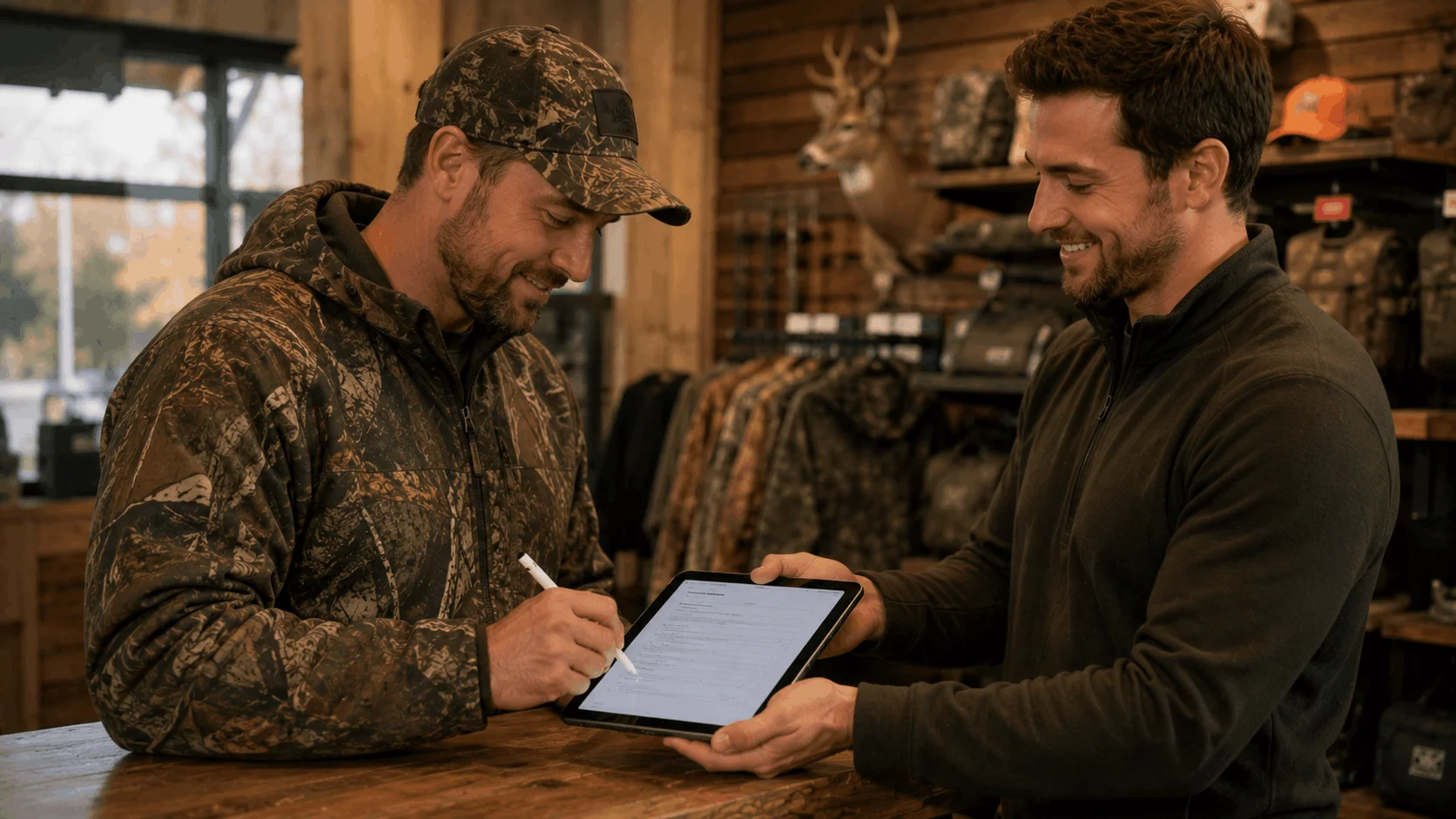
- Where to sign. Range USA's website links to its online waiver so you can finish it before you arrive. You can also complete it in store.
- How long it lasts. Range USA's waiver is reported to last 12 months, so regulars should expect to sign again each year.
- Fees. Listings for several locations mention a yearly range maintenance fee alongside the waiver. Ask your location what applies, as it may be separate from lane and rental fees.
- Age and ID. Age and supervision rules for minors, rentals and handguns can vary, so check Range USA's current policy before bringing a younger shooter. Bring valid ID.
- Questions about the wording. Read the waiver before you sign it. If you have a question about its terms, ask Range USA directly.
We can't sign, retrieve or change a Range USA waiver, so contact Range USA for anything about a waiver you've already signed.
What range owners can learn from it
The rest of this guide is for people who run a range. Three habits are common among multi-location indoor ranges, and they work just as well for a single range:
- Sign before arrival. A link on the website moves paperwork out of the queue at the counter.
- One waiver, renewed each year. Regulars don't have to sign at every visit, but they still see your current rules at least once a year.
- Keep the waiver separate from fees. If you charge an annual range fee, say so clearly and don't bury it in the release wording.
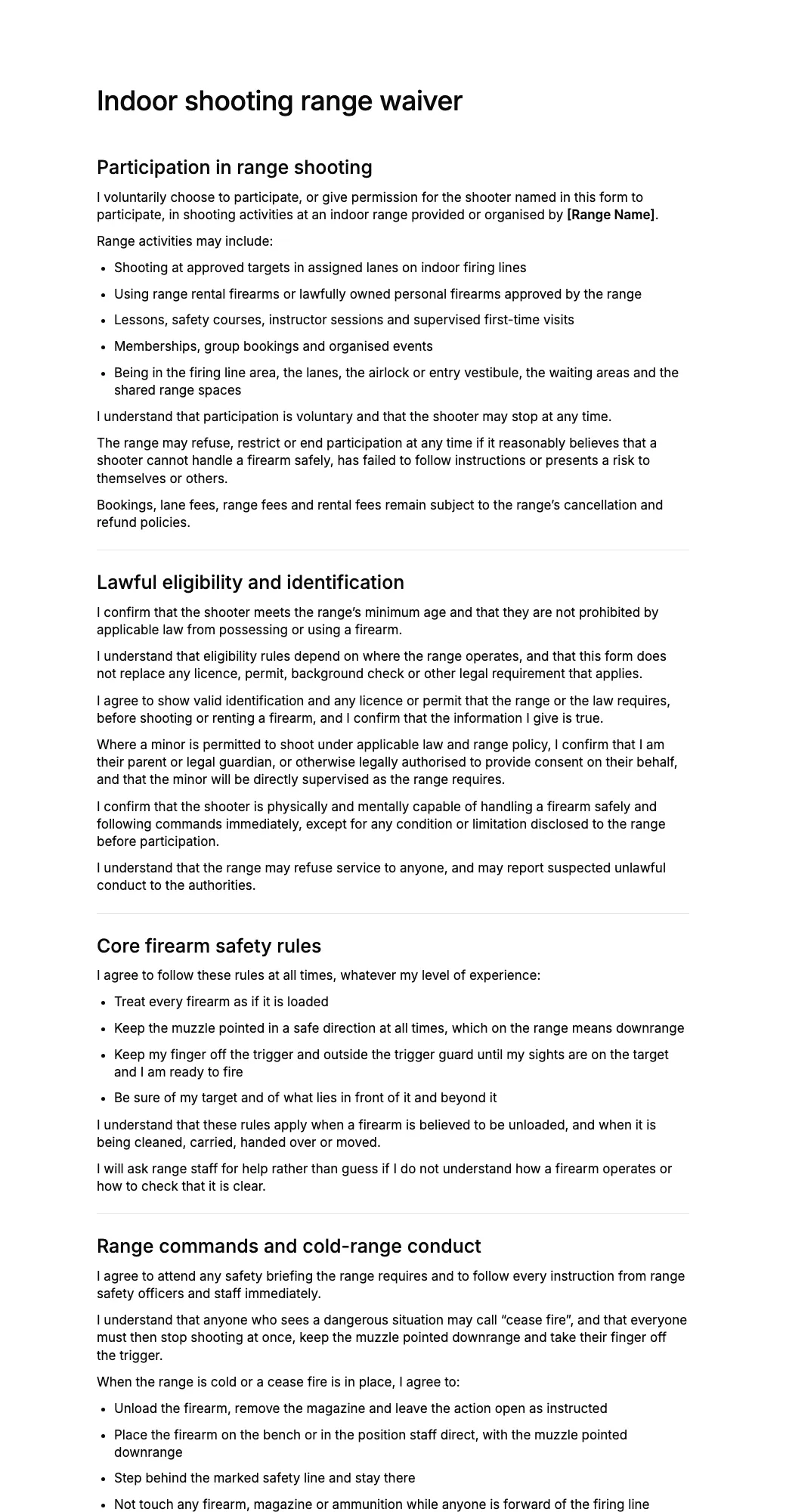
What is an indoor shooting range waiver?
An indoor shooting range waiver, also called a range waiver or range liability release, is a document in which the shooter:
- confirms they meet your minimum age and aren't legally prohibited from having a firearm
- acknowledges the risks of shooting in an enclosed range
- agrees to follow firearm safety rules, lane rules and range commands
- discloses health conditions that could affect their safety
- confirms they take part voluntarily
- releases the range from certain claims, to the extent permitted by law
- signs and dates the form, or has a parent or guardian sign where minors are allowed
A waiver is not a substitute for trained range safety officers, a well-maintained ventilation system and insurance. Courts in many places won't enforce a waiver against gross negligence, and it doesn't replace ID checks or any other step the law requires. For more on what can undermine a waiver, see what makes a liability waiver invalid.
What should an indoor range waiver include?
1. Shooter details
- full name and contact details
- emergency contact name and phone number
- shooting experience, from first-time shooter to instructor level
- whether they are using a rental firearm or their own
2. Lawful eligibility
Ask the shooter to confirm they meet your minimum age and aren't prohibited by law from possessing or using a firearm. State that they must show ID and any licence or permit that applies. A signed statement is a useful record, but staff still need to carry out the actual checks.
3. Firearm safety rules
Set out the core rules in plain language: treat every firearm as loaded, keep the muzzle pointed downrange, keep your finger off the trigger until ready to fire, and be sure of your target and what's beyond it.
4. Lane rules and range commands
- firearms stay cased or unloaded until the shooter is at the lane
- fire only at approved targets in the assigned lane
- never go forward of the firing line
- no drawing from a holster or rapid fire unless the range allows it
- stop immediately on a "cease fire" command
- what to do during a misfire or malfunction
5. Specific indoor range risks
Naming real risks is stronger than saying "shooting can be dangerous". Common risks include:
- being shot, including by another shooter's negligent discharge
- ricochet, splashback and fragments from targets, baffles and the bullet trap
- hearing damage, which can be greater in an enclosed space
- muzzle blast from neighbouring lanes
- burns from hot brass, including brass from other shooters
- eye injury from fragments, gas or debris
- lead exposure through breathing or swallowing it
- firearm or ammunition failure
- slips and falls on spent cases
6. Lead and ventilation
Ventilation reduces airborne lead but doesn't remove it. Tell shooters to wash their hands and face with soap and water after shooting, avoid eating or drinking on the range, and change clothes where practical. Advise anyone who is pregnant, nursing or planning a pregnancy to seek medical advice before entering.
7. Eye, hearing and clothing rules
Require eye and hearing protection for everyone in the firing area, including spectators. Closed-toe shoes and high-necked tops help keep hot brass off the skin.
8. Ammunition limits
Indoor bullet traps are rated for particular ammunition. List what you don't allow, such as steel-core, tracer or incendiary rounds, and say whether rental firearms need ammunition bought from you.
9. Rental and personal firearms
State that rental firearms stay on site, must be returned unloaded with the action open, and may have conditions such as ID, a minimum age or supervision. Personal firearms should arrive unloaded and cased, and you should reserve the right to refuse any firearm you consider unsafe.
10. Health and impairment
Ask shooters to disclose conditions that matter, such as seizures, heart conditions, pregnancy or medication that affects alertness. State that nobody may shoot after consuming alcohol or drugs, and that staff can refuse anyone they believe is impaired.
11. Waiver term
Say how long the signed waiver lasts. Many indoor ranges use 12 months, but the term is up to you. Ask shooters to sign again when the term ends or when your terms change, and keep the older versions.
12. Release, medical consent and signature
Name the range, its owners, safety officers, instructors and staff in a clear release, and note that it doesn't cover liability the law doesn't let you waive. Add consent to first aid and emergency care, an agreement checkbox, a signature and the date. Our release of liability form guide explains how release wording works.
If you run an outdoor range or both kinds of range, the gun range waiver template is a more general starting point.
Minors at an indoor range
Age rules for firearms, supervision and parental waivers all differ between states, so confirm them with a local adviser before you set your policy. Where you allow minors:
- a parent or legal guardian should sign the waiver
- state your minimum age and any height or size requirement
- require direct supervision, and say who has to provide it
- explain how rental rules differ for younger shooters
Some places limit how far a parent can waive a child's claims. Our guide to waivers for minors covers this in more detail.
Indoor range waiver sample structure
Use this outline as a starting point. Replace the bracketed details with your own and adapt each section to your range and state.
Indoor Shooting Range Waiver and Release of Liability
Range: [Range Name], [address], [phone], [email].
Shooter: full name, phone, email, emergency contact, shooting experience.
Eligibility: I meet the range's minimum age, am not prohibited by law from possessing or using a firearm, and will show valid ID when asked.
Risks: I understand that shooting at an indoor range involves risks, including gunshot injury, ricochet, hot brass, hearing and eye damage, lead exposure, firearm failure and death.
Safety rules: I will treat every firearm as loaded, keep the muzzle downrange, keep my finger off the trigger until ready to fire, and be sure of my target.
Range conduct: I will stay in my assigned lane, stop at any cease fire, never go forward of the firing line, and follow staff instructions immediately.
Protection and hygiene: I will wear eye and hearing protection and wash my hands and face after shooting.
Ammunition and firearms: I will use only permitted ammunition, and will follow the range's rules for rental and personal firearms.
Health and impairment: I have disclosed any condition that could affect my safety and won't shoot while impaired.
Term: This waiver applies to my visits for [12 months] from the date I sign it.
Release: To the extent permitted by law, I release [Range Name], its owners, safety officers, instructors and staff from claims arising from the inherent risks of range shooting.
Medical consent: I consent to first aid and emergency medical treatment if needed.
Minors: If the shooter is under [age], their parent or legal guardian signs below.
Agreement: I have read this waiver, understand it, and agree to its terms.
Signature and date.
Common mistakes in indoor range waivers
- Copying another range's waiver. Its rules, state and insurance conditions won't match yours, and its wording belongs to that business.
- Leaving out lead. Lead is one of the main health risks on an indoor range and should be named.
- No waiver term. If the form doesn't say how long it lasts, it's unclear whether it covers next year's visit.
- Treating the form as an eligibility check. A signature doesn't replace ID checks or any other step the law requires.
- One signature for a group. Each shooter should sign, and a parent or guardian should sign for each minor.
- Rules that don't match the range. If the form bans rapid fire but staff allow it, the waiver is harder to rely on.
Paper vs online range waivers
Paper forms slow down the counter on busy weekends, and finding a signature from eleven months ago means searching through a filing cabinet. With online range waivers:
- shooters sign on their phone before they arrive
- walk-ins scan a QR code at the counter
- staff can search by shooter name and open the signed waiver in seconds
- you keep the exact wording each shooter agreed to
See how to create a QR code waiver for setting one up at your counter.
How to create an indoor range waiver online
Here is how to set one up with AgreeDock:
Step 1: Start from a template or AI
Open the indoor shooting range waiver template, or describe your range to the AI waiver generator to get a draft written for your lanes, firearms and rules.
Step 2: Add your rules and term
Edit the lane rules, ammunition limits, rental terms, age policy and waiver term to match your range.
Step 3: Check the shooter fields
The template includes contact details, shooting experience, an eligibility confirmation, the firearms being used, an agreement checkbox and a signature. Add or remove fields to suit your process.
Step 4: Share the link or QR code
Add the signing link to your website and booking confirmations, and display the QR code at the counter for walk-ins.
Step 5: Check before the shooter goes on the range
Every signed waiver appears in your Signatures list with the shooter's answers and the exact wording they agreed to, and you can download each one as a PDF.
See how activity businesses use AgreeDock for waivers.
Frequently asked questions
Where do I sign the Range USA waiver?
Use the waiver link on Range USA's website, or complete it at the store. AgreeDock isn't affiliated with Range USA and can't sign, retrieve or change its waivers.
How long does a Range USA waiver last?
It is reported to last 12 months, after which you sign a new one. Range USA sets its own terms, so check with your location for the current details.
Can I use the AgreeDock template as a Range USA waiver?
No. Our template is for businesses that want a waiver for their own range. Shooters visiting Range USA need to sign Range USA's own waiver.
What should an indoor shooting range waiver include?
Most include shooter details and emergency contact, an eligibility confirmation, firearm safety and lane rules, specific indoor range risks, lead and hygiene guidance, protective equipment rules, ammunition and rental terms, health questions, the waiver term, a release of liability, medical consent, and a signature and date.
How long should a shooting range waiver last?
The term is up to the range. Many indoor ranges use 12 months, so regulars don't need to sign at every visit but do see current rules each year. State the term in the waiver and ask shooters to re-sign if your terms change.
Are shooting range waivers enforceable?
Often, but not always. Enforceability depends on state law, how clearly the waiver is written, and what happened. Many courts won't enforce a waiver against gross negligence, and some states limit waivers more broadly.
Can shooters sign a range waiver online?
Yes. Electronic signatures are recognised under the ESIGN Act and UETA in the United States. Shooters can sign from a link on your website or by scanning a QR code at the counter, and you keep a signed record of each waiver. Staff still need to carry out ID and any other legally required checks.