A volunteer waiver is the form a volunteer signs before helping a nonprofit, charity, church, school or event. It describes the volunteer role, explains the risks involved, confirms the volunteer will follow the organization's rules and safety instructions, and releases the organization from certain claims arising from the ordinary risks of the work.
Volunteering rarely feels risky. People hand out food, set up chairs, walk shelter dogs, plant trees or marshal a fun run. But volunteers lift heavy boxes, use ladders and tools, drive their own cars, work outdoors in the heat and meet members of the public. When someone gets hurt, the organization often has fewer protections than it would for an employee, which is why many groups ask every volunteer to sign a waiver before their first shift.
This guide covers what a volunteer waiver is, what to include, how it differs from a volunteer agreement, how to handle young volunteers, a sample structure you can adapt, and how to collect waivers online. It is general information, not legal advice. Waiver rules differ between countries and states, so have your final waiver reviewed for where you operate.
What is a volunteer waiver?
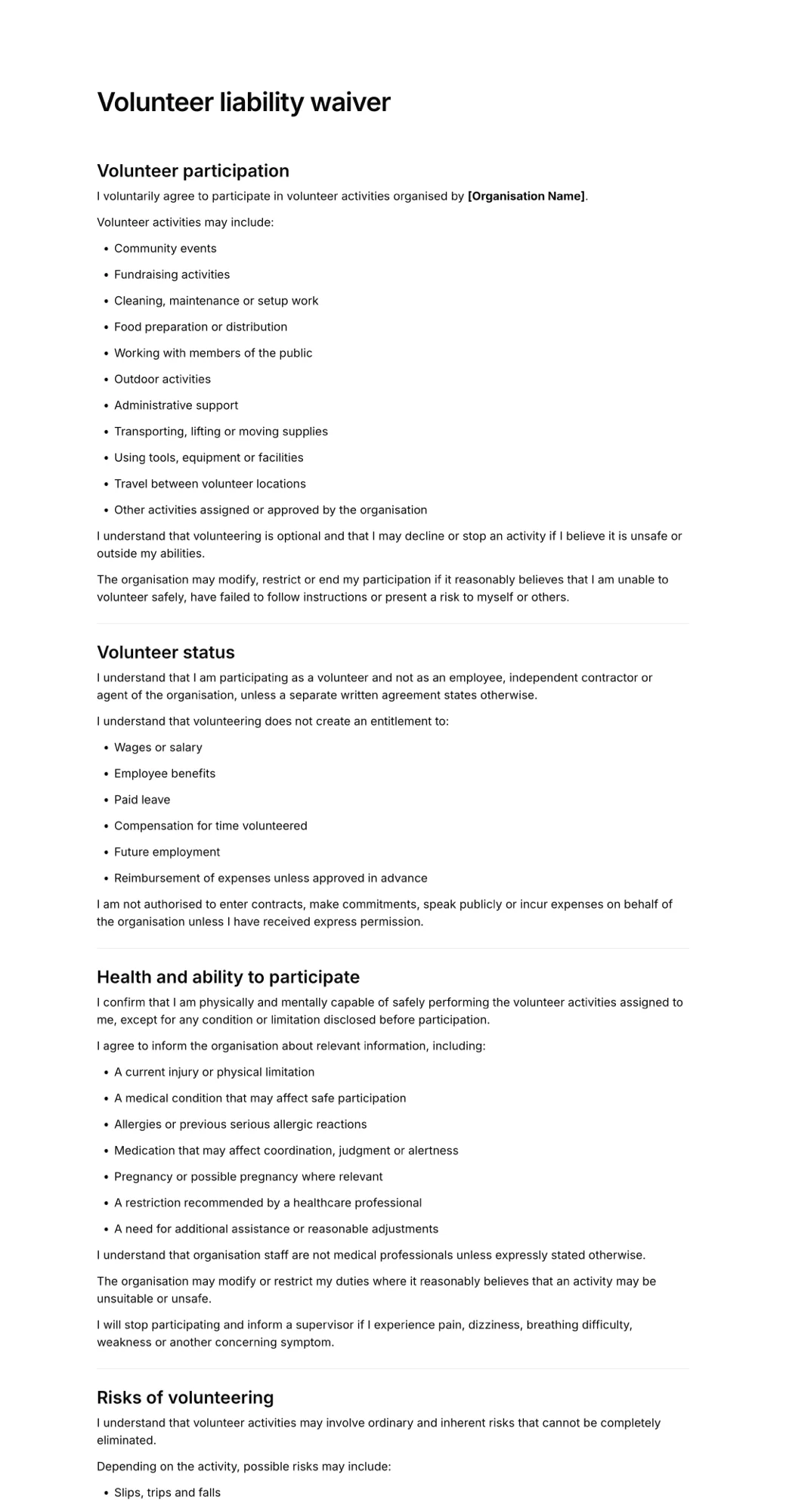
A volunteer waiver, also called a volunteer liability waiver, volunteer release form or volunteer waiver of liability, is a document in which the volunteer:
- confirms the role and activities they have agreed to take on
- acknowledges the physical and other risks of those activities
- agrees to follow the organization's policies, safety procedures and staff instructions
- discloses health conditions or limits that could affect their safety
- confirms they take part voluntarily and without pay
- releases the organization from certain claims, to the extent permitted by law
- signs and dates the form, or has a parent or guardian sign for them
Most organizations use one waiver for all volunteers and add role-specific sections for higher-risk work such as construction, animal care, driving or outdoor events.
Why organizations need a volunteer waiver
Volunteers aren't employees, so they often aren't covered by workers' compensation, and they may not be covered by your general liability policy either unless it says so. A clear, signed waiver helps you:
- show that the volunteer was told about the risks of the role
- record agreement to your safety rules and code of conduct
- collect emergency contacts and relevant health information before a shift
- confirm the volunteer understands the role is unpaid
- keep a record of parental consent for volunteers under 18
- limit certain claims, where local law allows it
A waiver is not a substitute for training, supervision, safe equipment and the right insurance. Courts in many places won't enforce a waiver against gross negligence, such as handing a volunteer a power tool with a missing guard or sending them out without basic safety gear. For more on what can undermine a waiver, see what makes a liability waiver invalid.
Does the Volunteer Protection Act replace a waiver?
No. In the United States, the federal Volunteer Protection Act of 1997 gives individual volunteers some protection from personal liability for harm they cause to others while acting within the scope of their role. It protects the volunteer, not the organization, and it doesn't cover injuries the volunteer suffers themselves. It also has exceptions, such as gross negligence, willful misconduct and harm caused while driving a vehicle that requires a license or insurance. Many states have their own volunteer protection laws on top of it.
A volunteer waiver deals with a different question: what happens when a volunteer is hurt while helping you. That's why most organizations need both an understanding of these laws and a signed waiver.
Volunteer waiver vs volunteer agreement
The two are often confused, and many organizations combine them into one form:
- A volunteer waiver focuses on risk. It records that the volunteer understood and accepted the risks of the role and releases the organization from certain claims.
- A volunteer agreement focuses on the relationship. It sets out duties, schedule, supervision, conduct standards, confidentiality and the unpaid nature of the role.
If you use a combined "volunteer agreement and release of liability", keep the release section clearly headed and easy to find, not buried among the duties.
What should a volunteer waiver include?
1. Volunteer details
- full name and contact details
- date of birth or age confirmation
- emergency contact name and phone number
- program, event or team they are volunteering with
2. Description of the volunteer role
Name what the waiver covers so there is no doubt about scope:
- the program or event, such as a food bank, animal shelter, build day or race
- typical tasks, such as sorting donations, serving food or setting up equipment
- locations, including off-site work, outdoor areas and partner sites
- whether the role involves travel, driving or transporting others
- the dates covered, or that the waiver applies to all future shifts until withdrawn
3. Specific risks
Generic wording such as "volunteering involves some risk" is weaker than naming what can actually happen. Common risks include:
- strains and back injuries from lifting, carrying and repetitive work
- slips, trips and falls, including from ladders and steps
- cuts and injuries from tools, kitchen equipment and sharp objects
- bites, scratches and allergic reactions when working with animals
- heat, cold, sun exposure and insect stings at outdoor events
- road traffic risks when driving, delivering or marshaling
- exposure to illness, and difficult situations when working with the public
- damage to or loss of personal property
4. Assumption of risk
State that the volunteer understands these risks, accepts them voluntarily, and knows that some can't be removed without changing the nature of the work.
5. Volunteer responsibilities and rules
Most volunteer waivers include rules like these:
- follow the instructions of staff and volunteer leaders
- complete any required training before doing certain tasks
- wear the safety gear provided, such as gloves, vests or closed-toe shoes
- don't use tools, vehicles or equipment you haven't been cleared to use
- report injuries, hazards and incidents straight away
- don't volunteer under the influence of alcohol or drugs
- follow the organization's code of conduct and safeguarding policies
6. Unpaid role
State that the volunteer isn't an employee, won't be paid, and isn't entitled to employee benefits. Mention any expenses you do reimburse, so the wording matches what actually happens.
7. Health and fitness
Ask volunteers to disclose conditions or limits that could affect their safety in the role, such as allergies, back problems, heart conditions or mobility limits. Only ask for the health information you actually need for the tasks involved, and store it securely.
8. Driving and transportation
If volunteers drive their own cars, transport clients or ride in your vehicles, cover it explicitly. Ask for a valid license, confirm they hold their own insurance where required, and state who is responsible for traffic fines and vehicle damage. Driving is one of the higher-risk parts of many volunteer programs and is excluded from some volunteer protection laws.
9. Confidentiality
If volunteers see client records, donor details or personal information about the people you serve, add a short confidentiality clause. Longer obligations usually belong in a separate volunteer agreement.
10. Photo and media consent
Many organizations share photos from events and volunteer days. Ask for photo consent as a separate checkbox rather than bundling it into the release, so volunteers can say no without refusing the whole waiver. Our photo consent form template covers this in more detail.
11. Release of liability
The release section states which claims the volunteer gives up, to the extent permitted by law. Name the organization, its directors, officers, staff, other volunteers and any partner sites, and keep the wording clear and visible, not buried in small print. Our release of liability form guide explains how release wording works.
12. Medical treatment consent
Allow staff to give first aid and call emergency services if needed, and state who is responsible for medical costs.
13. Signature and date
End with an agreement checkbox, the volunteer's signature and the date. For digital waivers, the signing date and time can be recorded automatically.
Young volunteers and minors
Teenagers volunteer through schools, youth groups and community service programs, and some roles admit younger children alongside a parent. If you accept volunteers under 18:
- set a minimum age for each role, and higher limits for tools, kitchens, animals or driving
- have a parent or legal guardian sign for any volunteer under 18, or the age of majority where you operate
- record the child's name, age, school or group, and the guardian's contact details
- require adult supervision and follow your safeguarding policy
- check child labor and youth employment rules, which can restrict certain tasks even when unpaid
Some places limit how far a parent can waive a child's claims, so check local rules. Our guide to waivers for minors covers this in more detail.
Volunteer waivers for churches, schools and events
The same core waiver works across most organizations, with a few adjustments:
- Churches. Cover activities such as youth ministry, mission trips, building maintenance and childcare, and link to your safeguarding policy. The church activity liability waiver template is a good starting point for participants as well as volunteers.
- Schools and PTAs. Cover field trips, classroom help and fundraising events, and confirm any background check your district requires.
- Animal shelters. Name bites, scratches, zoonotic illness and dog walking off-site, and require training before handling animals.
- Races and festivals. Cover marshaling near traffic, setup and takedown, crowds and weather, and add a short section for one-day volunteers. The event liability waiver template covers attendees.
- Build and cleanup days. Name tools, heights, heavy lifting and required protective equipment.
Volunteer waiver sample structure
Use this outline as a starting point. Replace the bracketed details with your own and adapt each section to your organization and location.
Volunteer Waiver and Release of Liability
Organization: [Organization Name], [address], [phone], [email].
Volunteer: full name, date of birth, phone, email, emergency contact, program or event.
Role: I have agreed to volunteer with [Organization Name] in [role or program], including [main tasks], at [locations].
Unpaid role: I understand that I am a volunteer, not an employee, and that I will not be paid for my time.
Risks: I understand that volunteering involves risks, including lifting injuries, slips and falls, cuts from tools, outdoor conditions, traffic, and serious injury.
Rules: I will follow staff instructions, complete required training, wear the safety equipment provided, and report injuries and hazards straight away.
Health: I have disclosed any condition that could affect my safety in this role.
Driving: If I drive as part of my role, I hold a valid license and the insurance required by law.
Release: To the extent permitted by law, I release [Organization Name], its directors, officers, staff and volunteers from claims arising from the inherent risks of my volunteer activities.
Medical consent: I consent to first aid and emergency medical treatment if needed.
Minors: If the volunteer is under [age], their parent or legal guardian signs below.
Agreement: I have read this waiver, understand it, and agree to its terms.
Signature and date.
Common mistakes in volunteer waivers
- One vague form for every role. A food bank shift and a roofing build day carry very different risks, so name the tasks.
- Forgetting about driving. Volunteers who drive their own cars are one of the most common gaps in coverage.
- Assuming the Volunteer Protection Act covers the organization. It mainly protects individual volunteers, not the group that recruits them.
- Mixing photo consent into the release. Keep it as a separate, optional checkbox.
- No guardian signature for teens. Every volunteer under 18 needs a parent or guardian to sign.
- Paper forms nobody can find. A waiver you can't produce after an incident is of little use.
- Never updating it. Ask volunteers to re-sign when you add new programs, tools or locations, or at least once a year.
Paper vs online volunteer waivers
Paper waivers get lost in event boxes, are hard to collect from volunteers who sign up online, and are difficult to match with shift schedules months later. With online volunteer waivers:
- volunteers sign on their phone when they register, before their first shift
- the waiver link can go out with every sign-up confirmation
- day-of volunteers scan a QR code at the check-in table
- you can search every signed waiver by name and open it in seconds
See how to create a QR code waiver for setting up a QR code at your check-in table, or read our guide to building an online waiver form.
How to create a volunteer waiver online
Here is how to set one up with AgreeDock:
Step 1: Start from a template or AI
Open the volunteer liability waiver template, or describe your organization and roles to the AI waiver generator to get a draft written for your programs.
Step 2: Describe your roles and risks
Edit the activities, locations, risks, rules and driving section to match the work your volunteers actually do.
Step 3: Add volunteer fields
Include contact and emergency details, health questions, a minor and guardian section if you accept young volunteers, a photo consent checkbox, and an agreement checkbox above the signature.
Step 4: Share the link or QR code
Add the signing link to your volunteer sign-up page and confirmation emails, and display the QR code at check-in for walk-up volunteers.
Step 5: Check before each shift
Every signed waiver appears in your Signatures list with the volunteer's answers and the exact wording they agreed to, and you can download each one as a PDF.
Frequently asked questions
What is a volunteer waiver?
A volunteer waiver is a form volunteers, or their parents, sign before helping an organization. It describes the role and its risks, records agreement to the organization's rules, collects contact and health details, and releases the organization from certain claims to the extent permitted by law.
Do volunteers need to sign a waiver?
There is usually no legal requirement, but most nonprofits, churches, schools and event organizers ask volunteers to sign one. Volunteers often aren't covered by workers' compensation, so a waiver helps show they were told about the risks and agreed to the safety rules.
What should a volunteer waiver include?
Most include volunteer details, a description of the role, specific risks, an assumption of risk, volunteer rules, a statement that the role is unpaid, health questions, driving terms where relevant, photo consent, a release of liability, medical treatment consent, and a signature and date.
Are volunteer waivers enforceable?
Often, but not always. Enforceability depends on local law, how clearly the waiver is written, and what happened. Many courts won't enforce a waiver against gross negligence or intentional harm, and some places limit waivers more broadly.
Does the Volunteer Protection Act protect nonprofits?
The federal Volunteer Protection Act mainly protects individual volunteers from personal liability for harm they cause while acting within their role. It doesn't protect the organization itself and doesn't cover injuries to the volunteer, so organizations still rely on insurance, good safety practices and a signed waiver.
Can a minor sign a volunteer waiver?
A volunteer under 18, or the age of majority where you operate, should have a parent or legal guardian sign the waiver for them. Some places limit how far a parent can waive a child's claims, so check local rules.
Can volunteers sign a waiver online?
Yes. Electronic signatures are recognized in many countries, including under the ESIGN Act and UETA in the United States. Volunteers can sign on their phone when they register or by scanning a QR code at check-in, and you keep a signed record of each waiver.