A dock, a couple of kayaks and maybe a pontoon boat are often the reason guests book a lake rental. They are also where most of the host's risk sits. A slip on a wet dock, a kayak that drifts too far, a guest who takes the boat out after a few drinks: any of these can turn into an injury claim.
There is no single document that makes that risk disappear. Hosts who handle it well usually stack several layers: the right insurance, clear rental terms, a signed waiver for water activities, a safe dock, and a record of what each guest agreed to.
This guide walks through each layer, what to ask your insurer, and what your rental agreement and waiver should say.
Important: This article is general information, not legal or insurance advice. Liability rules, boating laws and insurance policies vary by state, country and carrier. Talk to a local attorney and a licensed insurance agent before relying on any of this.
The short answer
To handle boat and dock liability for guests at a lake rental:
- Get written confirmation from your insurer that your policy covers short-term rental guests, the dock, and every watercraft you provide, including use off your property.
- Decide exactly what guests may use: the dock only, paddle craft, or a motorized boat. Each step up adds risk and may need its own coverage.
- Put water rules in your rental agreement: who may use what, life jackets, no swimming at night, no alcohol while operating a boat, children supervised at all times.
- Have every adult sign a watercraft and dock waiver before they use anything, with a parent or guardian signing for minors.
- Maintain the dock and get its wiring checked by a licensed electrician.
- Keep signed records for every stay, so you can show who agreed to what and when.
The rest of this guide explains each step.
Where lake rental liability comes from
It helps to separate the different ways a guest can get hurt, because each one is covered (or not) in a different way.
The dock and shoreline
Docks are slippery, uneven and close to deep water. Common problems include:
- Slips and falls on wet or algae-covered boards
- Loose boards, nails or broken railings
- Diving into shallow water off the end of the dock
- Children falling in without a life jacket
- Poor lighting at night
- Electrical faults in dock wiring or boat lifts
This is premises liability: the risk that comes with owning the property guests are invited onto.
Watercraft you provide
Kayaks, canoes, paddleboards, paddle boats, pontoons and jet skis all add risk. A guest can capsize, collide with another boat, get caught in bad weather, or drift far from the property.
This is where many hosts get caught out, because watercraft are commonly excluded or limited in homeowners and rental policies, and coverage often stops at the property line.
Boats guests bring or rent elsewhere
Some guests tow their own boat or rent one from a local marina and tie up at your dock. You do not control the boat or the operator, but an accident at your dock can still pull you into a claim.
Guests' guests
A guest invites friends over for the afternoon. Those visitors never signed your rental agreement, but they are using your dock.
Layer 1: Insurance that actually covers the water
Insurance is the most important layer, and the one hosts most often assume they have.
Why your homeowners policy may not be enough
- Many standard homeowners policies limit or exclude coverage when the home is rented to paying guests.
- Homeowners policies commonly exclude owned boats above certain sizes or engine power, and watercraft rules vary by carrier and form.
- Docks are not always covered the same way as the house.
- Coverage for amenities often ends at your property line, which matters for kayaks and boats that leave the dock.
What about Airbnb or Vrbo protection?
Booking platforms offer host liability programs, but they come with exclusions. Airbnb's host liability insurance, for example, is subject to its own terms and exclusions, and watercraft-related claims are commonly listed among them. Read the current program summary for your platform and country, and do not treat it as your main policy.
Questions to ask your insurance agent
Ask for the answers in writing:
- Does my policy cover short-term rental guests?
- Is the dock covered for liability and for physical damage?
- Is each kayak, paddleboard, canoe and boat I provide covered when a guest uses it?
- Does coverage continue when a guest takes a watercraft off my property?
- Are guests covered if they operate my motorized boat?
- What happens if a guest brings their own boat and docks it here?
- Would an umbrella policy sit above all of this?
- Do you require waivers, signage or life jackets as a condition of coverage?
Specialist short-term rental insurers exist for exactly this situation. If your current carrier hesitates on any of these questions, get a second quote.
Layer 2: Decide what guests can use
The simplest way to reduce risk is to be deliberate about what you offer. Think of it as three tiers:
| What you offer | Typical risk | What you usually need |
|---|---|---|
| Dock and swimming only | Slips, falls, drowning, shallow diving | Premises coverage, house rules, life jackets on site, waiver for dock and swimming |
| Paddle craft (kayaks, canoes, paddleboards) | Capsizing, drifting, weather, cold water | Coverage for amenities on and off site, life jackets for every seat, watercraft waiver |
| Motorized boats (pontoon, jet ski) | Collisions, injuries to others, operator error | Separate boat insurance, operator rules, boater education checks, a boat rental agreement |
Many hosts offer paddle craft but do not let guests drive a motorized boat. Letting guests operate your boat can raise questions about whether you are effectively renting it out, which in some places brings licensing, livery or commercial insurance rules. Check your state's boating laws and ask your insurer before including a boat in the listing.
If you do include a motorized boat, consider a separate boat rental liability waiver and agreement, and confirm the operator meets local boater education and age requirements.
Layer 3: Put water rules in your rental agreement
Your rental agreement or house rules should spell out the water rules before guests arrive. Useful clauses include:
- Permitted use. List exactly which watercraft guests may use and which are off limits.
- Who may operate. Minimum age, and for motorized boats, a valid boater education card where required.
- Life jackets. Required for anyone on a watercraft, and for children on the dock.
- Children. Must be supervised by an adult near the water at all times.
- Swimming. No swimming at night, alone, or near the boat lift; no diving off the dock.
- Alcohol. No operating any watercraft under the influence.
- Weather. Stay off the water during storms, high wind or after dark.
- Boundaries. How far guests may paddle or boat from the property.
- Guest-owned boats. Whether they are allowed at your dock, and whether proof of their own insurance is required.
- Visitors. Visitors may use the dock and watercraft only after signing the waiver.
- Damage and loss. Who pays if equipment is damaged or lost.
- Reporting. Guests must report injuries and damage immediately.
Rules only help if guests see them. Put them in the agreement guests sign, repeat them in the house manual, and post a short version at the dock.
Layer 4: Have guests sign a watercraft and dock waiver
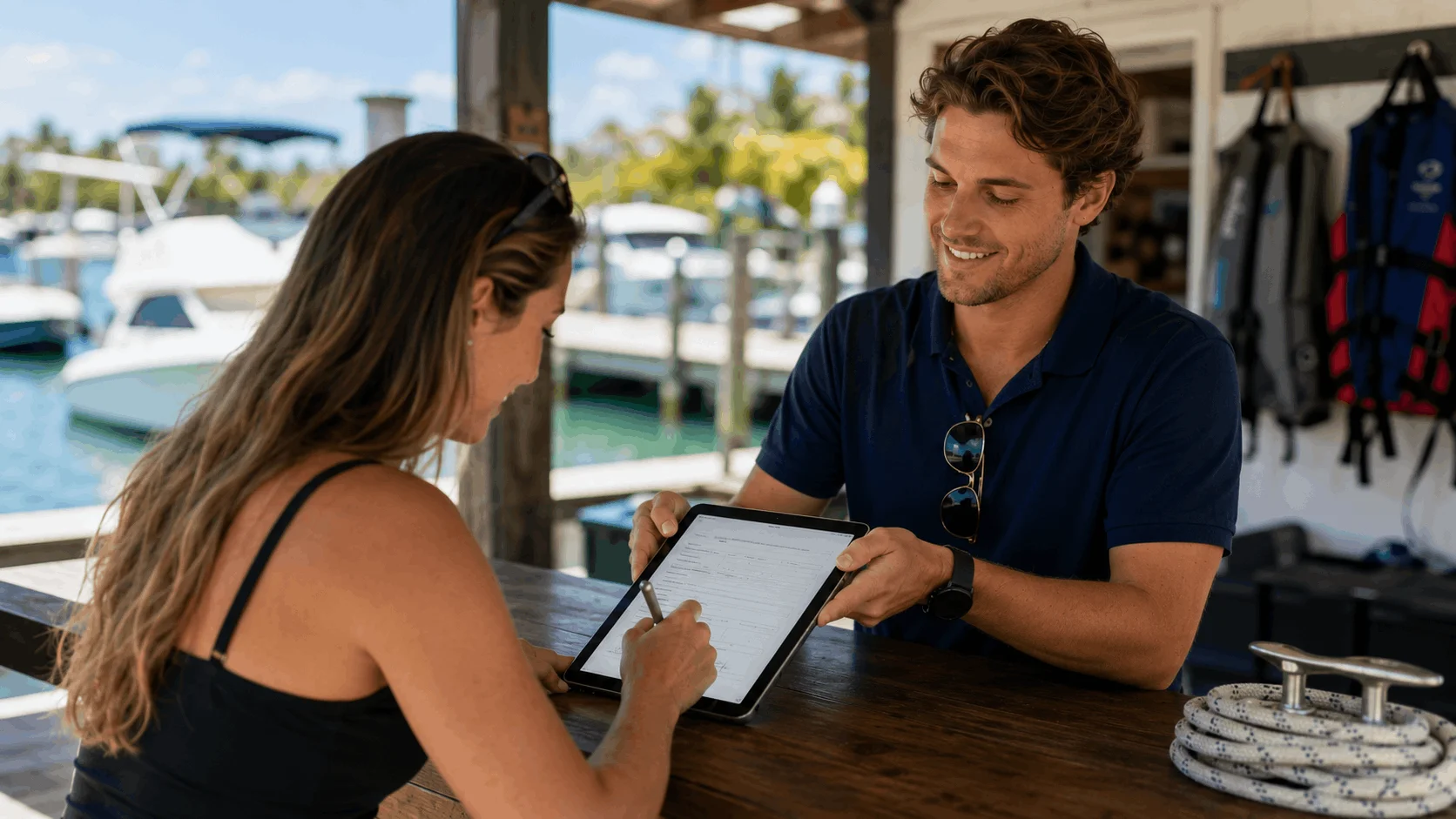
A rental agreement covers the booking. A waiver focuses on the activity: it explains the risks of using the dock and watercraft and asks each person to accept them before participating.
What the waiver should include
- The activities it covers: dock use, swimming, kayaking, paddleboarding, boating
- A clear description of the risks, such as drowning, capsizing, cold water, weather, collisions and slippery surfaces
- Confirmation that the person can swim and is fit to take part
- Agreement to wear a life jacket and follow the posted rules
- Assumption of risk and a release of claims, to the extent allowed by local law
- An emergency contact and any relevant medical information
- A parent or guardian signature for minors
- Signature, printed name and date
Who should sign
- Every adult who will use the dock or watercraft, not only the person who booked
- A parent or guardian for each child
- Visitors who come over for the day
When to collect it
Send the waiver link with the booking confirmation so guests sign before arrival. Keep a QR code at the dock or in the house manual for visitors and anyone who missed it. See our guide on how to create a QR code waiver.
What a waiver can and cannot do
A well-written waiver can show that guests understood the risks and agreed to the rules. It usually cannot protect you from claims of gross negligence, such as knowingly leaving a broken dock board in place, and enforceability varies a lot by state. That is why it is one layer, not the whole plan. For more, see what makes a liability waiver invalid and our guide to waivers for minors.
Templates to start from
- Boat rental liability waiver
- Kayak rental waiver
- Paddleboard rental waiver
- Jet ski rental waiver
- Swimming pool waiver, which adapts well to swimming off a dock
- Gear rental agreement for equipment damage and return terms
Edit the template to name your property, your lake and the exact equipment you provide.
Layer 5: Make the dock safer
A waiver does not replace reasonable care. Courts and insurers will look at how well you maintained the property.
Dock safety checklist
- Surface: replace loose or rotten boards, remove protruding nails, and clean algae regularly.
- Railings and ladders: a sturdy ladder at the end of the dock so a swimmer can get out.
- Lighting: light the walkway and the end of the dock for evenings.
- Life jackets: properly sized life jackets for adults and children, stored at the dock.
- Rescue gear: a throwable flotation device and a reaching pole within easy reach.
- Signage: water depth, "No diving", "Life jackets required for children" and an emergency number with the property address.
- Electrical: have a licensed electrician inspect dock wiring, outlets and boat lifts. Electric shock drowning happens when faulty wiring energizes the water around a dock, and electrical codes now require ground-fault protection on dock circuits, including at many private residential docks. Test ground-fault devices regularly.
- Boat lift and moorings: check cables, controls and lines before each season.
- Watercraft: inspect kayaks, paddles and boats between stays and pull anything damaged.
- Seasonal check: walk the dock at the start of every season and after storms.
Write down when you did each check. A simple maintenance log is useful evidence if something goes wrong.
Layer 6: Keep records for every stay
If a guest is hurt, you will want to show what they agreed to and when. For each booking, keep:
- The signed rental agreement
- A signed waiver for every adult and minor who used the dock or watercraft
- Your house rules and the version guests received
- Your dock maintenance and inspection log
- Any incident reports
Paper forms in a kitchen drawer get lost. A digital waiver keeps each signature with the exact text the guest agreed to, the date, and a PDF you can download later.
How to collect lake rental waivers with AgreeDock
AgreeDock lets you send a waiver with each booking and collect signatures on guests' phones.
- Start from a template. Pick the boat, kayak or paddleboard waiver, or describe your property to the AI waiver generator.
- Add your rules. Name your lake, list your equipment, and add life jacket and supervision checkboxes, emergency contacts and a guardian section for minors.
- Share it. Add the link to your booking confirmation and print the QR code for the dock or house manual.
- Get notified. You get an email each time a guest or visitor signs.
- Keep the record. Every response saves the exact wording that was signed, and downloads as a signed PDF.
Create your lake rental waiver →
Frequently asked questions
Am I liable if a guest gets hurt on my dock?
You can be. As the property owner you generally owe guests reasonable care, such as fixing known hazards and warning about risks that are not obvious. How liability works depends on your state and the facts. Insurance, clear rules, a signed waiver and good maintenance all reduce the risk. This is general information, not legal advice.
Does my homeowners insurance cover guests using my kayaks or boat?
Often not fully. Many homeowners policies limit coverage for short-term rentals and for watercraft, and coverage may stop at your property line. Ask your agent to confirm in writing whether guests using your dock and each watercraft are covered, including off your property.
Does Airbnb cover boat or kayak accidents?
Airbnb's host liability program has exclusions, and watercraft-related claims are commonly among them. Read the current program summary for your country and do not rely on it as your only coverage. Get a short-term rental policy that explicitly covers your water amenities.
Should I let guests drive my boat?
Many hosts do not. Letting guests operate a motorized boat raises the risk considerably and, depending on where you are, may bring boat rental licensing or commercial insurance requirements. If you do allow it, get separate boat coverage, confirm boater education and age requirements, and use a boat rental agreement and waiver.
Do I need a separate waiver for kayaks and paddleboards?
You can use one waiver that covers the dock, swimming and all the watercraft you provide, as long as it names each activity and its risks. Some hosts prefer separate waivers for motorized boats because the rules and risks are different.
Do day visitors need to sign the waiver?
It is a good idea. Visitors did not sign your rental agreement, so a waiver is often the only record that they saw your rules. A QR code at the dock makes this easy.
Is a liability waiver enough to protect me?
No. A waiver helps show that guests understood the risks and agreed to your rules, but it usually cannot protect against gross negligence and its enforceability varies by state. Use it alongside proper insurance, a safe dock and clear rental terms.
Make water safety part of every booking
A lake rental's dock and boats are worth the risk when you manage it deliberately: insurance that covers the water, clear rules, a waiver every guest signs, a well-kept dock, and records you can find later.
With AgreeDock, you can send a watercraft and dock waiver with every booking, collect signatures on guests' phones, get an email for each one, and keep a signed PDF for every stay.